



Use Wozber and land your dream job
Create CV
No registration required
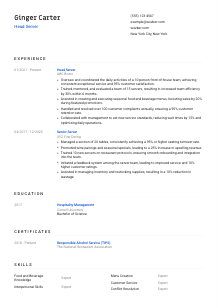
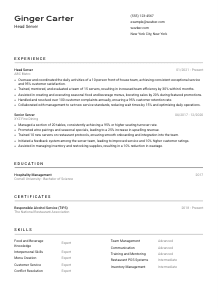
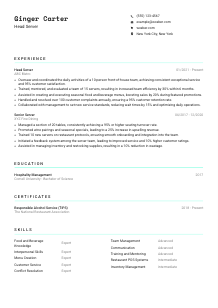
Leading front of house, but your CV's out of sight? Check out this Head Server CV example, created with Wozber free CV builder. It shows how to bring together your service excellence and leadership savvy to match job requirements, so your career progression stays as impressive as your tableside presentations!
A Head Server is expected to steady the dining room when service gets busy, keep the floor team aligned, and protect the guest experience when something goes wrong. Your CV should make that operational presence visible. Hiring managers want to see how you lead servers, uphold service standards, support menu execution, and handle guest issues without letting the room slip.
When a CV is tailored well for this kind of front-of-house leadership role, the difference shows up quickly. Service leadership, staff training, complaint resolution, and food and beverage knowledge become easier to spot in both human review and ATS screening. Wozber's free CV builder helps organise that experience into an ATS-compliant CV that reads clearly, so a restaurant can quickly judge whether you can run service, coach the team, and keep guests coming back.
In hospitality, small details shape first impressions fast. Your contact section should reflect the same professionalism you bring to pre-shift setup, guest interaction, and front-of-house coordination.
Your name should be the clearest element at the top of the CV. Use a larger font so it stands out immediately, just as a Head Server needs to take visible command on the floor. A clean layout in Wozber's ATS-friendly CV template also helps keep this section readable in applicant tracking systems.
Place "Head Server" directly under your name if that is the role you are pursuing. Matching the posted title helps frame your experience around front-of-house leadership rather than a general service position. For jobs with similar titles such as Lead Server or Senior Server, mirror the wording when it accurately reflects your background.
Include a reliable phone number and a professional email address. Restaurants often move quickly when scheduling interviews or trial shifts, so even a small typo can cost you a callback. If you include a website, make sure it supports your hospitality background instead of distracting from it.
If the employer specifies a local hiring need, include your city and state. In this example, "New York City, New York" directly addresses the stated location requirement and removes questions about relocation or commute. Only add full address details if an employer explicitly asks for them.
A LinkedIn profile or personal website can be useful when it reinforces your experience in restaurant service, hospitality leadership, or beverage knowledge. Keep it current. If the profile is sparse or outdated, leave it off and let your CV carry the story.
This section should confirm who you are, how to reach you, and whether you meet practical requirements like location. For a Head Server role, that kind of clarity sets the right tone from the start.




For a Head Server, experience is where leadership becomes tangible. Restaurants look for more than table service. They want to see how you direct the front-of-house team, maintain service quality during busy shifts, and contribute to sales, retention, and smoother operations.
Read the job description closely and underline the responsibilities that define success in the dining room. For a Head Server, that usually includes supervising servers, training staff, handling guest complaints, supporting menus and pairings, and working with management on service standards. Those should shape the wording of your bullets so your experience lines up naturally with both ATS terms and restaurant priorities.
List your positions in reverse chronological order, starting with the most recent. Prioritise front-of-house roles such as Head Server, Senior Server, Lead Server, or similar positions where you managed sections, coached staff, or influenced guest service. If you have broader hospitality experience, keep the focus on what shows leadership on the floor.
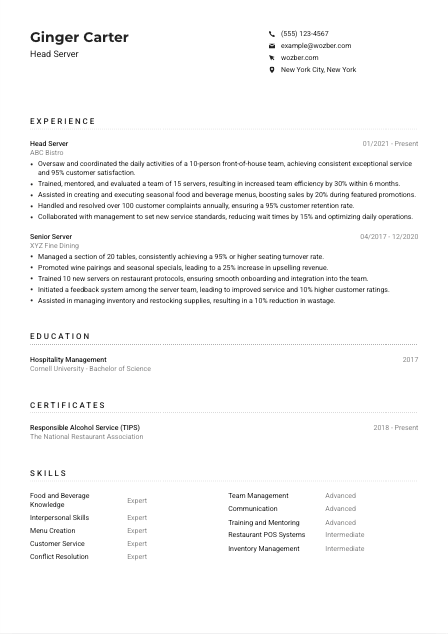
Each bullet should show what you were responsible for and what changed because of your work. Strong Head Server bullets often cover shift coordination, server coaching, upselling, guest recovery, or workflow improvements between floor staff and management. The sample CV does this well by showing oversight of a 10-person front-of-house team, training servers, and resolving guest complaints with strong retention results.
Use metrics that belong naturally to hospitality work. Team size, customer satisfaction, retention, upselling revenue, table turnover, reduced wait times, and waste reduction all help hiring managers understand your scope and results. In the example, figures like 95% customer satisfaction, a 30% increase in team efficiency, and 20% promotional sales growth make the leadership impact much easier to judge.
Keep this section centered on guest service, staff leadership, beverage knowledge, operational support, and measurable restaurant outcomes. Older or unrelated jobs can stay brief or be removed if they do not support your case for leading service. A Head Server CV should read like someone ready to run a shift, not someone listing every job they have held.
The experience section should answer a practical question fast: have you already led service, improved operations, and handled pressure in a live dining environment? If that is clear, the rest of the CV has a solid foundation.
Education is rarely the first thing a restaurant reviews for a Head Server opening, but it can still strengthen your profile. Hospitality coursework, management training, and food and beverage study can reinforce the operational and service knowledge behind your front-of-house experience.
Some Head Server postings focus almost entirely on experience, while others value formal hospitality training. If you have a degree in Hospitality Management, Restaurant Management, Business, or a related field, include it clearly because it adds context to your service leadership and operational understanding.
Include your degree, school, field of study, and graduation year or completion date. This section should be easy to scan. Wozber's ATS-friendly CV format helps keep education structured so it does not get buried under design choices or extra text.
If your education ties closely to hospitality, place the field of study where it is easy to notice. In the sample CV, a Bachelor of Science in Hospitality Management from Cornell University supports the candidate's front-of-house leadership background and gives added weight to menu, service, and operations knowledge.
You do not need to list classes unless they strengthen your fit. Relevant examples might include beverage management, restaurant operations, hospitality leadership, guest relations, or food service finance. Use this only if you are early in your career or the coursework fills a gap not yet obvious in your experience.
Awards, hospitality societies, or leadership activities can help if they connect to service, team management, or the restaurant industry. Keep them brief. This section should support your credibility, not compete with your hands-on dining room experience.
For Head Server applications, education works best when it reinforces the service knowledge and leadership skills already shown elsewhere. Keep it relevant, concise, and tied to hospitality practice.
Certifications matter in front-of-house leadership because they show current standards, legal awareness, and operational responsibility. For Head Server roles, the most useful ones are the certifications that connect directly to alcohol service, food safety, and restaurant compliance.
If an employer asks for or prefers a specific certification, move it to the top of this section. Here, Responsible Alcohol Service certification is a clear example. Listing TIPS or ServSafe when you hold it helps show that you can lead service responsibly, especially in restaurants with beverage sales and wine pairing expectations.
Choose certifications that support the actual work of a Head Server. Responsible alcohol service, food safety, wine education, hospitality supervision, and service training programs are all stronger choices than unrelated credentials. This keeps your CV aligned with restaurant operations rather than padded with extra items.
Certification dates matter because many restaurant credentials require renewal. Include the earned date and, if relevant, note that the certification is current. In the sample CV, showing TIPS as active from 2018 to present immediately tells the employer that the credential is still in force.
Head Servers are often expected to model standards for the team, so current certifications send a useful message about accountability. If you renew alcohol service or food safety credentials regularly, that consistency supports your readiness to oversee shifts, coach staff, and protect compliance on the floor.
A well-chosen certification section tells the employer you understand restaurant standards and can lead within them. For Head Server roles, that practical credibility carries more weight than a long list of loosely related courses.
A Head Server skills section should read like the toolkit of someone who can lead a shift, support revenue, and keep service standards steady under pressure. That means blending guest-facing strengths with operational and team-management capabilities.
Pull skill themes directly from the job description and match them to your real experience. In this case, leadership, team management, food and beverage knowledge, communication, and interpersonal skills deserve clear placement because they are central to the role. Matching that language also improves ATS optimisation without making the section sound forced.
A Head Server needs both technical and interpersonal range. Include hard skills such as menu knowledge, POS systems, wine pairings, inventory support, and food and beverage standards alongside people-focused skills like conflict resolution, coaching, guest recovery, and staff mentoring. The sample CV handles this balance well by combining menu creation and POS knowledge with training, communication, and customer service.
Group your most relevant skills first so the section is easy to scan. Start with service leadership and restaurant operations, then add guest-facing and system-related skills. Avoid adding broad filler like "hardworking" or "team player" when more specific strengths such as upselling, complaint resolution, or section management say much more about how you perform on the floor.
Every skill listed here should help an employer picture you managing service, supporting the team, and improving the guest experience. If a skill does not contribute to that picture, it probably does not belong.
Language ability can matter in hospitality because service depends on smooth communication with guests, coworkers, and managers. For a Head Server, language skills become especially useful when they support guest comfort, clear staff direction, and consistent service across a diverse dining room.
If the job requires fluency in a specific language, list it prominently. Here, English fluency is a stated requirement, so it should appear first with an accurate proficiency level. That immediately confirms you can handle guest interaction, staff coordination, and issue resolution in the language used on the floor.
Additional languages can strengthen your value, especially in busy urban restaurants or venues with international guests. If you can comfortably assist tables, explain menu items, or support service recovery in another language, include it. In the sample CV, Spanish adds practical guest-service range without overstating its importance.
Use honest labels such as Native, Fluent, Advanced, or Conversational. Restaurants may rely on this information during scheduling or guest-facing assignments, so accuracy matters. Overstating proficiency can create problems in live service situations where clarity and speed count.
When language skills are relevant, they support more than casual conversation. They can improve order accuracy, reduce guest friction, and help staff communicate clearly during busy service. That makes them especially valuable in establishments where guest mix and pace require strong interpersonal control.
Only list languages you could actually use in a restaurant setting. A short, truthful section is stronger than a long one filled with classroom-level knowledge that would not hold up during service. For Head Server roles, practical communication always matters more than impressive-looking labels.
For a Head Server, language skills are valuable when they support guest care and team coordination in real time. Present them clearly so an employer can tell where they would make a difference.
The summary should quickly establish your level, your front-of-house scope, and the kind of restaurant results you influence. For a Head Server, that usually means leadership in service, staff development, guest satisfaction, and smooth coordination with management.
Start by identifying the few requirements that matter most in the posting. For Head Server roles, that often means years of service experience, leadership of front-of-house staff, guest issue handling, and knowledge of food and beverage service. Those should guide the opening lines of your summary so it feels targeted rather than generic.
Lead with a direct statement of who you are professionally. A line such as "Head Server with 4+ years of front-of-house leadership experience" gives immediate context and tells the reader you already operate at the right level. Keep it factual and tied to restaurant work.
Use the summary to highlight the capabilities that matter most in service leadership. Training servers, maintaining service standards, supporting menu execution, improving guest retention, or increasing upsell performance are all stronger than vague claims about passion or dedication. The sample summary works because it points to team leadership, operations, guest experience, and revenue impact in a compact way.
Aim for 3 to 5 lines. Restaurant hiring managers often review CVs quickly, so your summary should be easy to absorb at a glance. Wozber's AI CV builder can help tighten the language, surface missing terms from the job description, and keep the section aligned with ATS screening while preserving your actual experience.
When this section is doing its job, a hiring manager can immediately see your level, your leadership range, and the kind of guest and team outcomes you deliver. That is exactly the right note to start a Head Server CV.
A Head Server CV should make one thing easy to understand: you can lead service, support the team, and protect the guest experience when the room is busy. When each section is tailored to show staff oversight, food and beverage knowledge, complaint handling, and measurable restaurant results, the application reads with much more authority.
Use Wozber to sharpen that alignment from top to bottom. Wozber's free CV builder, ATS CV scanner, and ATS-friendly CV format help you match the language of the job posting, surface missing requirements, and present your background in a structure that works for both screening systems and restaurant managers. The finished CV should make your front-of-house leadership easy to judge.




