



Use Wozber and land your dream job
Create CV
No registration required
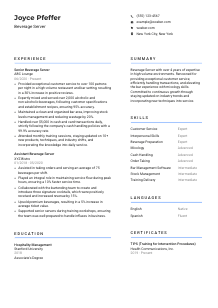
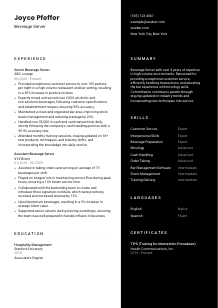
Pouring delights, but your CV comes up dry? Quench your thirst with this Beverage Server CV example, created with Wozber free CV builder. It shows how naturally you can blend your serving skills with job expectations, keeping your career as refreshing as your signature cocktails!
Beverage service gets evaluated in motion. Hiring teams want to see that you can keep orders straight during a rush, recommend drinks with confidence, follow recipes, handle transactions accurately, and still deliver the kind of guest experience that keeps people ordering another round. Your CV needs to make that pace and consistency visible quickly.
A tailored CV helps separate beverage servers who simply worked in hospitality from those who can perform in a high-volume service environment. Using Wozber's free CV builder and an ATS-friendly CV format, you can align your wording with the posting's priorities, from mixology knowledge to cash handling and service speed, so the CV reads clearly to both screening systems and bar managers reviewing who can step onto the floor with minimal ramp-up.
This section is simple, but in hospitality hiring it still carries practical weight. Managers need to know who you are, what role you are targeting, and whether basic requirements like location and contactability are already covered.
Place your full name at the top in a clean, easy-to-read format. In a stack of applications for service roles, clarity matters more than design flourishes.
Write "Beverage Server" beneath your name if that is the role you are pursuing. Matching the posted title helps frame the rest of your experience around beverage service rather than broader restaurant work.
Hospitality interviews often move quickly, especially for busy venues. Make sure your phone number is current and your email address looks professional.
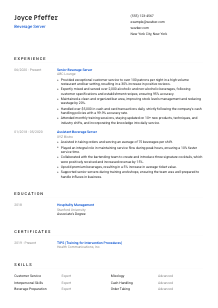
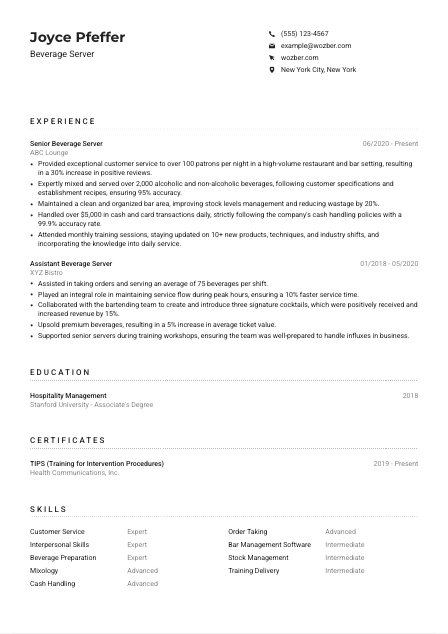
If the employer specifies a city requirement, include your city and state. In the example, listing New York City, New York directly supports the posting's location requirement. If you plan to relocate, make that clear here instead of leaving the employer to guess.
A LinkedIn profile can be useful if it matches your CV and shows consistent hospitality experience. Personal websites are optional for this role and usually only worth adding if they reinforce your background in beverage programs, events, or hospitality work.
Your personal details should remove friction, not add personality for its own sake. Make it easy for a hiring manager to confirm the role, reach you, and see that you meet any location-related requirement.




For a Beverage Server, experience is where the hiring decision usually sharpens. Managers look for evidence that you can move quickly, maintain service quality, follow recipes, manage guest interactions, and stay accurate with orders and payments during busy shifts.
Start by identifying what the job emphasizes most. Here, the core themes are high-volume service, drink knowledge, customer interaction, multitasking, cash handling, and current beverage practices. Those points should guide which accomplishments you feature and how you phrase them.
For each position, include the venue name, your title, and dates of employment. Put the most recent role first so employers immediately see your latest service environment, whether that was a bar, lounge, restaurant, or event setting.
Hospitality CVs improve fast when bullets show scale and accuracy. Instead of saying you served drinks and handled payments, show volume, speed, and control. The example does this well with details like serving more than 100 patrons per night, mixing over 2,000 beverages with 95% accuracy, and processing over $5,000 in daily transactions at 99.9% accuracy.
Focus on work that shows drink preparation, guest recommendations, upselling, teamwork with bartenders, bar cleanliness, stock support, or service during peak periods. Even if your title was not exactly "Beverage Server," keep bullets that show the same workflow and trim unrelated restaurant tasks.
Strong beverage service bullets often connect your actions to smoother shifts, better guest feedback, or stronger revenue. Examples include increasing positive reviews, reducing waste through better stock control, improving service times during peak hours, or raising average ticket value through premium beverage upselling.
A hiring manager should be able to picture you working a real service rush from this section. When your bullets show volume, drink knowledge, transaction accuracy, and guest-facing results, your experience reads like someone ready for the floor.
Formal education is rarely the deciding factor for a Beverage Server, but it can still strengthen your CV when it connects to hospitality, service, or business operations. Keep the section concise and relevant.
If you studied hospitality management, food and beverage operations, tourism, or a similar field, include it clearly. The sample CV uses an Associate's Degree in Hospitality Management, which supports the candidate's service background without overstating its importance.
Include your degree, field of study, school, and graduation year or completion date. That is enough for most beverage service roles unless the employer specifically asks for more detail.
Coursework, honors, or student leadership can help early-career candidates if they relate to guest service, restaurant operations, or beverage programs. Leave them out if they are dated or do not strengthen your case for front-of-house work.
Even when a posting does not require a degree, hospitality education can show familiarity with service standards, operations, and guest experience. That is useful support, especially if you are competing against candidates with similar floor experience.
If you already have several years in high-volume bars or restaurants, education should stay brief. Let your service record carry more weight, and use education as supporting context rather than the centerpiece.
Education can add context, especially when it connects to hospitality management or service operations. For most Beverage Server CVs, though, it works best as a short, clean section behind stronger experience and certifications.
Certifications carry more weight in beverage roles than in many other service jobs because they speak directly to responsible alcohol service and current industry standards. When a posting names one, treat it as a priority item.
If the posting asks for TIPS or an equivalent certification, include it clearly and exactly. In this example, listing the current TIPS certification directly answers a stated requirement and removes uncertainty early.
Prioritise certifications tied to alcohol service, food safety, responsible serving, or beverage knowledge. Leave off unrelated credentials that do not support bar, lounge, or restaurant performance.
Expired credentials can raise avoidable questions, especially for roles that involve alcohol service and customer safety. If a certification is active, show that with a current date range or renewal date.
List the certification name, issuing organisation, and date. That format is easy for hiring teams and ATS systems to scan, and it keeps an important requirement from getting buried in the CV.
For Beverage Server hiring, the right certification is often more than a nice extra. It can be the quickest way to show you are prepared to serve responsibly and step into the role without administrative delays.
A Beverage Server skills section should feel grounded in actual shift work. That means pairing guest-facing strengths with operational skills like beverage preparation, cash accuracy, stock awareness, and pace under pressure.
Start with the capabilities that show up in the posting and in your experience. For this role, that includes customer service, beverage preparation, mixology knowledge, multitasking, cash handling, and professional communication.
Do not separate people skills from bar skills. Beverage service depends on both. A useful mix might include interpersonal skills, order taking, mixology, recipe adherence, POS familiarity, and stock management.
Organise skills in a straightforward way so hiring teams can pick out the role's essentials quickly. The sample does this by combining service strengths such as Customer Service with operational skills like Cash Handling and Beverage Preparation.
When this section mirrors what happens during service, it becomes much more credible. Focus on the abilities that help you recommend drinks, execute orders accurately, support the bar, and keep guests taken care of during busy periods.
Language ability can be a real advantage in beverage service, especially in busy restaurants, tourist-heavy venues, and diverse city markets. Still, it needs to be presented in a practical way, not as filler.
If the employer asks for professional English, list English clearly with an honest proficiency level. That immediately confirms you can communicate with guests, teammates, and managers in service situations.
Additional languages can be valuable when they help with service, recommendations, or handling common guest questions. In a market like New York City, Spanish or other widely spoken languages can strengthen front-of-house versatility.
Use clear levels such as Native, Fluent, Conversational, or Basic. Language claims get tested quickly in hospitality settings, especially when guest communication affects service flow or order accuracy.
If you work in neighborhoods, hotels, event spaces, or bars that attract an international or multilingual crowd, this section can add real value. Keep the list selective and tied to customer service usefulness.
Language skills matter most when they improve the guest experience. If a second language helps you explain menu items, answer questions, or build rapport with regulars, it belongs on the CV.
For a Beverage Server, languages matter when they help you serve guests smoothly and communicate with confidence. List them clearly, rate them honestly, and let them support the kind of venue you want to work in.
The summary sits at the top of the CV, so it should establish your level, service setting, and strongest relevant strengths in a few lines. For beverage service, that usually means experience level, environment, guest service quality, and operational reliability.
Start with your title and years of experience, then ground it in the kind of environment you know best. "Beverage Server with 4+ years in high-volume bars and restaurants" tells a manager much more than a generic hospitality introduction.
Choose two or three strengths that connect directly to the job. For this role, that could include beverage knowledge, mixology, customer service, transaction accuracy, or the ability to stay composed during busy shifts.
Close by pointing to what your work improves. The sample summary does this by emphasizing guest experience, efficient transaction handling, and ongoing product knowledge. You can also mention upselling, recipe consistency, or reliable support during peak service if those are part of your track record.
Aim for a short paragraph that sounds like a service professional, not a generic applicant. Avoid broad claims and use wording that fits the job's real demands, including high-volume service, drink execution, and guest interaction.
With the right details in place, your CV should show that you can manage volume, serve accurately, communicate well, and contribute to a polished guest experience. Wozber's free CV builder can help you tighten the wording, structure the content in an ATS-compliant CV, and refine role-specific phrasing with its ATS CV scanner so the hiring team can quickly see your value behind the bar or on the floor.
A Beverage Server CV works when it makes service pace, beverage knowledge, and guest-facing professionalism easy to spot. Keep the content grounded in real shift volume, drink preparation, responsible service, and the results you helped deliver.
Use Wozber to build an ATS-friendly CV template that matches the posting's language and keeps the structure clean. The finished CV should make one thing clear right away: you can step into a busy service environment and perform with confidence.