



Use Wozber and land your dream job
Create CV
No registration required
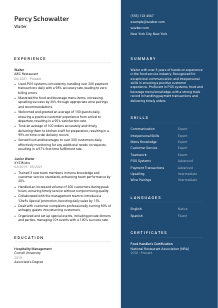
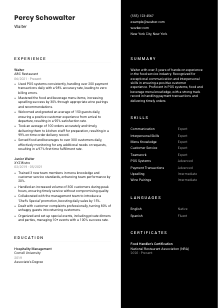
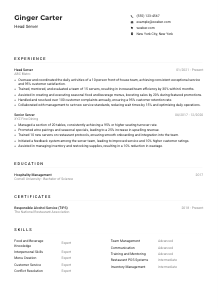
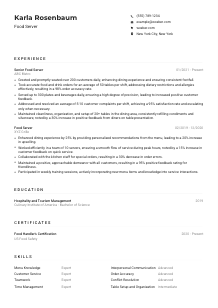
Juggling dishes, but your CV feels out of sync? Check out this Waiter CV example, created with Wozber free CV builder. Learn how to serve up your dining finesse in line with the job standard, ensuring your career is always ready to take orders!
Fast service means very little if orders are wrong, tables are neglected, or guests leave without wanting to return. A waiter CV has to show the pace you can handle, the guest experience you create, and the operational habits that keep service accurate, coordinated, and profitable across a busy shift.
Restaurant hiring often moves quickly, and CVs that mirror the posting's language around POS systems, menu knowledge, payment handling, and guest service are easier to prioritise in both an ATS and a first skim. Wozber's free CV builder helps shape that language into an ATS-friendly CV format so your background reads clearly as restaurant-ready, not just generally customer-facing.
For front-of-house roles, the contact section does more than identify you. It should immediately confirm that you are reachable, professionally presented, and, when relevant, already based where the employer needs staff on the floor.
Place your name at the top in a clean, readable format. Keep it easy to spot so managers reviewing multiple hospitality CVs can immediately connect your application to the experience and service results listed below.
Add the title "Waiter" under your name when that is the role you are pursuing. Matching the posted title helps position your background correctly, especially when restaurants are sorting applicants across host, server, bartender, and other front-of-house roles.
List a current phone number and a professional email address. In restaurant hiring, callbacks for interviews or trial shifts often happen fast, so accuracy matters. One typo in your number can cost you an interview during a busy hiring week.
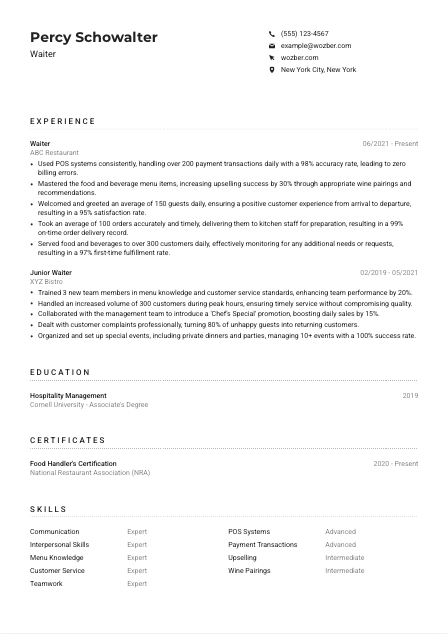
If the employer specifies a city or borough, include your location so they can see right away that commuting and shift availability are realistic. Here, showing New York City, New York directly supports the posting's stated requirement without taking up much space.
Most waiter CVs do not need a portfolio, but a polished LinkedIn profile can still help if it supports your restaurant history, certifications, or hospitality training. Only include it if the information is current and consistent with your CV.
This section should answer a few practical questions at a glance: who you are, what role you want, how to reach you, and whether you meet any location requirement. That gives the hiring team a smooth start before they review your service experience.




This is the section restaurant managers usually read most closely. They want to see whether you can manage guest flow, communicate with the kitchen, handle payment accurately, and keep service quality steady during busy periods.
Start by marking the responsibilities and requirements that define the job. For a waiter role, that usually includes greeting guests, taking accurate orders, menu guidance, POS use, payment handling, and teamwork on the floor. Those priorities should shape which bullets you keep and how you phrase them.
List your jobs in reverse chronological order with the restaurant name, job title, and dates. If you have held several hospitality roles, this format helps show progression from junior service work into full table responsibility, higher guest volume, or stronger sales contribution.
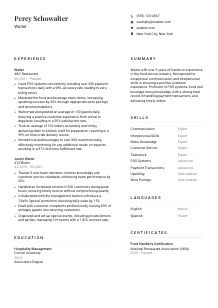
Instead of repeating standard duties, focus on what you achieved in service. Strong waiter bullets show results like order accuracy, guest satisfaction, upselling success, complaint recovery, event support, or high-volume table coverage. The sample CV does this well by tying menu knowledge to a 30% increase in upselling through wine pairings.
Metrics make waiter experience more credible when they reflect real floor performance. Daily guest count, transaction volume, billing accuracy, on-time order delivery, first-time fulfillment, and sales lift all work well. Examples like handling 200+ payment transactions daily with 98% accuracy or serving 300 customers in a day make the scope of work easy to understand.
If you have older or unrelated jobs, trim them unless they directly support customer service, teamwork, or high-pressure operations. A waiter CV benefits most from experience that shows guest interaction, food service rhythm, POS familiarity, and coordination with kitchen or management teams.
After reading your experience section, a restaurant should understand how you perform in a live service environment: how many guests you handle, how accurately you work, how you support sales, and how well you keep service moving when the floor gets busy.
Education rarely outweighs restaurant experience for waiter hiring, but it can still strengthen your profile. Hospitality coursework, service training, and customer-facing academic experience add useful context, especially early in your career.
Some waiter postings do not ask for a degree at all, while others value hospitality training or a related background. If education is not central to the role, keep this section concise and let your service record carry more weight.
Include your degree, field of study, school, and graduation year. Keep the structure simple so managers can scan it quickly without losing focus on the restaurant experience that matters most for front-of-house hiring.
If you studied Hospitality Management, Culinary Arts, or a related field, make that easy to find. In the example, an Associate's Degree in Hospitality Management adds useful context because it supports the candidate's menu knowledge, service standards, and understanding of guest operations.
Early-career candidates can benefit from including coursework tied to food service, guest relations, beverage knowledge, or restaurant operations. Skip generic classes and include only what helps explain your readiness for floor service.
Honors, hospitality clubs, event work, or student leadership can be worth mentioning if they show responsibility, teamwork, or customer interaction. Keep these details selective so the section stays useful rather than padded.
Use education to support your waiter profile, not to overpower it. In most cases, this section works best when it reinforces service knowledge, guest-facing professionalism, or hospitality training in a compact format.
Certifications carry practical weight in restaurant hiring because they point to compliance, food safety awareness, and readiness to work without extra delay. When a certificate is requested, make it visible and current.
If the posting asks for a Food Handler's Certification, include it clearly with the full name of the certificate. This is one of the easiest ways to show immediate eligibility for food service work and avoid being screened out early.
Focus on certifications that support waiter responsibilities, such as food handling, alcohol service where relevant, or hospitality safety training. Avoid filling the section with unrelated credentials that do not strengthen your case for guest-facing food service work.
Many food service certifications need to be current. Including the date or active period helps the employer see whether you are ready to start serving without another round of compliance paperwork. The example does this by showing an active Food Handler's Certification.
If you add certifications over time, choose ones that match the kinds of venues you want to work in, such as fine dining, wine service, banquet service, or food safety. Ongoing training can be especially useful when you want to move into higher-end service environments.
For waiter roles, certificates are not decorative. They show that you understand food-service standards and can step into the dining room with fewer onboarding barriers.
A waiter skills section should read like the tools you actually use on shift. That means balancing service fundamentals such as communication and teamwork with operational skills like POS use, billing accuracy, menu knowledge, and upselling.
Look for the exact capabilities the employer names, then mirror them naturally. In this example, communication, interpersonal skills, POS proficiency, payment handling, menu knowledge, wine pairings, and teamwork all belong because they connect directly to daily waiter responsibilities.
Lead with the abilities that influence table experience and service consistency. Communication, customer service, menu knowledge, teamwork, and POS systems are stronger for this role than generic traits because they connect to order accuracy, guest guidance, and clean coordination between tables and kitchen.
Do not overload this section with every soft skill you can think of. Choose skills you can back up through experience, such as handling transactions, recommending pairings, managing peak-hour volume, or resolving guest issues professionally. A shorter, sharper list carries more weight.
Your skills section should confirm that you can manage both the guest-facing and operational sides of waiter work. If the hiring manager can picture you taking orders, guiding selections, processing payments, and working smoothly with the team, the section is doing its job.
In dining rooms that serve varied neighborhoods, tourists, or multilingual communities, language skills can improve guest comfort and service speed. They matter most when they help you explain menu items, answer questions clearly, and handle requests without confusion.
If fluent English is required, list it clearly and use an honest proficiency level. For waiter work, that requirement usually reflects practical needs on the floor such as taking orders accurately, explaining dishes, handling concerns, and coordinating with teammates.
Use simple labels such as Native, Fluent, Intermediate, or Basic. Clear ratings help employers understand how confidently you can communicate with guests and staff without reading between the lines.
Additional languages can be a genuine advantage in busy restaurants or diverse service settings. In the sample, Spanish adds value because it broadens guest communication while supporting team interaction in many hospitality environments.
Only claim the level you can use in real service situations. If a guest asks about ingredients, allergies, or payment questions, your language skill needs to hold up under pressure, not just look good on paper.
When they are relevant, languages can suggest better guest rapport and smoother service across different customer groups. Keep them on the CV if they would genuinely help you on the floor.
For waiter positions, language skills matter when they improve service. List the ones that help you welcome guests, explain the menu, and manage requests with clarity and confidence.
The summary sits at the top of the CV, so it should quickly establish your level, service background, and strongest matching strengths. For waiter roles, that usually means years in food service, guest interaction quality, menu knowledge, and comfort with POS and payments.
Pull out the few requirements that define the job, then reflect them in two to four lines. For waiter work, that often means customer service, order accuracy, menu guidance, payment handling, and team-based floor operations.
Start with a direct description such as "Waiter with over 3 years of food service experience." That quickly tells the reader whether you meet the experience threshold and whether your background is restaurant-based rather than broadly retail or customer support.
Follow with the abilities that matter most for the role. Communication, interpersonal skills, menu knowledge, wine pairings, POS systems, and timely order handling are all stronger than vague claims about being hardworking or passionate. The sample summary gets this right by linking service experience with POS proficiency and guest experience.
A hiring manager should be able to read your summary in seconds. Aim for a compact paragraph that covers your experience, your service strengths, and one or two operational capabilities that match the restaurant's needs.
A well-written summary should make the rest of your CV easier to read. It should tell the employer, right away, that you understand guest service, can handle the pace of restaurant work, and bring the practical skills needed on the floor.
A waiter CV works best when it shows more than friendliness. It should make your guest service range, order accuracy, POS confidence, menu knowledge, and ability to keep pace during busy service easy to understand.
Use Wozber's free CV builder to organise that experience into an ATS-compliant CV, and refine the language with its ATS CV scanner and AI tools so your wording matches the restaurant's priorities without sounding forced.
When your CV clearly shows how you handle guests, coordinate service, and support smooth restaurant operations, you are ready to apply with confidence.