



Use Wozber and land your dream job
Create CV
No registration required
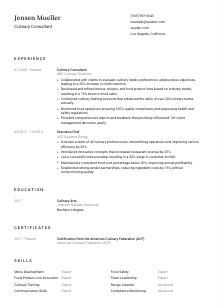
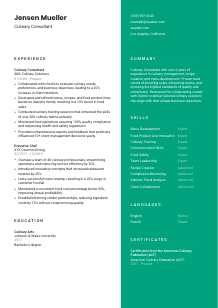
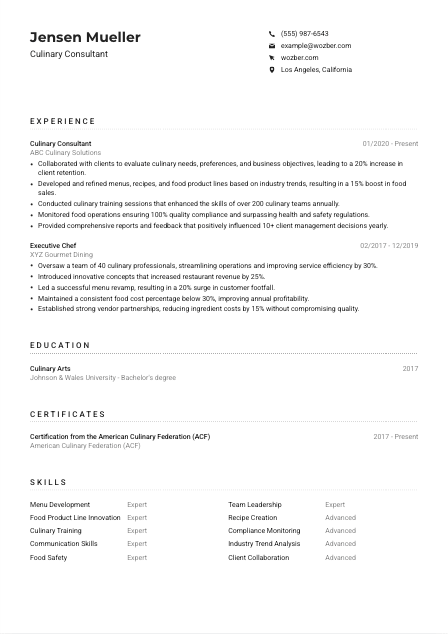
Whisking up flavorful dishes, but your CV doesn't sizzle? Check out this Culinary Consultant CV example, created with Wozber free CV builder. Learn how to blend your gastronomic expertise with job expectations, crafting a career narrative as appetizing as a five-course feast!
Culinary consulting sits at the intersection of food creativity and business performance. Hiring teams want to see more than kitchen credibility. They look for someone who can translate culinary judgment into menu strategy, product development, team training, food safety oversight, and measurable profitability for a client operation. Your CV needs to make that commercial and operational range visible fast.
CV tailoring changes how quickly a reader can place you in that mix of client advisory and culinary execution. When your language reflects the posting's priorities, from menu refinement to reporting on profitability, Wozber's free CV builder helps you shape an ATS-compliant CV that surfaces the right experience early and makes your consulting value easier to recognize.
For a Culinary Consultant, the top of the CV should read like a clear professional introduction, not a generic header. This role depends on trust, responsiveness, and client-facing credibility, so your contact details should immediately confirm who you are, what role you do, and whether you meet practical requirements such as location.
Use your full name in the largest, cleanest text on the page so it anchors the CV immediately. In a consulting-focused food role, your name should sit above the content like a professional signature, especially if your work involves client workshops, menu reviews, or multi-site operational support.
Place "Culinary Consultant" directly under your name if that is the role you are targeting. Matching the job title helps frame your background correctly, especially if your past work includes adjacent titles like Executive Chef, Corporate Chef, or Culinary Manager. In the sample CV, using the target title upfront makes the shift from kitchen leadership to consulting work easy to understand.
Include a professional email address and a phone number you actually answer. Client service roles often move quickly, and hiring teams may want to schedule a screen as soon as they confirm your background in menu development, food operations, or training. One typo in your contact details can stall that process entirely.
If the employer requires a specific city or expects local availability, list your city and state clearly. Here, Los Angeles, California matters because the posting specifically asks for candidates who are based there or willing to relocate. Treat that as a tailoring point tied to this opening, not a rule for every Culinary Consultant CV.
A LinkedIn profile or personal site can help if it reinforces your CV with consulting projects, branded menu work, product launches, speaking engagements, or culinary leadership highlights. Only include it if the content is current and consistent with the story your CV tells on the page.
This section is brief, but it carries practical screening value. When your title, contact details, and location are easy to confirm, the reader can move straight to your food strategy, operational results, and client-facing experience.




This is the section that usually decides whether a Culinary Consultant CV moves forward. Employers need to see how you have influenced menus, product lines, team capability, food quality, compliance, and business performance, ideally across more than one setting or client environment.
Before writing bullets, isolate the experience themes that define the role. Here, those include client consultation, menu and recipe development, trend-aware product refinement, culinary training, food safety oversight, and reporting on profitability. Your experience section should mirror that structure so the reader can immediately connect your background to the work they need done.
List your jobs in reverse chronological order and make sure each entry shows title, employer, and dates clearly. For Culinary Consultant positions, progression matters. A path from Executive Chef or culinary management into consulting can work very well when the bullets show broader responsibilities such as cross-functional collaboration, business recommendations, or concept development rather than only back-of-house execution.
Lead each bullet with a strong action and finish with a result. Good Culinary Consultant bullets often show menu performance, cost control, training reach, operational consistency, or client retention. The sample CV does this well with points tied to increased food sales, stronger retention, and management decisions influenced by reporting. That kind of framing makes your work legible in business terms, not just culinary terms.
Use numbers where they naturally reflect your impact. In this field, that can mean food cost percentage, revenue lift, sales growth, training volume, retention, compliance rates, margin improvement, or number of locations supported. Metrics such as "15% boost in food sales" or "200 culinary team members trained annually" tell a much clearer story than general claims about innovation or leadership.
Keep the emphasis on work that shows strategic culinary value. Routine duties that come with any kitchen role should give way to bullets about creating marketable food products, refining recipes to meet nutritional or trend requirements, coaching teams, or improving operational performance. If a bullet does not help prove your value in advisory, development, or oversight work, replace it with one that does.
A well-built experience section should show that you do more than run kitchens. It should demonstrate that your recommendations improved menu performance, team capability, compliance, or profitability in ways a client or employer can measure.
Education matters here because it establishes formal training behind your culinary judgment. For a consulting role, that background supports credibility in recipe development, food science considerations, nutrition-aware menu planning, and structured operational thinking.
Start with the credential that most closely matches the posting. If the employer asks for a bachelor's degree in Culinary Arts, Food Science, or a related field, make sure your degree and field are stated clearly without forcing the reader to infer them. The sample CV handles this directly with a Bachelor's degree in Culinary Arts.
List the degree, field of study, school name, and graduation year in a straightforward format. Hiring teams usually scan this section quickly, so clarity matters more than decoration. The easier it is to read, the faster they can move back to the parts of your CV that show menu results, training experience, and operational impact.
If your education aligns closely with the role, there is no need to overexplain it. A Culinary Arts or Food Science degree already supports work in product development, recipe testing, and food operations. Put that credential in plain view and let your experience section build on it.
You do not need to list classes unless they strengthen your case for a specific opening. Courses in nutrition, food safety, product development, sensory evaluation, or culinary management can be worth adding if the role leans heavily in that direction. For most experienced candidates, though, the degree itself and the results in your work history will matter more.
Honors, leadership roles, or major projects can help if you are earlier in your career or if they directly connect to culinary innovation, research, or leadership. Once you have several years of consulting or culinary management experience, keep this section concise and let professional accomplishments carry more weight.
This section should quickly establish that you meet the academic bar for the role. Once that is clear, the hiring team can focus on how you have applied that training in live food operations, client work, and menu performance.
Certifications can add weight to a Culinary Consultant CV when they confirm recognized professional standards. They are especially useful in roles that combine culinary leadership with training, food safety oversight, and client trust.
If the job mentions a preferred credential, move it to the top of this section. In this case, an American Culinary Federation certification is specifically referenced, so including it clearly helps align your CV with the employer's stated preference. The sample CV does that well by naming both the credential and the issuing organisation.
Give space to credentials that strengthen your consulting profile, such as ACF certification, food safety credentials, training certifications, or specialised product development coursework. A long list is less useful than a focused one that supports menu creation, compliance oversight, or culinary leadership.
Add issue dates or active date ranges when the credential is current, renewable, or time-sensitive. That is particularly useful for certifications tied to safety standards or continuing professional status. It shows that your knowledge is current enough for modern operational and regulatory expectations.
Consulting work often expands across trends, nutrition requirements, operational systems, and team development. Updating certifications over time shows that your methods are current and that you continue to build authority beyond your original kitchen training. That matters when clients expect both culinary creativity and sound operational advice.
Relevant credentials help confirm that your expertise is recognized beyond a job title. They can be a deciding factor when an employer is comparing experienced culinary leaders who otherwise look similar on paper.
The skills section should reflect how Culinary Consultants actually create value. That usually means a mix of culinary development, operational oversight, client communication, and business-minded decision-making rather than a random list of kitchen abilities.
Read the posting for language that points to real day-to-day work. Here, that includes menu development, food product innovation, collaboration with clients, training culinary teams, compliance monitoring, and communication. Those are better anchors than vague words like "creative" or "dynamic" because they map directly to deliverables and responsibilities.
Choose the abilities that best explain how you improve an operation. Skills like Menu Development, Food Product Line Innovation, Food Safety, Culinary Training, Client Collaboration, and Team Leadership tell a hiring team far more than generic descriptors. The sample CV's skill mix is strong because it balances product, people, and compliance capabilities.
Group skills in a simple, readable format so both recruiters and software can identify them easily. If you use Wozber's AI CV builder, you can align your wording with the terminology in the posting and keep the structure in an ATS-friendly CV format. The key is to use terms you can support elsewhere in your CV with real achievements, tools, or scope.
A focused skills section should reinforce the story told by your experience. It should show that you can develop food concepts, guide teams, maintain standards, and work with clients in language that matches the role you want.
Language ability matters in culinary consulting when the job involves client meetings, written recommendations, staff workshops, or cross-cultural food environments. Even when only one language is required, listing proficiency clearly helps remove doubt about communication readiness.
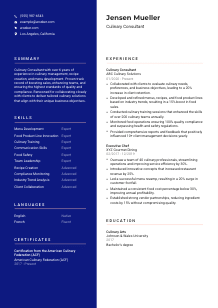
If the job asks for strong English skills, make English impossible to miss in this section. That requirement matters for presenting recommendations, leading training sessions, writing reports, and communicating with management. In the sample CV, English is listed first and marked as Native, which addresses the requirement directly.
Lead with the language most relevant to the job, then follow with any others in descending order of proficiency. This keeps the section aligned with the role while also showing any added cultural or operational flexibility you bring to the table.
Extra languages can strengthen your profile if you work with diverse teams, multicultural concepts, global cuisines, or client groups across markets. They are not a substitute for core culinary results, but they can support training, vendor relationships, and broader hospitality communication.
Use honest labels such as Native, Fluent, Conversational, or Basic. Overstating language skill can become a problem quickly in a consulting role where meetings, workshops, and written feedback may all depend on communication quality.
Not every extra language needs emphasis. Highlight multilingual ability when it connects to the employer's client base, concept style, workforce, or expansion plans. Otherwise, keep the section concise and factual.
For this kind of role, language proficiency is not just a nice extra. It can support client trust, team instruction, and written reporting, all of which sit close to the core of culinary consulting work.
Your summary should position you as someone who can improve a food business, not simply someone with kitchen experience. In a few lines, it needs to connect your culinary background with outcomes like stronger menus, better product performance, capable teams, and sound operational standards.
Lead with your years of experience and the kind of work you are known for. For a Culinary Consultant, that often means culinary management, corporate chef experience, menu strategy, recipe development, or product innovation. The opening line should tell the reader what professional lane you operate in before they reach the body of the CV.
Use the summary to mention the strengths most relevant to the role, such as creating cost-effective food products, refining menus around trends or nutrition needs, training culinary teams, or improving operational quality. Pick two or three points that match the posting closely and that you can prove later in the CV.
A summary becomes much more credible when it includes measurable business value. That might be sales growth, client retention, food cost control, training reach, or compliance results. The sample summary works because it pairs years of experience with clear contributions like boosting sales and strengthening teams.
Aim for three to five lines that read smoothly and avoid buzzwords. Strong summaries sound grounded in actual consulting work. They make room for terms like menu development, food product lines, profitability, and quality compliance without turning into a keyword dump.
When your summary is tailored well, the hiring team immediately understands your mix of culinary depth, operational judgment, and client value. That sets up the rest of the CV to read as proof rather than explanation.
A strong Culinary Consultant CV shows how your food knowledge changes business outcomes. When each section points clearly to menu performance, product innovation, team capability, compliance, and profitability, the hiring team can picture you contributing in a client-facing advisory role from the start.
Use Wozber's free CV builder to organise that experience in an ATS-friendly CV template, align your wording with the posting through ATS optimisation, and refine sections with the ATS CV scanner. The final result should make one thing easy to judge: how effectively you can turn culinary expertise into practical results for the employer or client.




