



Use Wozber and land your dream job
Create CV
No registration required
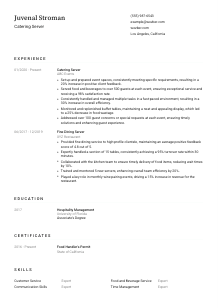
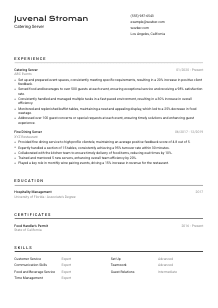
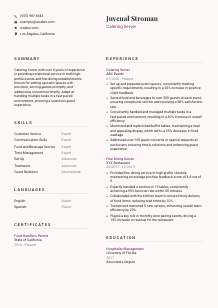
Juggling trays, but your CV isn't serving up opportunities? Check out this Catering Server CV example, created with Wozber free CV builder. It shows how to serve up your hospitality skills to match job demands, finally landing a career as delectable as your canapés!
Catering work gets judged in motion. Hiring teams want to see whether you can walk into an event space, get the room set correctly, serve guests smoothly under pressure, and keep service standards steady when timing shifts or special requests pile up. Your CV should make those service habits visible, not bury them under generic restaurant duties.
For this role, tailoring changes which details stand out first. A hiring manager scanning an ATS-compliant CV for catering service will look quickly for event setup, guest-facing service, food safety, and pace. Wozber's free CV builder helps you organise those details clearly and match the language of the posting, so your CV reads like someone ready to step into live event service.
In catering, logistics matter almost as much as service. Your header should give an employer the basics they need to contact you, confirm local availability, and see right away that you're applying for event service rather than a general hospitality role.
Use your full name as the most visible line at the top of the page. Keep the styling clean and professional. Catering managers often review CVs quickly between event planning tasks, so readability matters more than design flourishes.
Place "Catering Server" directly under your name if that is the role you are targeting. This helps separate your application from banquet captain, restaurant server, or bar staff profiles and keeps your positioning aligned with the posting.
Include a reliable phone number and a professional email address you check regularly. If a coordinator needs extra staff for an event weekend or wants to schedule a quick interview, delayed replies can cost you the opportunity.
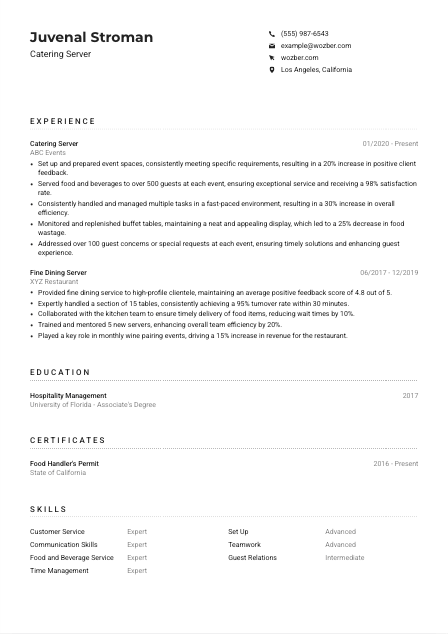
If an employer asks for local candidates, include your city and state. In the example, listing Los Angeles, California directly supports the stated location requirement and removes doubt about availability for local event work.
A LinkedIn profile can help if it reinforces your hospitality background, event experience, or certifications. Leave it off if it is empty or outdated. For catering roles, a clean header with accurate contact details usually matters more than a weak online presence.
This section does not need personality or filler. It needs to show that you are reachable, professionally presented, and ready for the practical realities of catering work.




This is where employers decide whether you have worked the kind of service they need. For catering, that usually means event setup, guest interaction, speed, attention to presentation, and the ability to stay composed when the room gets busy.
Read the job description closely and mirror the work that matters most. For a catering server, that includes setting up event spaces, serving food and beverages promptly, replenishing buffet tables, keeping equipment clean, and handling guest requests. When those responsibilities appear naturally in your experience, your CV feels aligned instead of generic.
Start with your most recent service job and work backward. Include the employer name, your title, and dates. If your background includes both catering and fine dining, as in the example, that combination is worth highlighting because it shows event experience alongside polished guest service.
Avoid repeating job duties without context. Show what your work improved. A bullet like setting up event spaces to client specifications and contributing to a 20% rise in positive feedback tells more than "responsible for setup." The same applies to guest issues, turnaround speed, and buffet upkeep.
Catering CVs benefit from concrete volume and outcome measures. Guest counts, satisfaction scores, waste reduction, response volume, and efficiency gains all help employers picture your pace and reliability. In the sample CV, serving more than 500 guests per event and maintaining a 98% satisfaction rate gives immediate scale.
Cut points that do not support event service, hospitality standards, or teamwork. If you include restaurant experience, frame it in ways that transfer well, such as guest relations, section management, coordination with the kitchen, or training newer staff. The hiring team should be able to connect every bullet to live event execution.
Your experience section should show that you can step into setup, service, and guest interaction without slowing the event down. When the bullets combine scope, pace, and service quality, your background becomes much easier to trust.
Most catering server jobs are won on service record and professionalism, not on academic pedigree alone. Still, education can strengthen your CV when it connects to hospitality, customer service, event operations, or food service standards.
If the posting does not require a degree, keep this section straightforward. Use it to support your background rather than lead the case. Hospitality coursework or service-related study can still help, especially when candidates have similar event experience.
Include the school, degree, field of study, and graduation year or date. In the example, an Associate's Degree in Hospitality Management adds relevant context because it connects directly to guest service and event operations.
If you are earlier in your career or your program included event planning, hospitality operations, food service management, or customer experience training, mention that selectively. Skip course lists that do not strengthen your case for front-of-house event work.
Recognition tied to hospitality programs, event committees, student service work, or leadership in customer-facing settings can help if you do not yet have deep experience. Keep it relevant and concise.
Once you have solid catering or fine dining experience, education should play a supporting role. Keep the section lean and focused so the reader stays on your event execution, guest care, and service consistency.
A relevant degree can add polish, especially in hospitality. It works best when it backs up the practical service record already shown in your experience section.
Food service certifications matter because they speak to compliance and day-of-event readiness. When a posting names a required permit, include it clearly so employers do not have to hunt for it.
Start with any required credential, especially food safety documentation. Here, a Food Handler's Permit is specifically requested, so it should appear on the CV without delay.
List certifications that relate to food handling, alcohol service if applicable, hospitality safety, or event operations. A short, targeted section reads better than a long list of unrelated training.
If a certificate must be current, show the issue date, renewal date, or active date range. The example's "2016 - Present" format works because it quickly suggests ongoing validity for the Food Handler's Permit.
Expired credentials create unnecessary friction in hospitality hiring. Review permit status, renewal timing, and state-specific requirements before you send the CV, especially when moving between markets or service environments.
For catering roles, certificates are practical hiring information. When they are current, relevant, and easy to find, you remove one more reason for an employer to hesitate.
A catering server skills section should read like the demands of a live event, not a generic list of personality traits. Focus on the abilities that help you set up correctly, move quickly, communicate well, and keep guests taken care of from first tray pass to final breakdown.
Catering requires a mix of operational and guest-facing ability. Customer service, communication, food and beverage service, time management, and teamwork all connect directly to how events run and how guests experience the service.
Use the employer's wording where it fits your real experience. For this job, skills such as setup, multitasking in a fast-paced environment, guest relations, and buffet monitoring are more useful than broad terms like "hardworking" or "friendly." The sample CV handles this well by keeping the list close to the job's service needs.
Choose skills you can support with bullets elsewhere on the page. If you claim expert-level customer service, your experience should show guest volume, satisfaction, or issue resolution. A shorter list with clear proof is stronger than an inflated one.
Anyone can list soft skills. Your CV should show the mix of service technique, speed, and guest handling that catering managers actually need on site.
Language ability can be useful in catering because events often involve varied guest groups, quick requests, and front-of-house coordination. It is rarely the lead qualification, but it can strengthen a CV when communication is central to the service environment.
If the job asks for strong English proficiency, make that visible. In this case, English is a stated requirement, so listing it clearly helps confirm you can handle guest interaction, instructions, and event communication.
Put the language you use most confidently first and label proficiency honestly with terms like Native, Fluent, or Intermediate. This gives the employer a quick read on how you can communicate with guests and coworkers.
Additional languages can be valuable in hospitality, especially in diverse markets or high-volume guest settings. In the example, Spanish is worth listing because it may support smoother guest service and team communication, though it is an advantage rather than a universal requirement.
Do not overstate what you can do. If you can greet guests and handle basic service exchanges, say so with an accurate level. Employers notice quickly when claimed fluency does not match on-the-job communication.
Only include languages that could help you in real event scenarios, such as answering guest questions, understanding requests, or coordinating with a multilingual team. Relevance matters more than the number of languages listed.
When language skills are accurate and relevant, they add practical value to a catering CV. They should support better service, smoother coordination, or both.
Your summary should quickly tell an employer what kind of service professional you are. For catering roles, that usually means years of experience, the service environments you know best, and the kind of guest experience or event support you consistently deliver.
Start with a direct line that identifies you as a catering server or hospitality professional and notes your experience. A phrase like "Catering Server with 4+ years of experience in events and fine dining service" works because it establishes both tenure and setting right away.
Mention a few role-specific strengths such as event setup, prompt food and beverage service, multitasking under pressure, or guest request handling. These are the traits that tell an employer you understand the rhythm of catered service.
If you have strong metrics, use them briefly. Satisfaction scores, guest volume, or feedback improvements can sharpen the summary without turning it into a bullet list. The sample summary works because it connects service quality with practical event responsibilities.
Aim for a short paragraph that can be read in seconds. Three to five lines is enough to position you clearly before the hiring manager reaches your experience section. Save the detail for the bullets that follow.
A focused summary tells the reader what kind of event support and guest care they can expect from you. When it is specific to catering work, the rest of the CV lands with more clarity.
A catering server CV should make one thing easy to judge: can you support setup, serve guests professionally, and keep service running smoothly when the pace picks up? If that answer is clear in your experience, skills, permits, and summary, you are applying with the right emphasis.
Wozber's free CV builder helps turn that experience into an ATS-friendly CV format that stays focused on the details catering employers actually scan for. Use it to tailor your wording, strengthen ATS optimisation, and present a CV that reads like someone ready for the next event shift.




