



Use Wozber and land your dream job
Create CV
No registration required
Plotting high-level strategies, but your CV feels like middle management? Check out this Vice President CV example, created with Wozber free CV builder. Learn how to present your leadership strengths and executive insight to match job demands, driving your career trajectory to C-suite prominence.
Vice President hiring usually turns on a simple question: have you already led at a level where strategy, revenue, operations, and stakeholder trust move together. Titles alone do not answer that. Your CV needs to show how you set direction, aligned senior leaders, improved performance, and carried accountability for business results that reached beyond one function.
At this level, weak CVs often blur the difference between senior management and executive leadership. Wozber's free CV builder helps you shape an ATS-compliant CV around the language of the role so the first read makes your scope clear, whether that means growth targets, cross-functional leadership, client relationships, or executive representation. The reader should quickly see that you can lead the business, not just a department.
For a Vice President CV, the header should read like a clean business card, not a branding exercise. Keep it precise, current, and aligned with the basics the employer can confirm immediately before they move on to your leadership record.
Use your full name prominently at the top in a clean, readable style. At this level, the goal is instant recognition and professionalism. Avoid nicknames, decorative formatting, or anything that competes with the substance of your experience.
Place "Vice President" under your name when that is the role you are pursuing. This creates immediate alignment with the opening and helps frame your experience through an executive lens. If your current title is different, such as COO or Senior Director, your experience section will show the progression.
Include a reliable phone number and a professional email address. Executive hiring often involves direct outreach from recruiters, board members, or senior leaders, so accessibility matters. Use an email format based on your name rather than a personal alias.
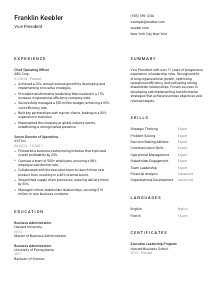
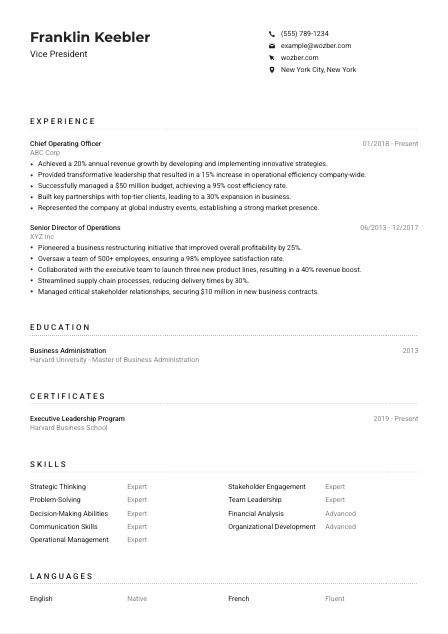
Some Vice President searches include a firm location requirement because of board access, executive team presence, or client-facing obligations. Here, New York City, New York is explicitly requested, so listing New York City, New York in your personal details removes an avoidable screening issue early.
A LinkedIn profile or personal website can support your candidacy when it reflects the same executive story as your CV. For senior leaders, this may include board activity, speaking engagements, published insights, or a consistent career timeline. Make sure the link is current and polished before you include it.
This section should confirm the basics quickly and cleanly. Once location, title, and contact information are clear, the reader can focus on the part that matters most for a Vice President search: your strategic and operational track record.




For Vice President candidates, experience does the heaviest lifting. Hiring teams want to see the size of the business problems you handled, the leaders you influenced, the financial outcomes you drove, and the scope of decisions you owned.
Arrange roles in reverse chronological order and make the progression obvious. A Vice President posting asking for 10+ years of leadership experience is looking for accumulated executive judgment, not a single senior title. Your timeline should show increasing responsibility across strategy, operations, growth, or business leadership.
Under each position, focus on the work that matters at executive level: strategic planning, organizational alignment, revenue growth, operational efficiency, budget ownership, and stakeholder management. The example CV does this well by framing the COO role through outcomes such as annual revenue growth, company-wide efficiency gains, and partnership expansion rather than generic leadership duties.
Numbers matter because they define your executive scope. Revenue growth, margin improvement, cost efficiency, budget size, team size, contract value, and operational improvements all help the reader understand the level at which you operate. Examples like 20% annual revenue growth, a $50 million budget, or a 30% business expansion make the impact concrete.
A Vice President role centered on strategic planning, executive collaboration, and client or partner relationships calls for bullets that reflect those priorities. Move the strongest matches higher in each job entry. If you launched product lines with the executive team, restructured operations for profitability, or secured major contracts, those points belong near the top because they mirror what the role needs.
Executive CVs should show how you led, not just what improved. Include examples of directing department heads, guiding large teams, driving cross-functional execution, or representing the company externally. In the sample, overseeing 500+ employees and representing the company at industry events helps show leadership presence alongside financial and operational results.
Your experience should leave no doubt about executive range. By the end of this section, the reader should understand the size of your remit, the business outcomes you delivered, and how you led people, priorities, and partnerships at scale.
Education rarely decides a Vice President search on its own, but it still matters when the job specifies degree requirements or gives preference to advanced study. Present it clearly so the employer can confirm the academic foundation without having to search for it.
When the role asks for a bachelor's degree in Business, Finance, or a related field, make that qualification easy to find. If you also hold a master's degree, especially an MBA or another leadership-focused graduate credential, place it first because it directly supports executive-level positioning.
List each degree with the institution, degree name, field of study, and graduation year. Keep the format straightforward. Senior-level CVs benefit from clarity more than extra detail, especially when the reader is checking alignment with stated education requirements.
If the posting says a master's degree is preferred, do not bury it. In the example, the MBA from Harvard University immediately strengthens alignment with that preference. That does not mean every Vice President role requires an MBA, but when you have a preferred credential, make it visible.
At this level, coursework usually stays off the CV unless it directly supports a targeted move, such as finance-heavy leadership, corporate strategy, or regulated industry work. Most Vice President candidates are better served by a concise education section and a stronger experience section.
Leadership programs, strategy programs, and other advanced study can reinforce your commitment to executive growth. If they are substantial, recent, and relevant, they can either support the education section or appear under certifications, as the sample does with an executive leadership program.
This section should confirm that you meet the academic baseline and, where applicable, exceed it. Keep the presentation clean so your degrees support your candidacy without distracting from the business results that define senior leadership hiring.
Certifications are usually secondary to experience for a Vice President role, but the right ones can sharpen your profile. Focus on credentials that reinforce strategic leadership, governance, finance, operations, or industry-specific expertise.
Do not fill this section with short courses that add little to your candidacy. Prioritise programs tied to leadership, strategy execution, financial management, transformation, or board-level decision making. For this kind of role, relevance matters more than volume.
When a posting emphasizes strategic thinking, organizational growth, and stakeholder leadership, certificates in executive leadership or advanced management fit naturally. The example's "Executive Leadership Program" works because it supports the leadership and organizational oversight expected of a Vice President.
Adding the date or duration helps show whether a credential is current or part of ongoing development. That context is useful when the certificate reflects recent investment in leadership capability, transformation methods, or industry knowledge.
Senior leaders are expected to keep sharpening how they lead through change, scale operations, and guide strategy. A well-chosen certificate can show that you continue to invest in those areas, especially if your core degrees are older and your recent learning is more directly tied to current business challenges.
A small number of relevant credentials can strengthen an executive CV. The section works best when every item reinforces the kind of strategic, operational, or leadership judgment the role requires.
For a Vice President CV, the skills section should mirror how senior leaders are expected to operate. That means emphasizing strategic judgment, business performance, organizational leadership, and relationship management rather than listing every capability you have developed over time.
Start with the wording in the posting and match it where it reflects your real strengths. Here, terms such as strategic thinking, problem-solving, decision-making, communication, and stakeholder relationship building belong in the section because they are central to the role and ATS screening.
Prioritise capabilities that point to business leadership: strategic planning, operational management, financial analysis, organizational development, executive communication, and stakeholder engagement. The sample skills list works because it stays close to the responsibilities of driving growth, leading departments, and improving performance.
A crowded skills section weakens executive positioning. Choose the capabilities that best support your target role and that also show up in your experience section through real outcomes. If a skill cannot be backed by examples such as revenue growth, cost control, client expansion, or cross-functional leadership, reconsider including it.
This section should echo the language of the role and support the story told in your experience. When the skills, achievements, and summary all point in the same direction, your executive profile reads as deliberate and well aligned.
Language skills matter differently at senior level. Sometimes the requirement is simple and practical, such as communicating effectively in English. In other cases, additional languages can strengthen your value in client relationships, international operations, or cross-border growth.
If the role explicitly requires English, list it clearly with an accurate proficiency level. For an executive position, this is about more than conversation. It covers board communication, client discussions, negotiation, public representation, and strategic decision-making.
Additional languages can be useful when the company works across regions, manages multinational clients, or expects senior leaders to represent the business externally. A language such as French may support international relationships, but include it because it is genuinely useful, not as decoration.
Use straightforward labels such as Native, Fluent, or Professional Working Proficiency. Overstating language ability can create problems quickly in senior interviews, especially if the role involves investor communication, government interaction, or client-facing leadership.
When additional languages are relevant, they can quietly reinforce your capacity to work across markets and stakeholder groups. That may be particularly valuable for Vice President roles involving partnerships, expansion, or external representation at industry events.
This is a supporting section, not the centre of your candidacy. Include only languages you can actually use in professional settings and present them with enough clarity that the employer can judge where they may add value.
Handled well, languages reinforce communication range and external-facing capability. For a Vice President CV, that is most useful when it supports stakeholder leadership, market reach, or the role's stated language requirement.
The summary is where you establish your level quickly. For a Vice President role, it should capture years of leadership experience, business impact, and the type of executive responsibilities you are prepared to own.
Before writing, identify the few themes the employer cares about most. In this case, that includes strategic planning, organizational growth, revenue performance, operational efficiency, and stakeholder leadership. Those themes should shape the summary far more than broad adjectives.
Start with a direct line that anchors your experience level, such as more than 10 years in executive or senior leadership roles. The example summary does this effectively with "over 11 years of progressive experience in leadership roles," immediately establishing the level expected for a Vice President.
Choose achievements or strengths that map closely to the job. Growth, efficiency, profitability, strategic execution, and relationship building are all strong options when they reflect your real record. Phrases like driving organizational growth or optimising operational efficiency work best when the experience section backs them up with metrics.
Aim for a summary that reads like an executive briefing, not a personal statement. In a few lines, the employer should understand your leadership level, your main business contributions, and the kind of organizational responsibility you can handle from day one.
By the time the reader finishes these opening lines, your executive identity should be clear. A focused summary sets up the rest of the CV to confirm your leadership range, growth record, and readiness for a Vice President seat.
A Vice President CV needs to present more than senior titles. It should show strategic direction, business growth, operational command, and the ability to lead across teams and stakeholders with measurable results.
Wozber's free CV builder can help you organise that story in an ATS-friendly CV format, align your language with the job description, and refine key sections with faster ATS optimisation. The final version should make it easy to judge your executive scope and your ability to deliver results in the role.




