



Use Wozber and land your dream job
Create CV
No registration required
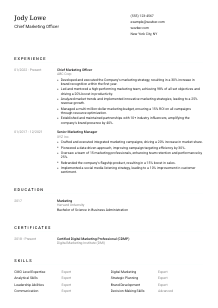
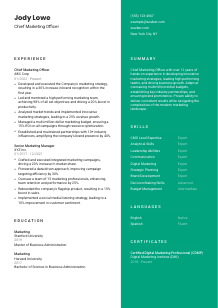
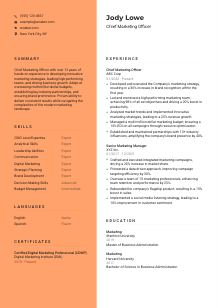
Crafting brand stories, but your CV feels like it's losing its narrative arc? Explore this Chief Marketing Officer CV example, created with Wozber free CV builder. It shows how to blend your marketing genius with job prerequisites, landing your career at the forefront of success and not lost in the campaign shuffle!
Chief Marketing Officer hiring turns quickly on business traction. Boards and CEOs want to see who can shape market position, grow revenue, direct brand investment, and lead a marketing organisation with discipline when targets are high and budgets are visible. Your CV should make that executive scope obvious from the first few lines, not bury it under generic brand language or broad claims about creativity.
A tailored CMO CV also changes how your background is interpreted in review and in ATS filtering. When strategy, team leadership, channel decisions, and ROI language mirror the target brief, Wozber's free CV builder helps you present an ATS-compliant CV that surfaces the right executive keywords and makes it easier to recognize your operating range as a growth leader.
For a Chief Marketing Officer, the header should read like clean executive positioning. Keep it precise, easy to scan, and aligned with any practical requirement the employer has already stated.
Use your full name in the largest, clearest text on the page. At this level, your CV should look polished and board-ready, with no decorative formatting competing with the actual content.
Place "Chief Marketing Officer" directly under your name when that is the role you are pursuing. Matching the title used in the posting helps frame your background immediately, especially when your prior roles include adjacent executive titles such as VP of Marketing or Head of Growth.
List a reliable phone number and a professional email address, then add a relevant website or LinkedIn profile if it supports your leadership story. For a senior marketing leader, that profile should reinforce major campaigns, brand work, market expansion, or speaking presence rather than feel like an unfinished social page.
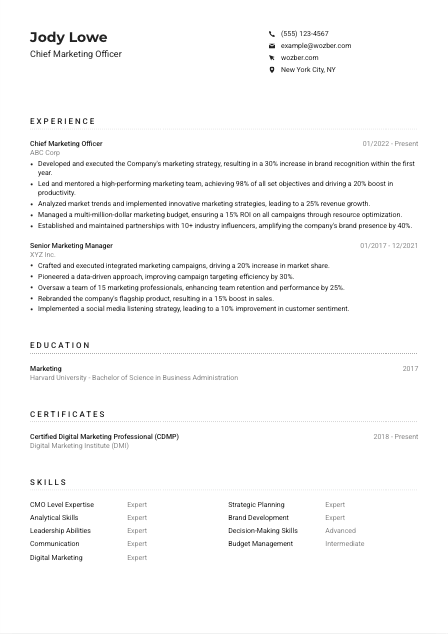
If the employer asks for a specific location, include it plainly in your header. In the example, "New York City, NY" directly answers the requirement and removes a common screening obstacle before anyone reaches the experience section.
If you include a website, portfolio, or LinkedIn URL, make sure it supports executive marketing credibility. Useful additions might include public brand launches, interviews, thought leadership, or major growth initiatives that back up the strategic claims on your CV.
Your personal details should remove friction. When the title, contact information, and any required location are handled cleanly, hiring teams can move straight to the part that matters most for a CMO: your growth record and leadership scope.




This is the section most likely to decide whether a Chief Marketing Officer CV moves forward. Hiring teams look for proof that you have owned strategy, influenced revenue, managed sizeable budgets, and led teams through measurable growth, not just contributed to marketing activity.
Start by marking the responsibilities that define the role's commercial weight. For a CMO posting, that usually means brand strategy, go-to-market leadership, channel decisions, budget ownership, team leadership, market analysis, and external partnerships. Then rewrite your bullets so those priorities appear in the language of your actual achievements. The example does this well by echoing the strategy requirement with a bullet about developing and executing the company's marketing strategy and tying it to a 30% increase in brand recognition.
List positions in reverse chronological order and make the progression easy to follow. For senior marketing candidates, that progression matters because it shows whether you moved from campaign ownership into team leadership, budget control, and enterprise strategy. Job title, company, and dates should be easy to spot so the reader can quickly trace your path to executive responsibility.
Your bullets should centre on outcomes a CEO or board would care about, such as revenue growth, market share, brand lift, customer acquisition efficiency, team performance, or return on marketing spend. The strongest examples combine strategic action with business impact, like rebranding a flagship product to lift sales or improving targeting efficiency through a data-driven approach.
Numbers matter because they show scale. Include metrics tied to budget size, growth percentage, team size, campaign ROI, partner count, retention improvement, or productivity gains. In the sample CV, details like 25% revenue growth, 15% ROI on campaigns, and management of a multi-million-dollar budget do more than impress. They establish that the candidate has operated at executive level.
Every bullet should support a senior marketing narrative. Remove tactical detail that belongs to an earlier-career CV unless it explains a meaningful result, such as a major product launch, a channel turnaround, or a customer insight program that changed strategy. A CMO CV needs concentration. Brand leadership, analytics, team development, and growth impact should stay in focus from top to bottom.
Your experience section should make your executive range unmistakable. When strategy, team leadership, market analysis, budget ownership, and commercial outcomes are all visible, the reader can quickly see whether you have already done work at CMO scale.
Education will not outweigh your leadership record at CMO level, but it still frames your business foundation. Keep it relevant, concise, and aligned with the academic requirements or preferences named in the posting.
Lead with degrees that directly support senior marketing leadership, especially marketing, business, or related fields. If the posting asks for a bachelor's degree and prefers an MBA, list both when you have them. In the example, the bachelor's in marketing and MBA in marketing map cleanly to what the employer requested.
Keep each entry easy to scan: school, degree, field, and graduation year. Executive CVs do not need extra formatting flourishes here. The value is in making your academic background immediately legible.
When an employer specifies education clearly, arrange this section so that requirement is answered without effort. If your degree title is broader, the field of study can do important work. For example, a business administration degree with a marketing concentration still communicates strong relevance for a CMO role.
At this stage, coursework, honors, or projects are optional and usually secondary to business results. Include them only if they reinforce something material to the role, such as advanced analytics, brand strategy, or market research, and only if the space would otherwise go unused.
If you continue to study emerging areas such as digital growth, customer analytics, or executive leadership, that is useful context, though it often belongs in certificates rather than in education. Keep the degree section focused on the formal credentials that support your seniority.
For a Chief Marketing Officer, education should confirm the business and marketing foundation behind your leadership record. Clear degree information and smart ordering are usually enough.
Certifications are rarely the deciding factor for a CMO, but the right ones can sharpen your positioning. They work best when they reinforce capabilities that matter in modern marketing leadership, such as digital strategy, analytics, customer insight, or executive development.
Start with the job description. If no certification is required, treat this section as support rather than filler. A relevant credential such as "Certified Digital Marketing Professional" can still strengthen your case by showing continued investment in current marketing practice.
Prioritise credentials that connect to the scope of the role. For CMOs, that usually means digital marketing, brand leadership, growth strategy, analytics, or cross-channel execution. Skip certificates that feel too entry-level or too narrow to support an executive profile.
Marketing tools, attribution models, and channel economics change quickly. Listing the year earned, or a validity range when relevant, helps the employer judge how current the credential is. The sample's date format does this cleanly.
A senior marketing leader is expected to keep pace with changing platforms, measurement practices, and customer behaviour. Updated certifications can reinforce that point, especially if your experience spans both traditional brand work and modern performance-driven marketing.
Keep only the credentials that add something meaningful to your executive marketing story. One relevant, current certification is stronger than a long list that does not match the scope of the role.
A Chief Marketing Officer skills section should read like an executive capability snapshot, not a generic keyword bank. Focus on strategic, analytical, financial, and leadership skills that support brand growth and organizational performance.
Look beyond the obvious title match and extract the work behind it. In this posting, that includes innovative strategy, data-driven decision-making, leadership, mentoring, brand development, marketing communications, channel distribution, and budget management. These are the terms and capability areas your skills section should reflect if they are genuinely part of your background.
Start with skills that carry the most weight in executive review. Strategy, growth planning, brand development, analytics, leadership, budget ownership, and communication usually belong near the top. In the example, analytical skills, leadership abilities, strategic planning, and brand development align well with the role's expectations.
Use concise phrasing and avoid clutter. An ATS-friendly layout helps, but so does clear human reading. Group skills naturally around executive marketing work rather than mixing unrelated tools and traits. The section should quickly confirm that you can lead the marketing function, not just contribute within it.
Your skills should reinforce the picture already established by your experience. If they point back to strategy, team leadership, market analysis, and ROI discipline, they are doing their job.
Language ability matters differently at CMO level. In some organizations it is essential for executive communication, media work, investor visibility, or multi-market brand leadership. In others, it is simply a useful edge. Present it in proportion to the role.
If the posting names a required language, list it clearly and use an honest proficiency level. Here, strong English proficiency is fundamental, so "English: Native" or an equivalent high-level description belongs near the top.
Additional languages can strengthen your profile when the company operates across regions, serves multilingual audiences, or values cross-border partnership building. In the example, Spanish adds breadth without distracting from the core requirement.
Use plain proficiency labels such as Native, Fluent, Intermediate, or Basic. Executive roles often involve public communication, stakeholder management, and negotiation, so overstating fluency can create problems later.
If the company works across international markets or diverse customer segments, multilingual capability can support campaign localization, regional messaging, and partner relations. If the role is primarily domestic, keep the section brief and factual.
Do not overload the section with limited language exposure that has no practical bearing on leadership work. Prioritise the languages that strengthen your ability to lead teams, represent the brand, or understand target markets.
For a Chief Marketing Officer, language skills should support communication range and market relevance. Lead with the required language, then add others only when they strengthen the case.
The summary is where executive marketing candidates either sharpen their positioning or blur it. It should quickly establish your level, your commercial impact, and the kind of marketing organisation you are equipped to lead.
Before writing, identify the few themes the employer clearly cares about most. In this case, that includes innovative strategy, business growth, analytics, leadership, and budget responsibility. Those themes should shape your opening lines rather than a generic statement about passion for marketing.
Start with your title and level of experience so the reader understands your seniority immediately. A line such as "Chief Marketing Officer with 12+ years in senior marketing leadership" works because it sets scope fast and leaves room for the business story that follows.
Use the next sentences to bring in the outcomes and capabilities that matter most for the job. That may include revenue growth, brand expansion, high-performing team leadership, budget ownership, channel strategy, or strategic partnerships. The example summary works because it combines leadership, business growth, and multi-million-dollar budget oversight in a compact space.
Aim for three to five lines that are rich in meaning, not broad in tone. Avoid vague claims like "results-driven" unless the next phrase explains what results you delivered. A CMO summary should sound grounded in P&L impact, market growth, and executive leadership, not in self-description alone.
A well-written summary gives the reader an immediate sense of your scale and commercial value. By the time they reach your experience section, they should already expect to see strategy ownership, growth results, and strong marketing leadership.
A Chief Marketing Officer CV should read like an executive business case. It needs clear proof of strategic leadership, measurable growth, budget control, team development, and market judgment, all expressed in language that matches the target role.
Use Wozber's free CV builder to sharpen that alignment, strengthen ATS optimisation, and organise your content in an ATS-friendly CV format that keeps executive achievements easy to scan. When the CV is tailored well, hiring teams can quickly judge whether you are ready to lead the marketing function.




