



Use Wozber and land your dream job
Create CV
No registration required
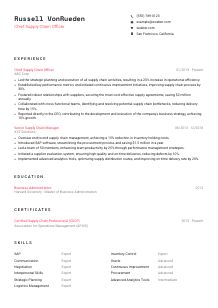
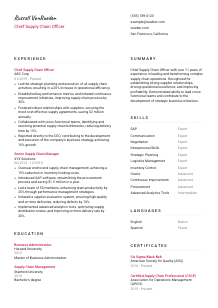
Masterminding supply chains, but your CV feels out of stock? Check out this Chief Supply Chain Officer CV example, created with Wozber free CV builder. Learn how to align your logistics expertise with job needs, ensuring your career flows as smoothly as a perfectly optimised supply chain!
At the Chief Supply Chain Officer level, hiring decisions turn on whether you can run the supply chain as a business system, not just a function. Your CV needs to show how you have improved procurement economics, inventory health, production flow, logistics performance, and supplier resilience while influencing company strategy at the executive table.
Executive CVs in supply chain are often screened first for scale, transformation results, and the systems behind them. Wozber's free CV builder helps you shape that experience into an ATS-compliant CV with the right ERP, analytics, and operations language, so a hiring team can quickly see where you have led cost, service, and efficiency gains.
For a Chief Supply Chain Officer, the header should confirm executive credibility in seconds. Keep it clean, direct, and aligned with the role so the reader can move straight to your leadership history and operating results.
Use your full name prominently and avoid unnecessary labels around it. At this level, your header should read like an executive profile, not a form. Clean formatting matters because board-facing and CEO-facing roles are expected to reflect polish and control.
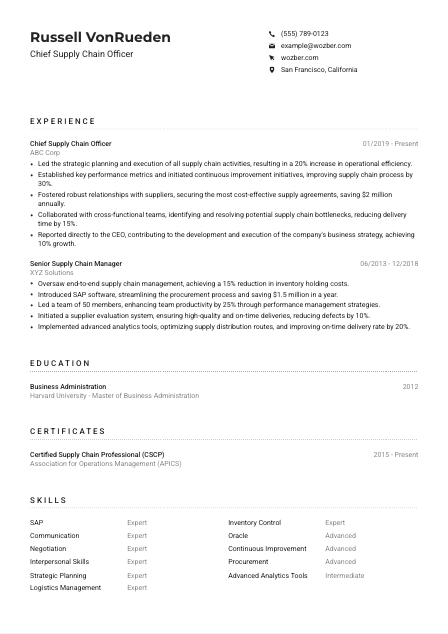
Place "Chief Supply Chain Officer" directly beneath your name when that is the role you are targeting. This immediately positions you for enterprise supply chain leadership rather than a senior manager or director track. If your current title differs, the rest of the CV should support that progression with strategic scope and transformation outcomes.
Include a reliable phone number and a professional email address. Executive hiring often moves quickly once interest is established, especially when a company is trying to stabilize costs, improve service levels, or scale operations. Make sure there is no friction in reaching you.
If the role specifies geography, include your city and state. In the example, "San Francisco, California" works because the posting requires local presence. When a role is location-sensitive, that detail removes an immediate question before the reader reaches your experience.
A LinkedIn profile or executive bio page can reinforce your background in supplier strategy, network design, ERP leadership, or operational turnaround. Only include it if the content is current and consistent with the CV. The extra link should deepen your profile, not raise new questions.
Your personal details should confirm that you are ready for an executive supply chain search. Keep the section concise, accurate, and aligned with the level of responsibility the role carries.




This section carries the most weight for a Chief Supply Chain Officer. Hiring teams want to see whether you have led end-to-end supply chain operations, improved performance through clear metrics, and influenced business strategy beyond the warehouse, plant, or transportation network.
Mark the responsibilities and requirements that define the search, then shape your bullets around them. For this role, that includes strategic planning, procurement, production, inventory management, logistics, continuous improvement, supplier negotiations, and cross-functional bottleneck resolution. Your experience section should mirror those priorities using language that matches the work you have actually led.
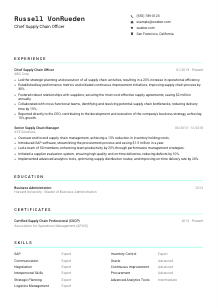
List roles in reverse chronological order and make the leadership path obvious. A Chief Supply Chain Officer CV should show increasing ownership across planning, sourcing, operations, logistics, and executive decision-making. The example does this well by moving from Senior Supply Chain Manager into a CSCO role with CEO-level reporting and broader business contribution.
Use numbers that matter in supply chain leadership: cost savings, efficiency gains, lead-time reduction, inventory carrying cost, on-time delivery, defect rates, or margin impact. Statements like a 20% increase in operational efficiency, $2 million in annual supplier savings, or a 15% reduction in delivery time give hiring leaders concrete proof of execution.
Each bullet should show what you led, how you changed the operation, and what improved because of it. Focus on transformation work such as redesigning supplier agreements, introducing ERP workflows, building KPI dashboards, or resolving supply-demand imbalances with sales and operations partners. In the sample CV, the strongest bullets pair executive actions with measurable business results instead of listing responsibilities alone.
Prioritise achievements that reflect strategic ownership, multi-function coordination, and business impact. Routine task detail can weaken the story when the role calls for enterprise leadership and operational excellence. Keep the emphasis on the scale of the network, the complexity of the change, and the performance improvements you delivered.
Your experience section should leave no doubt that you can lead a supply chain organisation at executive level. Show the scope you owned, the systems you improved, and the business results that followed.
Education matters here as a baseline qualification and as part of your leadership profile. Keep it straightforward, with enough detail to confirm the degree requirements and any advanced study that strengthens your strategic or operational background.
Start by making sure your bachelor's degree is easy to find, especially if it is in Business Administration, Supply Chain Management, or a related field. That directly addresses a stated requirement and helps the hiring team confirm qualification without digging.
List school, degree, field of study, and graduation year in a consistent format. Senior candidates do not need extra formatting tricks here. Clean presentation is enough, particularly when the reader is quickly checking that your background supports executive supply chain leadership.
If you hold an MBA or other relevant master's degree, include it prominently. In this search, a master's degree is preferred, so the example's MBA supports the strategic and cross-functional aspects of the role. That does not make it mandatory for every CSCO opening, but it is valuable when the posting calls it out.
Most executive candidates can skip coursework unless it directly supports the target role or explains a less obvious degree path. If included, choose subjects tied to supply chain strategy, operations management, analytics, or business transformation rather than broad academic lists.
Academic honors, case competitions, or leadership positions are optional at this level. Include them only if they add credible context around strategic thinking, operational discipline, or leadership development. The priority remains your executive track record, so education should support that story rather than compete with it.
Use the education section to confirm you meet the role's degree expectations and to reinforce your progression into senior supply chain leadership. Clear, relevant entries are enough.
Certifications are especially useful in supply chain because they can support your credibility in process improvement, planning discipline, and end-to-end operations. They work best when they complement your leadership record rather than trying to replace it.
Even when a posting does not require a certification, credentials such as CSCP, CPSM, Six Sigma, or Lean training can strengthen your profile. They are most useful when the role emphasizes transformation, operational excellence, supplier performance, or process control.
Do not list every credential you have earned. Focus on the ones that support the role's priorities, such as network efficiency, procurement discipline, continuous improvement, or enterprise process leadership. In the example, CSCP and Six Sigma Black Belt both align well with a CSCO brief centered on operational improvement.
Dates help show currency, especially for certifications tied to evolving methods, standards, or professional membership. If the credential is active or maintained, note that clearly. That makes it easier to read your development as ongoing rather than historical.
Supply chain leadership now overlaps with analytics, ERP transformation, resilience planning, and cost-to-serve improvement. Updated certifications or formal training in these areas can support your CV when you are moving into broader enterprise leadership or repositioning after a specialised role.
Relevant certifications add depth when they support the kind of supply chain transformation and operational control the role requires. Keep them current and clearly connected to your executive value.
For a Chief Supply Chain Officer, the skills section should read like an executive operating toolkit. It should combine strategic leadership, systems fluency, and the functional areas you are trusted to improve across the supply chain.
Start with the job description and capture both explicit requirements and implied leadership capabilities. Here, that includes ERP platforms such as SAP or Oracle, advanced analytics tools, procurement, inventory management, logistics, negotiation, communication, and continuous improvement. These are not filler keywords. They describe how the work gets done and what the organisation expects you to lead.
A CSCO skills section should not lean only on soft skills or only on software. Combine tools, supply chain functions, and leadership capabilities in a way that reflects enterprise responsibility. The example does this effectively by mixing SAP, Oracle, strategic planning, procurement, logistics management, negotiation, and communication.
Lead with the skills most relevant to the target role, especially the systems and functional areas named in the posting. Grouping or ordering them by importance helps the reader scan quickly and helps ATS matching stay strong without making the section look stuffed. Quality matters more than volume here.
Choose skills that show how you lead supply chain performance in practice, from ERP and analytics to supplier negotiations and operational improvement. Keep the list focused on what the role actually calls for.
Language ability can matter in senior supply chain roles, especially when supplier networks, manufacturing partners, or regional logistics operations cross borders. Keep this section simple and relevant to the business environment you are likely to lead.
If the posting specifies English proficiency, make that visible. For this role, proficient English is required, so listing English at a strong level is essential. That matters for executive reporting, supplier negotiations, and cross-functional communication with finance, operations, and the CEO.
Other languages can strengthen your profile when they are relevant to sourcing regions, manufacturing footprints, or customer markets. They are not always decisive, but they can add practical value in globally distributed supply chains. The example's Spanish fluency is a useful secondary asset.
Choose clear labels such as Native, Fluent, Advanced, or Intermediate. Senior roles often involve high-stakes negotiation and executive communication, so overstating language ability can backfire quickly. Accuracy matters more than breadth.
If the business relies on international suppliers, overseas production, or regional distribution hubs, language capability can support relationship-building and issue resolution. Include it when it adds real operational context, not just to fill space.
List language skills that strengthen your ability to lead across suppliers, functions, and markets. For executive supply chain roles, clear English proficiency is often essential, and additional languages can be a meaningful advantage.
The summary should quickly establish the scale of your leadership, the kind of supply chain problems you solve, and the results you are known for. At this level, a few targeted lines are enough if they connect strategy, execution, and business performance.
Open with your title or equivalent level, years of experience, and the operating scope you bring. For a Chief Supply Chain Officer, that usually means end-to-end supply chain leadership, transformation work, and responsibility across sourcing, inventory, logistics, and performance improvement.
Mention the results that define your value, such as reducing cost, improving service levels, strengthening supplier performance, or driving operational excellence. The example summary works because it highlights transformation, supplier relationships, profitability, and cross-functional leadership rather than using generic executive language.
If the role emphasizes ERP systems, analytics, continuous improvement, or executive partnership with the CEO, bring one or two of those themes into the summary. This helps the first lines of the CV align with the posting before the reader reaches the experience section.
Aim for a short paragraph that sounds like an executive introduction, not a biography. Avoid broad claims that could fit any leadership role. Every phrase should point back to supply chain strategy, operational control, or enterprise impact.
Your summary should position you as a supply chain executive who can improve operations and influence company strategy. Keep it brief, concrete, and closely aligned with the role you want next.
A Chief Supply Chain Officer CV should make three things easy to see fast: the scale of the operation you led, the improvements you delivered, and the systems and partnerships you used to get there. If those points are clear across your summary, experience, and skills, the CV is already doing executive-level work.
Use Wozber's ATS CV scanner and AI CV builder to tighten role-specific language, surface missing requirements, and keep the document in an ATS-friendly CV format. The final version should show that you can lead supply chain strategy, improve operational performance, and contribute at CEO level from day one.




