



Use Wozber and land your dream job
Create CV
No registration required
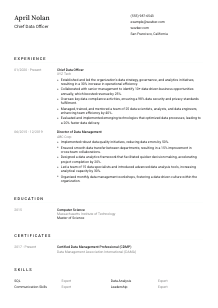
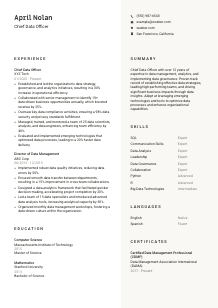
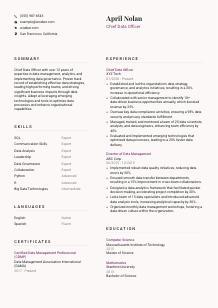
Crunching data, but your CV doesn't compute? Check out this Chief Data Officer CV example, created with Wozber free CV builder. Learn how to align your data-driven leadership with job specifics, ensuring your career trajectory is as optimised as your datasets!
Chief Data Officer hiring turns quickly on whether your CV shows enterprise-level judgment with data, not just strong analytics credentials. Boards and executive teams look for leaders who can set governance standards, improve data quality, translate information into business decisions, and build the operating model behind all of it. Your CV needs to make that scope visible early, with clear proof of strategy ownership, cross-functional influence, and measurable business outcomes.
A tailored CV also helps separate senior data leaders who managed reporting or analytics from those who truly owned data strategy, compliance, and organizational change. Using Wozber's free CV builder with ATS optimisation makes it easier to align your wording with the role's language, surface terms like data governance and privacy standards, and present that experience in a way that quickly shows executive-level readiness.
For a Chief Data Officer, the contact section should read like the front page of an executive profile. Keep it clean, direct, and aligned with the level of leadership the role carries, especially when the employer has stated practical requirements such as location or language.
Use your full name as the most visible element, then immediately anchor your profile with a title that matches the role you are pursuing. For a senior data leadership application, placing "Chief Data Officer" under your name helps frame the rest of the CV around governance, analytics strategy, and enterprise data leadership rather than narrower technical work.
If you already hold the title or your scope is equivalent, use the target title directly. If your background comes from roles such as Head of Data, VP of Data, or Director of Data Management, make sure the rest of the CV supports that progression with board-level strategy, data governance ownership, and leadership across analysts, engineers, and data scientists.
Include one dependable phone number and a professional email address. At this level, small mistakes in contact information look careless, especially in a role trusted with compliance, security, and data quality standards. Use a clean format such as firstname.lastname@email.com and avoid handles that feel informal.
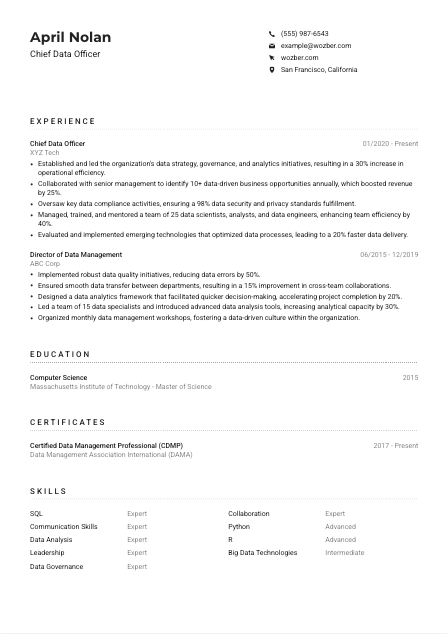
Some Chief Data Officer openings include location as an explicit hiring filter. In the example here, San Francisco, California is stated as a requirement, so listing it in your contact details removes immediate uncertainty. Only do this when it is relevant to the role you are targeting, not as a blanket rule for every application.
A LinkedIn profile, executive bio page, or personal site can reinforce the scale of your work. For a Chief Data Officer, that might include published talks on governance, articles on data strategy, or leadership highlights tied to transformation programs, analytics modernization, or privacy frameworks. Make sure anything you link supports the same narrative as the CV.
This section should tell an employer they are looking at a credible senior data leader with no friction around contact details, title alignment, or practical requirements. Make it easy for them to move straight to your strategic experience.




The experience section carries most of the hiring weight for a Chief Data Officer. This is where you show that you have led data strategy across the business, improved governance and quality, managed risk, and turned data investments into operational or revenue results.
Start by identifying the themes the employer cares about most, then mirror them with real achievements from your background. For this role, those themes include data strategy, governance, analytics initiatives, compliance, security, and senior-level collaboration. That is why the example CV leads with outcomes tied to strategy ownership, business opportunity identification, and privacy standards, rather than technical tasks alone.
List roles in reverse chronological order and make the growth in your remit easy to follow. A Chief Data Officer CV should show progression from hands-on data management or analytics leadership into broader ownership of policy, teams, platforms, and business alignment. Titles such as Director of Data Management can work well when the bullet points clearly show preparation for executive responsibility.
Each role should answer a practical leadership question: what changed because you led the data function? Focus on outcomes such as stronger governance, faster data delivery, cleaner reporting, reduced error rates, better compliance posture, or revenue unlocked through analytics. In the sample, statements like a 30% increase in operational efficiency and 25% revenue growth make the impact of data strategy easy to understand.
Numbers matter here because they show scope, not just success. Include metrics tied to team size, efficiency gains, error reduction, compliance performance, delivery speed, or business opportunities identified. The example does this well by noting leadership of 25 specialists, 10+ annual business opportunities, and a 20% faster data delivery cycle. Those details help hiring teams judge whether your experience matches enterprise-level expectations.
Remove or compress achievements that do not support the executive narrative. A Chief Data Officer CV should prioritise governance models, cross-functional leadership, analytics transformation, data quality programs, security and privacy oversight, and technology decisions with business consequences. If a bullet could sit on any mid-level analyst CV, it probably needs stronger strategic framing or does not belong here.
By the end of this section, your experience should read like a record of enterprise data ownership, not a list of analytics projects. The employer should be able to trace how you set direction, built teams, strengthened governance, and produced measurable business results.
Education matters for Chief Data Officer roles because it helps establish technical depth and quantitative grounding, especially when the posting asks for a degree in computer science, mathematics, or a related field. Present it clearly and let it support, not overshadow, your leadership record.
If the role requires a bachelor's degree and prefers a master's or PhD, make that easy to spot. List your highest relevant degree first, especially if it is in computer science, mathematics, statistics, information systems, or another quantitative discipline tied to data leadership. In the example, the master's in Computer Science immediately strengthens alignment with the stated preference.
Keep each entry straightforward: degree, field, school, and graduation year. Executive CVs do not need extra formatting flourishes here. A hiring team should be able to confirm educational requirements in seconds and move back to the experience section, where most CDO decisions are made.
When your background matches the posting closely, use the same field terminology the employer uses. If the role asks for Computer Science or Mathematics and your degrees are in those areas, state them exactly. That helps both ATS screening and human review, especially in organizations that use education as an early qualification filter.
Relevant coursework, research, or thesis work can help if it connects directly to data governance, analytics methods, machine learning, or information management. For an experienced Chief Data Officer, though, keep this brief. Once you have 10+ years of leadership experience, academic detail should support your profile, not take up space better used for strategic results.
If you completed notable research, quantitative capstones, honors, or academic leadership related to data-intensive work, include them selectively. Choose details that support how you think and lead in the field, such as research in statistical modeling, data systems, or governance frameworks, rather than generic campus involvement.
This section should confirm that you meet the formal educational bar and, where applicable, exceed it with advanced study. For a Chief Data Officer, concise and relevant degree information adds credibility without competing with your executive achievements.
Certifications are not always mandatory for Chief Data Officer roles, but the right ones can reinforce your command of governance, data management standards, privacy, or advanced analytics. Use them to sharpen your profile, not to pad it.
Prioritise certifications that connect to data governance, data quality, compliance, analytics leadership, cloud data architecture, or privacy. In this example, Certified Data Management Professional is a strong fit because it speaks directly to governance and management capability, both central to a CDO remit.
A short list of well-chosen credentials is more convincing than a long inventory of unrelated courses. Chief Data Officer hiring usually values certifications that reinforce enterprise stewardship of data, not every tool badge you have collected. If a certification does not strengthen your case for strategy, governance, or organizational data leadership, leave it out.
List issue dates and renewal windows where relevant, especially for certifications tied to evolving standards or active membership. For governance, privacy, and platform-related credentials, current dates suggest you stay engaged with changing regulations, frameworks, and practices rather than relying on outdated knowledge.
As data leadership evolves, your certification mix can evolve with it. Consider adding credentials that reflect areas increasingly relevant to CDO work, such as responsible AI, privacy, cloud data platforms, enterprise architecture, or advanced governance frameworks. Choose additions based on the roles you are targeting, not on trend-chasing alone.
Well-selected certifications add another layer of credibility around governance, compliance, and modern data practice. They work best when they support the leadership story already established in your experience section.
A Chief Data Officer skills section should show more than technical literacy. It needs to balance the tools and methods behind data work with the leadership capabilities required to set standards, guide teams, and influence executive decisions.
Start with the exact capabilities named in the job description, then add closely related skills you genuinely use. Here, that includes SQL, Python, R, data governance, data analysis, leadership, and communication. Matching this language naturally improves alignment while keeping the section grounded in real expertise.
A CDO sits at the intersection of technology, policy, and business strategy, so your list should reflect that mix. Include hard skills such as governance frameworks, analytics, data quality, SQL, Python, or big data platforms alongside leadership skills like stakeholder communication, team development, and cross-functional collaboration. The example CV does this effectively by pairing technical tools with leadership and communication strengths.
Do not turn this into a complete inventory of everything you know. Keep the list focused on the capabilities that matter most for enterprise data leadership. If the target role leans heavily into compliance and governance, prioritise those above niche tools. If it emphasizes analytics transformation, bring forward the platforms, languages, and operating skills that support that agenda.
This section should quickly confirm that you can lead the data function at both strategic and technical levels. Choose skills that reinforce your experience, echo the job language, and reflect the real scope of Chief Data Officer work.
For a Chief Data Officer, language requirements are usually less about translation and more about executive communication across teams, functions, and sometimes regions. Present language ability clearly when it is required or genuinely useful to the scope of the organisation.
If the employer specifies language competency, list it plainly and prominently. In this case, English is a stated requirement, so it should appear first with an accurate proficiency level. That removes ambiguity for a role that depends on board communication, policy discussions, and cross-department leadership.
Extra languages can be useful when the organisation works across markets or leads distributed teams. A second language such as Spanish can strengthen your profile if it reflects real communication ability and helps in stakeholder relationships, regional operations, or multinational collaboration. Treat this as an advantage where relevant, not a universal expectation for every CDO role.
Use clear labels such as Native, Fluent, Advanced, or Professional Working Proficiency. For executive roles, overstating language ability can create problems quickly in meetings, presentations, or negotiations. Honest levels are more useful than inflated claims.
Only include languages you can actually use in a business setting. A Chief Data Officer may need to explain governance policies, discuss risk, or align teams around analytics priorities, so this section should reflect communication you can deliver confidently, not casual familiarity.
Not every Chief Data Officer position needs multiple languages, but some organizations operate across international business units, offshore data teams, or regulated regional markets. When that applies, language ability can help support your leadership range. If it does not, keep the section brief and requirement-focused.
For most Chief Data Officer CVs, this section is straightforward. Show required language proficiency clearly, add other languages when they strengthen the business context, and keep every claim accurate.
The summary is where you define your value in a few lines before the reader reaches your detailed work history. For a Chief Data Officer, it should quickly establish seniority, strategic ownership of data, and the kinds of business outcomes your leadership has delivered.
Start with a concise line that states who you are professionally. Mention your years of experience, your core domain such as data management, analytics, or governance, and the level at which you lead. The sample summary works because it immediately frames the candidate as a Chief Data Officer with 12+ years in data management, analytics, and governance.
Use achievements that show strategic impact, not only technical competence. Good examples include revenue growth from data-driven opportunities, operational efficiency gains from data strategy, improved data quality, stronger compliance performance, or faster delivery from modernized processes. Keep the focus on enterprise outcomes created through your leadership.
Aim for a short paragraph that can be read in seconds. Three to five lines is usually enough to establish your background, your area of authority, and your strongest differentiators. Save supporting detail for the experience section, where metrics, team size, and transformation scope can be developed properly.
Work in the terms the employer is likely searching for, such as data governance, analytics initiatives, data quality, compliance, privacy standards, or emerging technologies, as long as they reflect your real background. Wozber's AI CV builder can help you refine that phrasing and shape an ATS-compliant CV that stays readable while clearly showing your alignment with the role.
A well-written summary should make the reader expect enterprise data strategy, governance leadership, and measurable business impact in the sections that follow. If it does that clearly, the rest of your CV has the right context to land.
A Chief Data Officer CV needs to show that you can lead data as an enterprise asset, not simply manage analysis or reporting. When your sections are aligned around governance, analytics strategy, compliance, team leadership, and measurable business outcomes, hiring teams can quickly see the level at which you operate.
Use Wozber to shape that story into an ATS-friendly CV format, tighten your wording with the ATS CV scanner, and align each section with the priorities of the role you want next. The finished CV should make your strategic data leadership easy to recognize.




