



Use Wozber and land your dream job
Create CV
No registration required
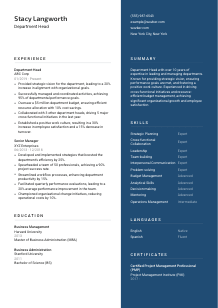
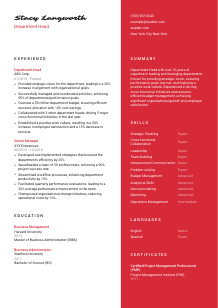
Leading the pack, but your CV feels like an intern? Level up with this Department Head CV example, created with Wozber free CV builder. Learn how to showcase your leadership and strategic skills to match top-tier job expectations, carving a career trajectory as distinguished as your office's morning coffee!
Department Head hiring tends to focus quickly on one question: have you led a function with enough scope to set direction, run operations, and improve results through other people. Titles alone rarely answer that. Your CV needs to show the size of the team, budget, initiatives, and business outcomes you owned, whether that meant lifting department performance, improving cross-functional execution, or building a healthier team culture.
Once that leadership scope is clearly tailored, the CV is easier to prioritise in both human review and ATS screening. Wozber's free CV builder helps you align your wording with the posting, keep an ATS-friendly CV format, and surface the requirements that matter first, so hiring teams can quickly see strategic leadership, operational control, and managerial depth instead of having to infer them.
At Department Head level, the header does not need personality flourishes. It needs to confirm who you are, how to reach you, and whether you meet practical screening requirements before the reader moves into your leadership record.
Use your full name as the most prominent text in the header. Senior leadership CVs are often reviewed quickly between meetings, so clean formatting matters. A clear name line helps your application look organised from the start, which suits a role built around structure, accountability, and oversight.
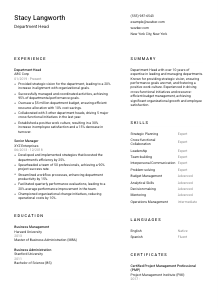
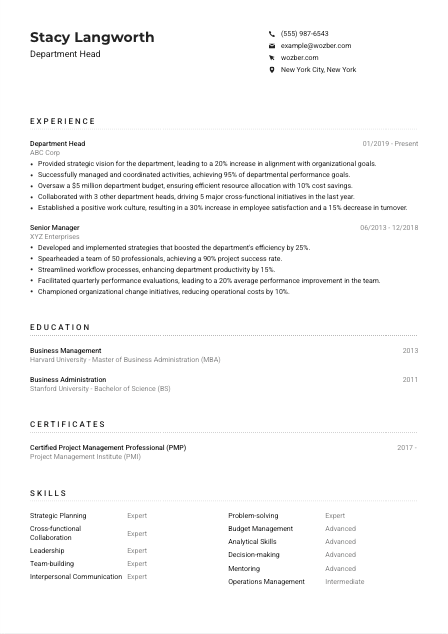
Place "Department Head" under your name if that is the role you are targeting. If your current title differs, the headline can still reflect the position you are pursuing as long as the rest of the CV supports it with relevant management scope. The sample does this cleanly and immediately frames the CV around departmental leadership.
Include a reliable phone number, a professional email address, and, if useful, a LinkedIn profile or personal website that reinforces your executive background. For a Department Head role, any linked profile should support the same story your CV tells, such as leadership progression, cross-functional work, and operational results.
If the role specifies location, reflect that in your contact details. Here, New York City, New York is a stated requirement, so listing it removes an avoidable question during early screening. Keep in mind that location is a tailoring choice based on the posting, not a universal rule for every Department Head application.
Do not add age, marital status, photo, or other personal details unless a local hiring norm explicitly calls for them. Department Head CVs are evaluated on leadership record, decision-making range, budget accountability, and team outcomes. Extra personal data only distracts from those points.
This section should remove friction, not create it. If your name, title, contact details, and required location are clear, the reader can move straight to the part that matters most for a Department Head: the scale and quality of your leadership.




For this level of role, experience is where the decision usually gets made. Hiring teams want to see that you have led a department or a comparable function, managed people and resources, worked across leadership groups, and delivered outcomes that show sound judgment under operational pressure.
Start by marking the non-negotiables in the job description, then make sure your work history answers them directly. In this case, the posting asks for 7+ years in the field and at least 3 years in leadership or management, along with strategic direction, budget oversight, cross-functional collaboration, and staff development. Those themes should appear clearly in your job titles, dates, and bullet points.
List roles in reverse chronological order and make the movement toward broader leadership easy to follow. For a Department Head CV, progression from manager to senior manager to department lead carries weight because it shows increasing responsibility for people, operations, and decision-making. The sample demonstrates that well by moving from Senior Manager into a Department Head role.
Department Heads are hired to improve how a function performs, not simply to oversee activity. Your bullets should therefore show what changed under your leadership. Good examples include raising goal attainment, improving process efficiency, reducing turnover, strengthening alignment with company priorities, or delivering major cross-functional initiatives. The sample's bullet about a 20% increase in alignment with organizational goals is strong because it links strategy to a measurable result.
Quantification matters more at senior level because it gives scale to your decisions. Include team size, budget size, savings delivered, performance rates, retention gains, project volume, or operational improvements where they are real. A line such as managing a $5 million budget with 10% cost savings tells more than vague claims about resource efficiency, because it shows financial oversight and outcome together.
Review every accomplishment and ask which requirement it supports. One bullet might prove strategic planning, another budget control, another mentoring, and another collaboration with senior leaders. That balance matters for Department Head roles because the job combines vision with execution. If a bullet does not help prove leadership range or departmental impact, cut it and use the space for something sharper.
After reading your experience section, a hiring team should be able to answer practical questions without guessing: what you led, how large the operation was, what results improved, and how you worked with other leaders. That is the standard this section needs to meet.
Education matters here because the posting names a bachelor's degree as required and a master's degree as preferred. For a Department Head, this section usually supports your candidacy rather than carrying it, so clarity and relevance matter more than detail for its own sake.
List the degree or degrees that satisfy the posting as directly as possible. If the job asks for a bachelor's degree in a relevant field and prefers a master's, include both in a straightforward format. The example does that effectively with a BS in Business Administration followed by an MBA, which aligns well with a leadership-focused role.
Include school name, degree, field of study, and graduation year or date format consistent with the rest of the CV. Hiring teams do not need a long academic narrative for a Department Head unless your education is unusually specialised or central to the role. They need to confirm that the educational benchmark is met quickly.
Where possible, present your degree in a way that clearly connects to the posting. Relevant fields may include business, operations, finance, engineering, healthcare administration, education, or another discipline tied to the department you lead. Matching that language helps the CV read as intentionally tailored rather than broadly recycled.
Senior candidates usually do not need coursework or extracurriculars unless those details reinforce industry relevance, leadership, or technical domain depth. If you are applying to lead a specialised department, a thesis, honors distinction, or research focus may be worth including. Otherwise, keep attention on your operational and managerial record.
Professional development can sit here or in certifications if it is recent and relevant. Executive programs, finance training, leadership development, or industry-specific coursework can help show that your approach stays current. For Department Heads, that matters when the role involves evolving regulation, changing operating models, or large-scale team development.
This section should answer the education requirement cleanly and then get out of the way. For most Department Head applications, your strongest case still comes from leadership scope, business results, and the way you have managed people and resources.
Certifications carry different weight depending on the department. In some functions they are essential, in others they are a useful supplement. Either way, they should support the kind of operational judgment, technical grounding, or professional discipline the role calls for.
Start with certifications that connect directly to the department's work or to the way the function is managed. The posting says certification is applicable if relevant to the field, which means you should tailor this section to the actual department, not add generic credentials for volume. In the example, PMP works because it supports structured execution, planning, and oversight.
For Department Head roles, the most useful certifications often relate to project delivery, operations, finance, compliance, quality, or the technical discipline of the department itself. Choose credentials that reinforce how you lead the function, allocate resources, and maintain standards, not just ones that sound impressive.
Include issue and renewal dates when relevant, especially for certifications that expire or require ongoing maintenance. Current status matters because it shows continued engagement with professional standards. That is particularly helpful when the department works in a regulated or process-heavy environment.
This section can also show that you invest in staying effective as a leader. If you have completed recent learning in strategy execution, change management, coaching, or industry regulation, include it when it adds substance. Department Heads are often expected to guide teams through change, so current development has practical value.
A focused certification section can strengthen your application by showing recognized expertise and ongoing development. Keep it relevant to the department, the management responsibilities, and the standards the role is expected to uphold.
For a Department Head, the skills section should read like a concise operating profile. It needs to show how you lead a function, make decisions, manage resources, and work across teams, while staying close to the language the employer uses in the posting.
Read beyond the explicit skills list and pull out the capabilities embedded in the work itself. This posting names analytical thinking, problem-solving, decision-making, communication, and team-building, and the responsibilities add strategic direction, budget oversight, and cross-functional coordination. Your skills section should reflect that full leadership mix.
Lead with the capabilities that matter most for running a department, such as strategic planning, leadership, budget management, operations management, cross-functional collaboration, and staff development. The sample gets this mostly right by foregrounding strategic planning, collaboration, leadership, and team-building before more secondary skills.
A Department Head is expected to set direction and run the machine. That means your list should not lean only on interpersonal strengths or only on operational mechanics. Include a combination of strategy, financial oversight, decision-making, communication, mentoring, and execution-related skills so the section reflects the full scope of the role.
Every skill listed here should be supported somewhere else in the CV, ideally through results in your experience section. When the wording matches the posting and the examples back it up, the skills section strengthens both ATS alignment and executive credibility.
Language usually plays a supporting role on a Department Head CV, but it can matter quickly when the posting names a communication requirement or the organisation works across diverse teams, regions, or client groups. Keep this section straightforward and honest.
If the posting specifies a working language, list it clearly. Here, English for professional interactions is required, so English should appear first with an accurate proficiency level. That removes ambiguity around a basic operating requirement for leading meetings, handling senior discussions, and communicating direction to staff.
Start with the language most important to the role, then add others that may support team leadership, stakeholder communication, or broader organizational reach. Additional languages are useful when they help you manage multicultural teams or support external partnerships, but they should not crowd out more important leadership content.
A second language can strengthen your profile when it helps with employee relations, regional coordination, or customer-facing leadership. In the sample, Spanish adds breadth without distracting from the core requirement. Present extra languages as useful business capabilities, not decorative additions.
Use clear levels such as Native, Fluent, Advanced, or Conversational, and avoid overstating your ability. For a Department Head, language claims can be tested quickly in interviews or stakeholder interactions, so accuracy matters.
If a language has practical value for the role, make that benefit easy to infer. For example, it may support team communication, vendor relationships, or cross-border coordination. Keep that implication grounded in business use, since Department Head roles are evaluated on communication effectiveness, not on language learning alone.
This section works best when it answers the posting directly and adds only language skills that have practical value in the workplace. Clear, accurate language information supports the broader picture of you as a leader who can communicate effectively across teams and stakeholders.
The summary sits at the top of the CV, but for a Department Head it should be written after the rest is done. That makes it easier to pull in the right themes from your actual record, such as departmental scope, strategic leadership, budget responsibility, and the results you have delivered through teams.
Start with the specific mix the employer is hiring for. In this case, that means years of experience, leadership tenure, strategic direction, operational coordination, budget oversight, collaboration with senior peers, and staff development. Use those themes to decide what belongs in the opening lines.
Open with a direct description of who you are professionally, including seniority and field depth. A line such as "Department Head with 10+ years of experience leading departmental strategy, operations, and team performance" immediately tells the reader the level you operate at. The sample summary does this well by establishing both tenure and leadership focus.
Add a few specifics that show how you lead, not just what traits you claim. Strong proof points might include budget ownership, performance improvement, cross-functional initiatives, cost savings, employee satisfaction gains, or process efficiency gains. This keeps the summary grounded in outcomes rather than generic executive language.
Aim for a short paragraph that can be read in seconds and still give a clear picture of your leadership value. Avoid stuffing in every skill or repeating bullets from the experience section. The summary should sharpen the reader's focus on the parts of your background that make sense for this Department Head opening.
A well-built summary gives the reader a fast, accurate read on your level, your operating range, and the results you tend to produce. For a Department Head application, that means strategic leadership backed by measurable operational performance.
A Department Head CV should leave little room for guesswork. It needs to show that you can set direction, manage resources, work across leadership teams, and improve departmental performance through sound decisions and strong people management.
Use Wozber's free CV builder and ATS CV scanner to align your content with the posting, surface missing requirements, and present everything in an ATS-compliant CV that keeps the focus on your leadership scope. When that is done well, the hiring team can quickly judge whether you are ready to lead the function from day one.