



Use Wozber and land your dream job
Create CV
No registration required
Leading squads, but your CV feels disjointed? Rally around this Team Manager CV example, created with Wozber free CV builder. Learn how to spotlight your leadership and collaboration for the role, orchestrating a career path that always hits the mark!
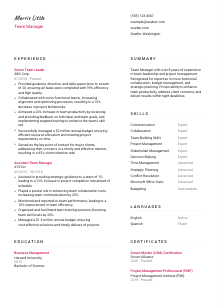
Team Manager hiring often comes down to one practical question: can you keep people productive while deadlines tighten, priorities shift, and stakeholders still expect consistent delivery. A CV for this role needs to make your management range visible quickly, especially how you direct day-to-day execution, remove blockers, coach performance, and keep quality steady across multiple projects.
When that story is tailored well, the reader can separate general supervisory experience from real team management experience within seconds. Wozber's free CV builder helps you shape that into an ATS-compliant CV by aligning your language with the job description and keeping the structure clean, so your CV surfaces the leadership scope, operating rhythm, and results a hiring team needs to see first.
For Team Manager roles, the header does more than identify you. It confirms basic hiring logistics and signals that you are already presenting yourself in the same lane as the opening. Keep it clean, professional, and aligned with the role you are targeting.
Your name should be the clearest text on the CV, easy to scan at the top without decorative formatting. Team Managers are expected to bring order and clarity, so even simple choices like readable typography and clean spacing reinforce that you communicate professionally.
Place "Team Manager" directly under your name when that is the role you are applying for. Matching the posted title helps the CV land correctly in both ATS filters and quick human review, especially when employers are sorting between adjacent profiles like team lead, supervisor, operations manager, or project manager.
Include a phone number you actually answer and a professional email address based on your name. Accuracy matters here. A missed digit or outdated email can stop the process before anyone reaches your leadership experience, budget oversight, or stakeholder work.
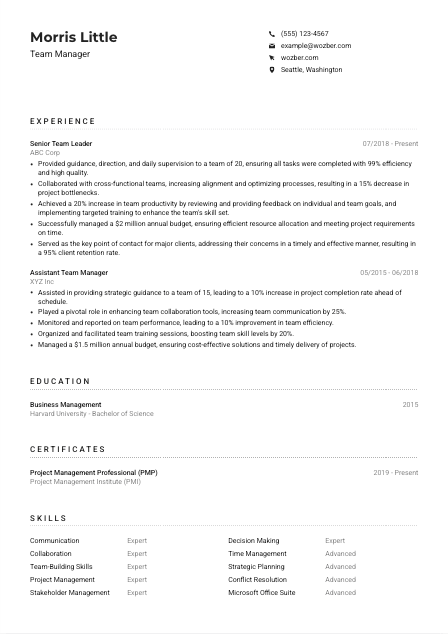
Some Team Manager openings include a location requirement because the work involves in-person supervision, stakeholder meetings, or coordination with local teams. In this example, Seattle, Washington is explicitly requested, so listing "Seattle, Washington" in your header removes avoidable doubt about availability.
A current LinkedIn profile can strengthen your application when it reflects the same management scope shown on your CV, such as team size, cross-functional leadership, delivery results, or client-facing responsibilities. Add a personal website only if it adds useful context, such as leadership projects, operational results, or speaking and training work.
Your personal details should answer the practical basics fast: who you are, what role you are targeting, how to reach you, and whether you meet any stated location requirement. Once those questions are settled, the rest of the CV can stay focused on how you run teams and deliver results.




This is the section most hiring managers read first for a Team Manager CV. They are looking for evidence that you have led people, coordinated work across functions, managed competing deadlines, and improved performance through clear direction, feedback, and resource decisions.
Before you write or revise bullets, mark the responsibilities that define success in the role. For a Team Manager, that often includes daily supervision, cross-functional coordination, performance management, stakeholder communication, training, and resource or budget oversight. Those themes should shape the language of your bullets more than generic management phrases.
List positions in reverse chronological order with title, employer, and dates. Keep the progression easy to follow so the reader can see how your leadership scope has grown, whether that means moving from assistant manager to team manager, taking on a larger team, or adding budget and client responsibility.
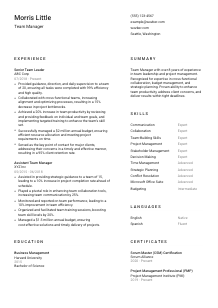
Each bullet should show what you led, what you changed, and what improved. The sample CV handles this well by linking team supervision to 99% task efficiency, process alignment to a 15% drop in bottlenecks, and stakeholder communication to 95% client retention. That is far stronger than writing "responsible for managing team operations" without any proof of execution.
Quantify impact with measures that make sense for leadership work: team size, productivity gains, on-time delivery, budget handled, retention, efficiency, training improvement, or reduction in delays. For example, managing a $2 million annual budget or improving team productivity by 20% tells the reader how much operational responsibility you actually carried.
Prioritise work that shows supervision, coaching, planning, decision-making, client handling, or cross-team delivery. Earlier roles can stay if they build the story toward management, but unrelated jobs should not take space away from stronger examples of leading people, handling deadlines, and improving team output.
Your experience section should make it easy to picture you running the team behind the job posting. If your bullets show scope, decisions, collaboration, and measurable outcomes, the reader can quickly see that you have managed work, people, and expectations at the level the role requires.
Education usually will not outweigh management experience at this level, but it still matters because many Team Manager openings set a baseline degree requirement. Present it clearly so the reader can confirm that requirement without hunting for it.
Check whether the employer asks for a specific level or field of study. Here, a bachelor's degree in Business, Management, or a related field is requested, so an entry such as "Bachelor of Science in Business Management" directly supports the application and mirrors the hiring language closely.
List your degree, field of study, school, and graduation year or date. That is usually enough for a Team Manager CV. A compact format works well because the reader mainly wants to confirm that you meet the educational baseline and can then move back to your leadership history.
If your degree closely matches the role, do not bury that detail. A management, business, operations, or related field strengthens the connection between your academic background and responsibilities like budgeting, planning, team oversight, or process improvement.
Relevant courses can help if you are early in your management career or if the coursework supports the role in a concrete way, such as organizational behaviour, operations management, finance, or project management. For more experienced candidates, this is usually less important than your team results and leadership scope.
Honors, leadership programs, team projects, or student organisation roles can stay when they show early experience with coordination, communication, or accountability. If they do not add anything to your case as a manager, leave them out and keep the section focused.
For most Team Manager applications, the education section should quietly do its job: confirm the required degree and support the professional story already established in your experience. Clear, relevant, and brief is the right standard here.
Certifications are not mandatory for every Team Manager role, but they can add weight when the work involves project delivery, process leadership, or structured ways of running teams. Include them when they clarify how you manage work, not simply to lengthen the CV.
If the job description mentions credentials such as PMP or Certified ScrumMaster, move those to the top of the section. In the provided example, both certifications are listed, which helps reinforce experience with project planning, delivery discipline, and team coordination methods that many management roles value.
Focus on certifications tied to the actual work. For Team Manager positions, that may include project management, agile delivery, people leadership, operations, service management, or industry-specific compliance training. Relevance matters more than volume.
Include the full certification name, issuing organisation, and date or active status when useful. This makes it easy for hiring teams to recognize current qualifications and understand whether the credential is active, recent, or part of your longer-term development.
A well-chosen certification can support the story told in your experience section. PMP can reinforce your ability to manage timelines, scope, and resources. Scrum Master can support experience leading iterative work, team ceremonies, and cross-functional collaboration. Add credentials that deepen that picture.
Certifications help when they sharpen your profile as someone who can organise work, guide teams, and deliver through a defined operating method. List the credentials that support that story, and keep the section current and easy to read.
A Team Manager skills section should reflect how you lead, communicate, and keep execution moving. It also needs to hold up under ATS screening, which means using the same role language the employer uses where it matches your real experience.
Read the job description for the capabilities tied to day-to-day performance. In this case, communication, collaboration, team-building, handling multiple projects, and delivering under tight deadlines are central. Those are more useful than broad filler terms because they map directly to how the job is performed.
Lead with the abilities that define you as a manager, such as team leadership, performance management, stakeholder communication, project coordination, budgeting, conflict resolution, or process improvement. The sample CV also includes project management and stakeholder management, which strengthens alignment with the posting's focus on deadlines, clients, and cross-functional work.
Do not overload this section with every tool or trait you have ever used. Choose skills that support your experience bullets and summary, then present them in a clean format that works well in an ATS-friendly CV format. A short, relevant list gives a clearer management profile than a long, unfocused inventory.
If your skills section reflects the language of the role and matches what your experience proves, it reinforces your value as a Team Manager instead of repeating generic strengths. Aim for terms that hiring teams actually associate with leading people, work, and stakeholder expectations.
Language ability matters more in management roles than many candidates realize. Team Managers often coach staff, handle escalations, and communicate with clients or internal partners, so language proficiency can affect how employers view your ability to lead clearly and consistently.
If the employer states a required language, list it clearly with your proficiency level. Here, English mastery is explicitly required, so placing English at the top of the section with a level such as "Native" or "Fluent" addresses that requirement directly.
Put the core working language first because it supports the essentials of the role: giving direction, providing feedback, resolving issues, and communicating with stakeholders. That matters more than listing additional languages lower down the section.
Additional languages can help if the organisation works across regions, serves multilingual clients, or manages diverse teams. In the example, Spanish adds breadth, though it is a secondary advantage rather than the main qualification for the role.
Terms such as "Native," "Fluent," "Advanced," or "Intermediate" are easier to read than vague descriptions. Hiring teams need a practical sense of whether you can lead meetings, write updates, and handle sensitive conversations in that language.
Multiple languages are most useful when they support the actual communication demands of the job, such as client relations, team coaching, vendor coordination, or cross-border collaboration. Include them when they strengthen that picture, not just because they are nice to mention.
For a Team Manager, language skills should clarify how effectively you can lead conversations, handle stakeholders, and keep teams aligned. List required languages first, be honest about proficiency, and treat extra languages as added management range.
The summary is where you give the reader a compact view of your management profile before they reach the detailed bullets. For Team Manager roles, that means combining years of leadership experience with the specific outcomes and operating strengths that define how you run a team.
Start with the few requirements that truly shape the role, such as team leadership, cross-functional coordination, deadline management, performance improvement, and stakeholder communication. Those themes should anchor the summary instead of broad claims about being results-driven or people-oriented.
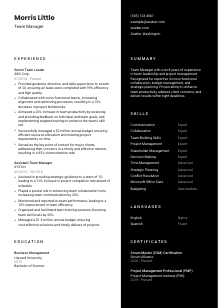
Lead with a direct statement of who you are professionally. The example summary does this well with "Team Manager with over 8 years of experience in team leadership and project management." That immediately places the candidate at the right seniority level for a role asking for 5+ years in leadership or management.
Choose strengths that connect to the actual responsibilities of the role, such as cross-functional collaboration, budget management, coaching teams, process improvement, or client communication. This helps the summary read like a management profile, not a generic introduction.
Aim for three to five lines that set up the experience section rather than repeating it. Mention capabilities you can support with examples later, such as improving productivity, handling tight deadlines, or leading stakeholder communication. The summary should sharpen the reader's focus on your strongest management assets.
A well-written summary gives hiring teams a quick read on your leadership level, operating strengths, and likely fit for the demands of the role. When it is tailored to the posting and supported by the experience section, it creates a clear starting point for the rest of your CV.
A Team Manager CV should leave little doubt about three things: the scale of teams you have led, the results you have delivered, and the way you handle coordination, performance, and stakeholder communication under pressure.
Use Wozber to turn that experience into a well-structured, ATS-friendly CV with sharper alignment to the job description, stronger wording, and cleaner ATS optimisation. The finished CV should make it easy to judge whether you can step in, lead the team well, and keep the work moving.