



Use Wozber and land your dream job
Create CV
No registration required
Leading with authority, but your CV feels like an intern? March into excellence with this Department Manager CV example, created with Wozber free CV builder. Learn how to align your organizational strengths and team-leading prowess with job expectations, ensuring your career rises as the head and shoulders of your department!
Department Managers are hired to keep a function moving toward plan while balancing people, performance, and coordination across the business. CVs for this role need to show how you have translated targets into team execution, tracked performance metrics, corrected drift, and kept daily operations aligned with larger company goals.
A tailored CV changes how quickly that management scope becomes visible. When your wording reflects the posting's language around departmental goals, budgets, staff development, and performance metrics, Wozber's free CV builder helps you shape an ATS-compliant CV that makes your leadership range and operating results easier to recognize at a glance.
This section should confirm that you are reachable, professional, and aligned with any practical requirements attached to the opening. For a Department Manager position, that can include matching the target title and, when requested, showing location clearly so hiring teams do not have to guess about availability.
Use your full name as the header anchor of the CV. Keep it larger than the body text and easy to read. For management roles, a clean presentation matters because it sets the tone for how you handle business communication and documentation.
Place "Department Manager" beneath your name if that is the role you are pursuing. This creates an immediate connection between your background and the opening, especially when your recent experience already includes departmental leadership or assistant manager progression.
List a phone number you answer, a professional email address, and only links that support your candidacy. Double-check for errors. A leadership candidate who misses a digit or uses an outdated email address creates avoidable friction before the first conversation even starts.
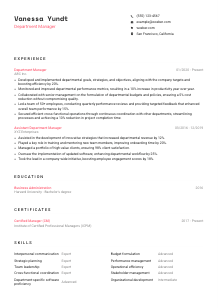
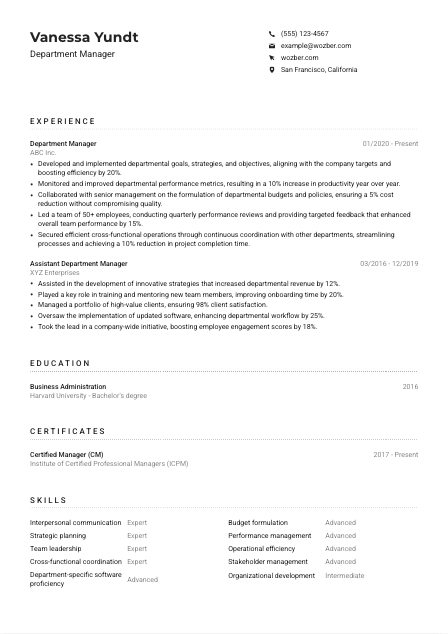
If the employer requires candidates to be based in a specific city, include your city and state. In the example, listing San Francisco, California directly supports a stated requirement. Do this when it is relevant to the posting, rather than treating location as a universal priority for every Department Manager CV.
A LinkedIn profile or personal site can help if it reinforces your management background with consistent titles, career progression, recommendations, or project scope. Make sure the content matches your CV, especially around team size, operational results, and leadership responsibilities.
Your personal details should remove logistical questions immediately and present you as an organised management candidate. Keep it clean, accurate, and aligned with the practical requirements of the role.




For Department Manager hiring, experience carries most of the decision weight. This is where employers look for operational ownership, team leadership, measurable improvement, and evidence that you can turn strategy into day-to-day execution across people, process, and budget.
Read the job description closely and identify the work themes that should shape your bullets. Here, the priorities are setting departmental goals, monitoring metrics, coordinating cross-functionally, leading staff, and working with senior management on budgets and policies. Those themes should appear in your experience section in language that matches your actual work.
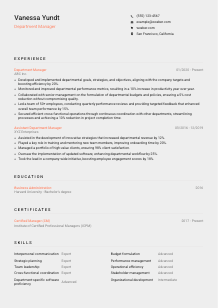
List roles in reverse chronological order with job title, employer, and dates. For management careers, progression matters. Moving from Assistant Department Manager to Department Manager, as shown in the example, quickly tells the reader that your scope and responsibility have grown over time.
Each bullet should show what you owned, what action you took, and what changed because of it. The sample does this well with points like developing departmental goals that improved efficiency by 20% and leading a team of 50+ employees through performance reviews and feedback. Those are the kinds of details that show management range, not just participation.
Department Managers are often measured through productivity, efficiency, budget control, turnaround time, team performance, service quality, or revenue contribution. Use percentages, team size, cost reductions, or time savings where you have them. A 10% productivity increase or 5% cost reduction tells more than a vague claim about improving operations.
Prioritise experience that reflects planning, accountability, staff supervision, process improvement, reporting, and cross-functional execution. If an older bullet focuses on routine tasks without showing leadership, decision-making, or results, trim or rewrite it. This section should leave no doubt that you can run a department, not just contribute within one.
Your experience section should show a manager who can set direction, track performance, coach people, and keep operations on target. When the bullets mirror real departmental outcomes, your leadership becomes much easier to trust.
Education usually plays a supporting role for experienced Department Managers, but it still matters when the posting names a degree requirement. Present it clearly so the reader can confirm your academic background without hunting for it.
If the posting asks for a bachelor's degree in Business Administration, Management, or a related field, place the strongest relevant degree first. The example's Bachelor's degree in Business Administration is a direct match, which helps close that question immediately.
Include degree, field of study, school, and graduation year. Keep the layout plain and consistent with the rest of the CV. This section is mainly about quick confirmation, not elaborate storytelling.
Do not bury a relevant major inside dense formatting. If your degree aligns with management, operations, business, or a related discipline, state it clearly. That matters more than decorative wording and helps both ATS parsing and human review.
If you are early in your leadership career, relevant coursework in management, finance, operations, or organizational behaviour can add context. If you already have several years of management experience, keep the focus tighter unless an academic honor or distinction adds meaningful value.
If you have completed leadership programs, workshops, or management training outside your degree, decide whether they belong under education or certificates based on how substantial they are. The key is to show continued growth in areas such as supervision, budgeting, change management, or operational planning.
For this role, education should quickly show that you meet the stated academic baseline and have a foundation relevant to managing people and departmental performance.
Certifications are rarely the first thing that gets a Department Manager hired, but the right one can strengthen your case, especially when it reflects leadership practice, operational discipline, or people management. Include certificates that add substance, not filler.
Some openings name certifications directly, while others imply them through responsibilities around supervision, process improvement, or management systems. Even when none are required, a credential tied to leadership or operations can support your profile. The Certified Manager credential in the example is one such addition.
Prioritise certifications that connect to management work, such as leadership, project oversight, operations, quality improvement, or workforce development. A short list of relevant credentials reads better than a long list of unrelated courses.
If a certification is active, recently earned, or renewed, include the date or date range. That helps show current professional development and can matter when the credential reflects up-to-date management practices or systems knowledge.
Look for development opportunities that strengthen budgeting, coaching, process improvement, analytics, or change leadership. Department Managers often need to improve output through both people leadership and operational control, so choose certifications that support those demands.
Use certifications to reinforce the parts of your management profile that matter most for the opening. They should add credible depth around leadership, operations, or continuous improvement.
The skills section should read like a concise map of how you manage a department. Hiring teams look for a mix of leadership capability, operational control, communication strength, and enough systems fluency to run reporting, workflows, and performance tracking without slowing the team down.
Pull skill terms from the posting and use the ones you can genuinely support. In this case, strategic planning, departmental performance management, cross-functional coordination, communication, and software proficiency are all fair targets because they tie directly to the role's responsibilities.
Do not list only soft skills. Department Managers are expected to coach staff and work across teams, but also to manage metrics, budgets, systems, and workflow efficiency. The example balances both sides with items like team leadership, budget formulation, performance management, and department-specific software proficiency.
Put the most role-defining skills first. For many Department Manager positions, that means leadership, strategic planning, performance oversight, stakeholder communication, and cross-functional coordination near the top. Keep the list focused enough that every item supports your candidacy.
Your skills should show that you can lead people, manage operations, and work through the systems and reporting that keep a department performing well.
Language skills matter most when the job posting names a required language or when the department works across diverse teams, customers, or regions. Present this section plainly so communication capability is easy to read and easy to trust.
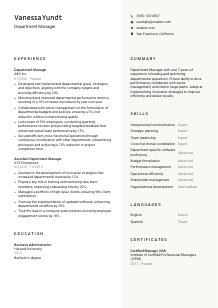
When a posting specifies English proficiency, list English prominently with an honest level such as Native or Fluent. In the example, placing English first directly addresses a stated requirement and avoids any ambiguity about communication readiness.
Additional languages can strengthen your profile when they help with team supervision, customer interaction, or collaboration across locations. Spanish, for example, may be useful in some workforces or markets, but it should remain a supporting advantage rather than the centerpiece unless the role specifically requires it.
Stick to standard levels such as Native, Fluent, Intermediate, or Basic. That makes your language capability easier to interpret in interviews and helps prevent overstatement.
If the role involves multilingual staff, vendor relationships, or international coordination, language skills can become more valuable. When that applies, order the languages with that business context in mind.
List languages that you can actually use in a professional setting. For management roles, credibility matters. A short, accurate language section is better than an inflated one that creates doubt later.
For Department Manager roles, language details should confirm that you can communicate clearly in the required business environment and add range where that range is genuinely useful.
Your summary should give a fast read on the scale and style of your leadership. For a Department Manager, that usually means years of management experience, the kinds of teams or functions you have led, and the operational results you are known for delivering.
Build the summary around the work this role is accountable for: setting goals, improving departmental performance, developing staff, and coordinating with senior leadership and adjacent teams. Keep the language close to the function you manage rather than relying on broad claims about being results-driven.
Your first sentence should establish who you are professionally. A line such as "Department Manager with 7+ years of experience leading departmental operations and team performance" is clear, credible, and immediately relevant to the role.
Use the next lines to mention the capabilities that matter most for the target opening. The example summary works because it points to optimising operations, collaborating with senior management, mentoring large teams, and improving efficiency. If you have strong metrics, you can hint at them here without turning the summary into a list of bullet points.
Aim for a short paragraph that can be scanned in seconds. Focus on leadership scope, business impact, and functional relevance. If Wozber's AI CV builder helps you refine the phrasing, use it to align your summary with the posting's language while keeping every claim grounded in your actual experience.
By the time someone finishes your summary, they should already understand your management level, your operating strengths, and the kind of department results you can deliver.
A Department Manager CV should make your leadership visible through goals set, metrics improved, teams developed, and operations kept on track. When each section supports that story, hiring teams can quickly see whether you have the judgment and execution range the role requires.
Use Wozber to tighten the language, strengthen ATS optimisation, and build an ATS-friendly CV format that keeps your management experience easy to read. The final version should make one thing clear fast: you can lead a department with structure, accountability, and measurable results.




