



Use Wozber and land your dream job
Create CV
No registration required
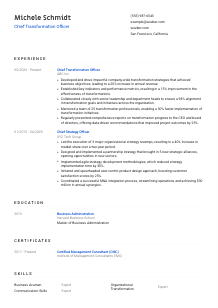
Reinventing organizations, but your CV feels stuck in the status quo? Check out this Chief Transformation Officer CV example, created with Wozber free CV builder. Learn how to show your visionary shift-making in line with job needs, ensuring your career narrative evolves as dynamically as the companies you reshape!
Transformation leadership gets judged by outcomes that cut across the whole business. Boards and CEOs want someone who can move strategy into execution, align resistant functions, and show that change is improving growth, operating performance, and decision-making. Your CV needs to make that scale visible quickly, with clear examples of enterprise initiatives, leadership influence, and measurable results.
For this kind of executive search, vague change-management language falls flat. Hiring teams look for proof that you can set transformation priorities, define KPIs, and report progress in a way senior leadership can trust. Wozber's free CV builder helps you shape that story into an ATS-compliant CV, using the right business and transformation language so the first read points to board-level leadership rather than general operations experience.
At the Chief Transformation Officer level, the header needs to do one job well. It should confirm who you are, what role you are targeting, and whether basic logistics line up before anyone gets into strategy, transformation programs, or board reporting.
Use your full name prominently at the top in a clean, professional style. For a senior leadership CV, visual clarity matters more than design flourishes. The page should immediately read like an executive document, not a creative portfolio.
Place "Chief Transformation Officer" directly under your name when that is the role you are pursuing. Matching the target title helps with ATS alignment and immediately frames your background around enterprise transformation, strategic execution, and organizational change.
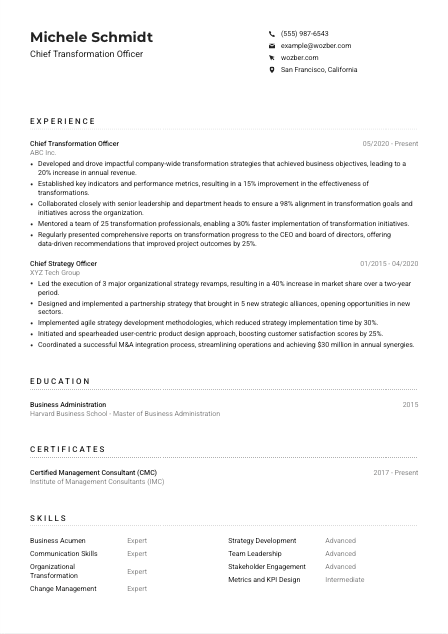
If the job specifies location, include your city and state. Here, San Francisco, California is directly relevant because the posting requires the candidate to be located there. When a role has an on-site or market-specific leadership expectation, this removes an early point of uncertainty.
Include LinkedIn or a personal site if it supports your executive narrative with board presentations, transformation case studies, speaking engagements, or thought leadership. Make sure the content matches your CV. If your CV says you led company-wide transformation programs, your online profile should reflect the same scope and chronology.
This section should confirm executive presence, role focus, and basic eligibility in seconds. Once that is settled, the reader can move straight to the transformation record that matters most.




For a Chief Transformation Officer, experience is the core of the CV. Hiring teams want to see how you shaped strategy, drove adoption across functions, measured progress, and adjusted course when transformation initiatives hit resistance or missed targets.
Read the posting for the business problems behind the wording. In this case, the recurring themes are company-wide transformation strategy, KPI design, cross-functional alignment, team leadership, and regular reporting to the CEO and board. Those themes should guide which accomplishments you feature and how you phrase them.
List roles in reverse chronological order with company, title, and dates. At the executive level, reviewers are looking for progression in scope. They want to see whether you have moved from strategy leadership or operational transformation roles into enterprise-wide ownership.
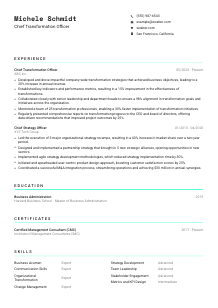
Each bullet should show what you led, how you did it, and what changed because of it. Prioritise transformation initiatives, operating model redesigns, digital modernization, integration work, or cross-functional change programs over generic executive duties. The sample CV handles this well by tying strategy design to outcomes like revenue growth, alignment across departments, and faster implementation.
Numbers matter here because transformation is tracked through business outcomes and execution metrics. Revenue growth, implementation speed, market share, synergy capture, KPI improvement, stakeholder alignment, and program adoption all make sense in this field. Results like a 20% increase in annual revenue or 30% faster implementation are stronger than broad claims about having "driven change."
Be selective. A Chief Transformation Officer CV should emphasize enterprise change, strategic planning, governance, team leadership, and measurable business impact. If an older bullet does not show scale, influence, or transformation relevance, trim it or rewrite it so the connection is clear.
Your experience section should make one thing easy to grasp. When you led transformation, the business moved in a measurable way. That is the standard executive hiring teams are looking for.
Education carries a different weight at the executive level. It will not replace a weak transformation track record, but it does reinforce business grounding, strategic training, and readiness for a role that works closely with senior leadership and the board.
Check the posting for required and preferred education, then mirror that structure. Here, a bachelor's degree in Business, Management, or a related field is required, and an MBA is preferred. If you have both, make sure the MBA is easy to spot.
List degree, field of study, school, and graduation year. Keep the format simple. Executive CVs benefit from clean structure because the reader is scanning for qualification match, not academic storytelling.
Degrees tied to business administration, management, strategy, operations, or technology transformation deserve prominence because they support the strategic and commercial demands of the role. In the example, both the MBA and business-focused bachelor's degree align neatly with what the employer asked for.
Most senior candidates can keep this section brief. Add honors, executive programs, or especially relevant coursework only when they support your transformation profile, such as digital strategy, organizational design, finance, or innovation leadership.
If you have completed executive education, transformation workshops, or strategy programs that sharpen your credentials, include them if they add real value. Keep the emphasis on learning that supports enterprise change leadership, not one-off training with little relevance to the target role.
This section should confirm that your academic background matches the business and leadership expectations of the role. Clear, relevant credentials are enough. Your transformation record remains the main proof.
Certifications are optional for many Chief Transformation Officer roles, so they need to earn their space. The right credential can reinforce expertise in consulting, change leadership, transformation delivery, or strategic execution. The wrong one just adds noise.
Focus on credentials that connect to organizational change, strategy, operating model design, innovation, consulting, or enterprise delivery. A certification such as Certified Management Consultant works because it supports advisory credibility and structured problem solving, both of which are useful in transformation leadership.
Do not overload the section with every course completion badge you have collected. One to three well-chosen certifications tied to transformation, change, digital strategy, or executive leadership will carry more weight than a long miscellaneous list.
Show the year earned and, if applicable, the active date range. This helps the reader understand whether the credential is current and whether you have maintained it over time.
Transformation leaders are expected to understand shifts in technology, business models, and operating practices. If you pursue current learning in areas such as digital transformation, AI adoption, enterprise agility, or change governance, include it when it supports the kind of transformation work you target.
A focused certificates section tells the reader that your development has kept pace with how transformation work is actually done. That matters most when the credentials back up your executive scope and decision-making range.
A Chief Transformation Officer is hired for more than vision. The skills section should show that you can shape strategy, run transformation programs, influence senior stakeholders, and build the operating discipline needed to deliver results across the business.
Start with the posting, then refine the list around the work itself. For this role, that includes business acumen, organizational transformation, change management, stakeholder engagement, communication, KPI design, and team leadership. If emerging technology knowledge is part of the brief, reflect that where it is genuinely part of your background.
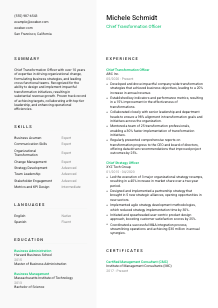
Lead with the capabilities most closely tied to the executive mandate. Strategy development, transformation leadership, cross-functional influence, and metrics design should appear before broader or less critical skills. The sample list does this effectively by foregrounding business acumen and transformation-related strengths.
Keep the section focused on the capabilities that support enterprise transformation. A shorter list with high relevance reads better than a crowded inventory of generic leadership terms. Every skill should connect to the kind of initiatives, governance, and outcomes you describe in your experience section.
This list should reinforce the impression that you can design change, lead adoption, and measure results at scale. If the skills feel generic, the section is not doing enough work.
Language ability is rarely the centerpiece of a Chief Transformation Officer application, but it can matter when the role involves board communication, international stakeholders, or transformation programs across multiple regions. Present it clearly and keep the emphasis practical.
If the posting specifies a language requirement, list it first and label it accurately. Here, strong command of English is required, so English should appear prominently with a proficiency level such as Native or Fluent.
After the required language, list additional languages that support stakeholder communication, regional leadership, or multicultural team management. For some transformation roles, a second language can be useful when initiatives span multiple markets or business units.
Choose clear terms such as Native, Fluent, Intermediate, or Basic. Avoid inflated descriptions. Executive roles involve high-stakes communication, so honesty here matters.
If your target roles involve global operations, post-merger integration, or regional transformation programs, language skills can add useful context. Include them when they genuinely support the scope of the work rather than simply filling space on the page.
Extra languages can strengthen your profile, especially if you have led change across diverse teams. In the example, Spanish adds breadth, but the main hiring priority remains executive transformation leadership and strong English communication.
List languages when they add real context to your leadership range. For this role, the key point is clear executive communication in English, with any additional language skills serving as a bonus.
The summary has to establish executive scope quickly. For a Chief Transformation Officer, that means showing years of transformation leadership, the scale of the business problems you have handled, and the kinds of outcomes you have delivered through strategy, execution, and stakeholder alignment.
Use the job description to identify the few themes your opening lines must cover. Here, the essentials are 10+ years of transformation leadership, successful enterprise initiatives, strategic and business acumen, and the ability to work across senior leadership teams.
Start with a direct description of who you are professionally. Phrases such as "Chief Transformation Officer with 10+ years leading organizational and digital transformation" work well because they establish scope immediately and align with the employer's language.
Follow the opening with a compact record of results. Mention outcomes that belong to transformation work, such as revenue growth, faster implementation, stronger KPI performance, operating efficiencies, or successful alignment across functions. The sample summary points in the right direction by tying transformation leadership to growth and operational improvement.
Aim for a concise paragraph, not a mini-biography. Four to six lines is usually enough to establish your transformation scope, leadership style, and measurable impact. Every sentence should earn its place by clarifying the level of change you can lead.
A well-built summary tells the reader, before they scan the rest of the page, that you have already led the kind of transformation this organisation needs. That is the benchmark.
A Chief Transformation Officer CV should leave no doubt about three things: the scale of change you have led, the business results you delivered, and the senior stakeholders who trusted you to steer it. When those points are clear, the rest of the application becomes much easier to evaluate.
Use Wozber's free CV builder to shape that story into an ATS-friendly CV format with language that matches the role, and use its ATS CV scanner to refine keywords, leadership terminology, and section-level alignment. The final document should make it easy to see that you can lead transformation from strategy through board-level reporting.




