



Use Wozber and land your dream job
Create CV
No registration required
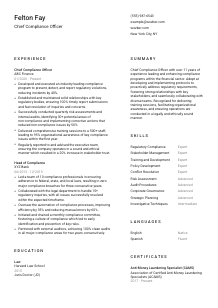
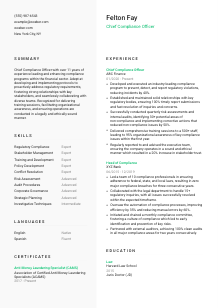
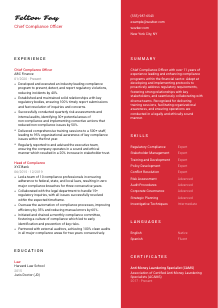
Upholding standards, but your CV feels non-compliant? Check out this Chief Compliance Officer CV example, created with Wozber free CV builder. Learn how to showcase your regulatory chops in line with job requirements, charting a career trajectory that's as lawful as it is impressive!
Chief Compliance Officer hiring turns quickly on whether your CV shows enterprise-level judgment. Boards and executive teams expect someone who can build a defensible compliance program, surface risk before it becomes a regulatory event, and keep the organisation operating within legal and ethical boundaries. Your CV should make that scope visible early through governance work, audit leadership, regulatory relationships, and the business outcomes tied to your decisions.
When compliance CVs stay generic, they blur together with broader legal, audit, or operations profiles. A tailored CV clarifies that you have led policy, monitoring, investigations, training, and executive reporting in a regulated environment. Wozber's free CV builder helps structure that experience into an ATS-compliant CV, so core terms such as risk assessment, internal audits, regulatory reporting, and compliance program management are easy to read by both screening systems and the people deciding who can own the function.
For a Chief Compliance Officer, the header should read like a clean executive document. Keep it accurate, professional, and easy to verify so nothing distracts from your regulatory and leadership credentials.
Use your full name in a larger font than the rest of the header. Senior compliance roles deal in credibility, board exposure, and regulatory accountability, so your CV should open with the same level of polish you would bring to a formal report or committee packet.
Place "Chief Compliance Officer" directly under your name when that is the role you are pursuing. This helps frame your background around enterprise compliance leadership instead of adjacent paths such as legal counsel, internal audit, or risk management.
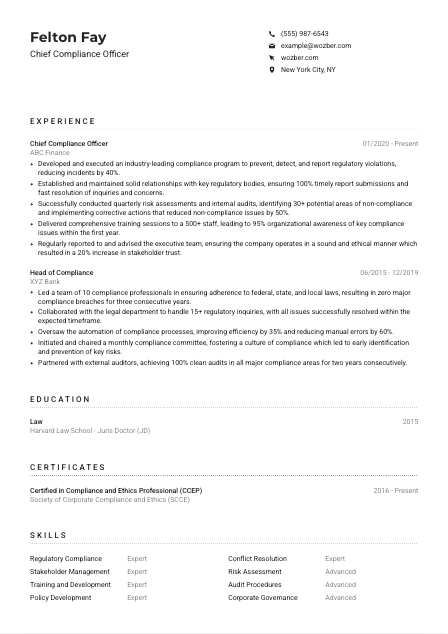
If the employer requires a specific location, include it in the header. In this example, listing New York City, NY immediately addresses a stated requirement and removes doubt about availability for an office-based or market-specific leadership post.
A polished LinkedIn profile or professional website can reinforce your governance background, certifications, speaking work, or committee leadership. Make sure the dates, titles, and major achievements match the CV exactly.
This section should confirm that you present yourself with the same care expected in compliance reporting. Clear title, correct contact details, and any required location information are enough.




This is where a Chief Compliance Officer CV earns its place. Hiring teams look for proof that you have led compliance operations in a regulated setting, influenced executive decisions, and reduced exposure through concrete controls, audits, investigations, and training.
Study the posting and pull out the core operating responsibilities. For this role, that includes developing the compliance program, managing regulatory relationships, leading risk assessments and internal audits, training staff, and advising senior management. Your experience bullets should mirror that operating scope so the reader immediately sees leadership at the right level.
List roles in reverse chronological order with employer, title, and dates clearly shown. For senior compliance candidates, progression matters. A move from Head of Compliance to Chief Compliance Officer, especially in banking, finance, healthcare, or another regulated sector, helps show that your remit expanded from oversight into enterprise ownership.
Each role should open with what changed because of your work. Strong bullets show the result of a policy overhaul, audit cadence, monitoring framework, or regulator engagement. The sample CV does this well with outcomes such as reducing compliance incidents by 40 percent and achieving 100 percent on-time regulatory reporting.
Quantify what you can: breach reduction, audit findings resolved, reports submitted on time, employees trained, clean audit results, turnaround time for regulatory inquiries, or process efficiency gains. Numbers work best when they reflect how compliance performance is actually measured. Training 500+ staff, identifying 30+ non-compliance areas, or reducing manual errors by 60 percent tells a much stronger story than saying you were "responsible for" these activities.
At this level, every line should support your candidacy for enterprise compliance oversight. De-emphasize unrelated operational duties unless they connect to governance, investigations, policy, controls, or risk. Keep the emphasis on the work that proves you can build programs, work with regulators, and advise executives under regulatory pressure.
A hiring team should be able to scan this section and understand the size of the programs you led, the types of risks you managed, and the results you delivered. Make your record read like an executive compliance portfolio, not a general management history.
Education matters in compliance leadership because it helps establish your grounding in law, finance, business, or governance. Present it cleanly, and make the most relevant credentials easy to find.
Start with degrees that match the posting most closely. Here, a bachelor's in Business, Finance, Law, or a related field is required, with an advanced degree preferred. If you have a JD, MBA, master's in compliance, or another relevant graduate qualification, include it prominently because it supports executive-level credibility.
List degree, field of study, institution, and graduation year in a consistent format. Avoid decorative layouts or incomplete entries. Compliance hiring often involves structured screening, so clarity matters as much as substance.
An advanced degree is especially useful when your work includes board reporting, regulatory interpretation, policy design, or cross-functional governance. In the example, the combination of a JD, MBA, and finance degree creates a strong foundation for senior compliance leadership, though not every candidate needs all three to be competitive.
For experienced Chief Compliance Officer candidates, coursework and honors are optional. Include them only if they strengthen your story, such as securities regulation, healthcare law, corporate governance, or academic distinction tied to legal or financial disciplines.
If you have recent executive education, regulatory workshops, or governance programs that add context to your leadership profile, they can complement your formal education. This is particularly useful if your degree is older and your current expertise is reinforced by continued learning.
Keep this section concise, but make sure it supports the regulatory environment you work in and the seniority of the role you want. Relevant degrees and advanced study help frame your judgment before the reader reaches your certifications.
Certifications carry real weight in compliance because they show current standards knowledge and professional commitment. For executive roles, they also help confirm that your expertise stays current as regulations, enforcement priorities, and ethics expectations evolve.
Start with credentials that are directly tied to compliance leadership. This posting specifically calls for CCEP or a related certification, so that credential should appear prominently if you hold it. Other certifications can support sector depth, such as AML, privacy, healthcare compliance, or governance credentials.
Do not turn this into a long list of every course completed. Focus on certifications that strengthen your profile for regulated industries and executive oversight. In the example, CCEP and CAMS work well together because they show broad compliance grounding plus specialised financial crime knowledge.
List the certifying organisation and the year earned or active period. That detail helps show legitimacy and current standing, especially when the credential is a stated hiring preference or requirement.
Compliance is a moving target. Renewed or recently earned credentials suggest that you stay engaged with evolving rules, enforcement expectations, and ethics frameworks. That matters when the role includes advising executives and maintaining regulator relationships.
Used well, this section shows both specialization and currency. Lead with the credentials that support your industry expertise and your ability to run a modern compliance function.
A Chief Compliance Officer skills section should look selective and senior. Focus on the capabilities used to run a compliance program, manage risk, and influence decisions across the business, not on broad corporate buzzwords.
Start with the language used in the job description and then match it to your real experience. For this role, that means compliance program development, regulatory compliance, risk assessment, internal audits, policy development, staff training, stakeholder management, and executive communication. These terms help both ATS screening and human review when they accurately reflect your background.
Prioritise the skills most tied to leading the function. Regulatory knowledge, audit procedures, corporate governance, investigations, and cross-functional stakeholder management usually matter more here than broad administrative strengths. The sample CV is strongest where it centers core compliance skills rather than generic leadership language.
A shorter, better-targeted list is more persuasive than an inventory of everything you can do. Choose skills that support the work of preventing violations, monitoring controls, training the organisation, responding to inquiries, and advising senior management in a regulated environment.
The reader should come away seeing a leader who can design the framework, monitor risk, and influence action when issues surface. Keep the skill list aligned with that level of responsibility.
Language ability matters in compliance when the role involves training, regulator communication, policy interpretation, or cross-border coordination. Present languages honestly and in order of business relevance.
If the employer specifies a required language, place it first. Here, high-level English communication is mandatory, which makes sense for a role involving executive reporting, training, policies, and responses to regulators or auditors.
Use plain levels such as Native, Fluent, Advanced, or Professional Working Proficiency. For a senior compliance role, this matters because vague language claims raise questions when the job depends on precise written and verbal communication.
Additional languages can be valuable when the organisation operates across jurisdictions, serves multilingual populations, or works with international partners. In the example, Spanish adds range, but English remains the business-critical language for this posting.
Do not overstate fluency. Compliance work often involves nuanced discussions around investigations, regulations, training content, and policy interpretation, so language claims need to hold up in real meetings and written communication.
If another language has helped you conduct training, support global compliance reviews, manage regulator interactions, or communicate across regional teams, that context can make the section more meaningful. If not, a simple proficiency listing is enough.
Keep this section straightforward. For most Chief Compliance Officer applications, clear English proficiency is essential, and any additional language should strengthen a real business or regulatory need.
The summary should sound like an executive introduction, not a generic profile paragraph. In a few lines, it needs to establish your compliance scope, industry context, and the results you are known for delivering.
Review the posting and identify the executive version of the job. Here, that means leading a compliance program, managing regulatory obligations, conducting risk assessments, training the organisation, and advising senior leadership. Your summary should reflect those responsibilities in concise language.
A direct opening works best, such as Chief Compliance Officer or senior compliance leader with 10+ years in a regulated industry. If your background is especially strong in finance or healthcare, say so early because sector context matters in compliance hiring. The example summary does this effectively by grounding the profile in more than 11 years in the financial sector.
Choose two or three strengths that map tightly to the role, such as building compliance programs, handling regulatory relationships, leading audits and risk reviews, or driving organisation-wide training. If possible, include one proof point or performance pattern, such as reducing incidents, improving audit outcomes, or strengthening stakeholder trust.
Aim for a compact paragraph of three to five lines. Senior hiring teams should be able to understand your regulatory scope, leadership level, and industry fit before they move into the experience section. Save the deeper metrics for your bullet points.
This paragraph should immediately position you as someone who can own compliance at the enterprise level. If it reads like a general legal, audit, or operations profile, sharpen it until the compliance leadership remit is unmistakable.
A Chief Compliance Officer CV should leave no doubt about your ability to build controls, manage regulatory exposure, guide executive decision-making, and foster an ethical culture. Every section should reinforce that leadership story with the right level of industry context, measurable outcomes, and regulatory language.
Wozber's free CV builder can help you shape that story in an ATS-friendly CV format, while its ATS CV scanner helps you align your wording with the posting's compliance requirements. When the final document is tailored well, hiring teams can quickly see whether you are ready to lead the compliance function from day one.