



Use Wozber and land your dream job
Create CV
No registration required
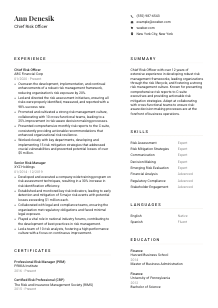
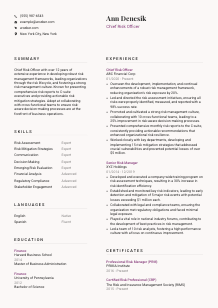
Shielding organizations from uncertainty, but your CV feels like a gambit? Browse through this Chief Risk Officer CV example, created with Wozber free CV builder. Learn how to present your risk-slaying strategies in a way that aligns with firms seeking guardians of stability!

Chief Risk Officer hiring turns on one question fast: have you built risk oversight that changes business decisions, not just written policies about it. At this level, boards and executive teams want to see judgment across enterprise risk, regulatory pressure, mitigation planning, and reporting cadence. Your CV needs to show where you set the framework, how you influenced leaders, and what changed because of your work.
A tailored CV makes that executive scope easier to recognize in both ATS screening and leadership review. Using Wozber's free CV builder helps you align your language with the posting, keep an ATS-friendly CV format, and surface the risk terms, governance work, and business outcomes that matter most first. That way, hiring teams can quickly see whether you've led risk programs at the level the role requires.
For a Chief Risk Officer, the header should read like executive business correspondence. Hiring teams are not looking for personality here. They want clean identification, direct contact details, and any logistical information that affects senior-level consideration.
Use your full name prominently and keep the formatting polished and restrained. At CRO level, the header should feel board-ready, with no decorative extras or crowded styling. The aim is simple: make your identity immediate and professional from the first line.
Place "Chief Risk Officer" directly under your name when that is the role you are pursuing. Matching the posted title helps ATS parsing and tells the reader your background is being positioned for enterprise risk leadership rather than a broader finance or compliance track. In the example CV, this direct title match keeps the positioning clear from the top.
List a reliable phone number and a professional email address, ideally in a standard format such as firstname.lastname@email.com. At executive level, small errors here look careless. Double-check every detail so the company can move quickly if they want to schedule a leadership interview or board-facing presentation discussion.
If a role specifies a city or market, reflect that in your header. Here, New York City is a stated requirement, so showing "New York City, New York" immediately removes a basic screening doubt. Treat that as tailoring to this opening, not as a universal CRO rule for every application.
A LinkedIn profile or professional website can support your candidacy when it reinforces board exposure, speaking engagements, industry participation, or executive career progression. Make sure it matches your CV titles, dates, and scope of responsibility. For risk leaders, consistency across these channels matters because credibility is part of the role itself.
This section only needs to do a few things, but it needs to do them cleanly. Clear contact information, the right title, and any required location detail let the reader move straight to your risk leadership record without distractions.




This is the section where a Chief Risk Officer CV either establishes authority or stays too operational. Employers want to see that you have led enterprise-wide risk work, influenced senior stakeholders, and turned risk analysis into policy, reporting, and mitigation decisions that protected the business.
Start by identifying the risk responsibilities that define the role. In this posting, those include building a risk management framework, leading risk assessment, reporting to the C-suite, and driving risk-aware decision-making across functions. Those themes should shape which bullets you lead with and which parts of your background you emphasize.
List roles in reverse chronological order and make the move into enterprise leadership easy to follow. A CRO CV should show increasing scope, from managing analysts or risk programs to setting organisation-wide frameworks and advising top leadership. The example does this well by moving from Senior Risk Manager into Chief Risk Officer with visible growth in influence and scale.
Numbers matter here because risk work is often abstract unless you anchor it in outcomes. Use metrics tied to the profession, such as reduced risk exposure, prevented losses, successful reporting coverage, major risk events mitigated, or cross-functional adoption of controls. The sample bullets work because they connect framework design to a 20% reduction in risk exposure and mitigation activity to more than $5 million in avoided losses.
Where the job description uses phrases like "identified, measured, monitored, and reported" or asks for mitigation strategies and cross-functional collaboration, reflect those concepts in your own wording when they are true to your experience. This helps ATS optimisation and also reassures a hiring committee that you understand the full risk lifecycle, not just one slice of it.
Prioritise accomplishments that show governance, decision support, regulatory awareness, enterprise controls, and leadership communication. Routine tasks, generic team management, or unrelated operational detail can weaken the story. Keep the focus on the work that shows you can oversee a robust risk framework and guide executives through complex risk situations.
The best experience sections for CRO roles show scale, judgment, and measurable business protection. When your bullets connect risk frameworks to executive decisions and real outcomes, the reader can picture you operating at the level the role demands.
Education is rarely the deciding factor for a senior risk executive, but it still sets baseline credibility. This section should confirm that you meet the formal requirements and, where relevant, show advanced study that supports financial, strategic, or governance leadership.
If the posting calls for a bachelor's degree in Finance, Risk Management, or a related field, make that easy to find. Include the degree, school, field of study, and graduation year in a clean format. In this case, a finance degree aligns directly with the stated requirement.
For executive CVs, clarity beats detail overload. List each degree with institution, credential, field, and year. That structure is enough for most CRO applications and keeps the reader focused on your leadership history rather than forcing them to decode the education section.
When an employer prefers an advanced degree, include it prominently. An MBA or master's in finance, risk, economics, or a related field can strengthen your positioning for board-level communication, strategic planning, and enterprise decision support. The example's MBA in Finance does exactly that.
Most senior risk leaders do not need to list classes. If you are earlier in your leadership path or moving from an adjacent area, relevant coursework in corporate finance, enterprise risk, quantitative analysis, or regulatory policy can help explain your foundation. Otherwise, keep this section lean.
Honors, major research, or leadership roles in relevant academic organizations can be useful when they reinforce your professional direction. For a seasoned CRO, these details should stay brief unless they connect directly to risk, finance, governance, or regulatory expertise.
This section should quickly show that you meet the academic expectations for the role and, if applicable, that you bring advanced business or finance training. After that, let your risk leadership experience carry the weight.
Certifications carry real weight in risk leadership when they reflect recognized frameworks, technical depth, and commitment to staying current. For a Chief Risk Officer, they work best as proof of specialised grounding in risk methodology and professional standards.
If the employer mentions credentials such as CRP or PRM, include them prominently when you hold them. This is one of the clearest ways to align with the stated preference and reinforce that your expertise is rooted in established risk practice, not just job title progression.
Choose certifications tied directly to enterprise risk, financial risk, governance, compliance, or control frameworks. The example lists both CRP and PRM, which immediately support the candidate's positioning for a senior risk leadership role. Put your strongest, most role-relevant credentials first.
Add the year earned and, if relevant, note that the certification is current. Dates help show the maturity and continuity of your professional development. For regulated or fast-changing environments, current credentials also signal that your knowledge has kept pace with evolving standards and emerging risks.
Risk leadership changes with regulation, market conditions, cyber exposure, operational threats, and governance expectations. Keep this section updated with meaningful credentials or continuing education that reflects those shifts. It shows you are still sharpening the frameworks and judgment the role depends on.
Well-chosen certifications tell the reader that your risk leadership is backed by recognized standards and current practice. A short, relevant list can add real weight to a CRO application.
A Chief Risk Officer skill section should read like an executive capability snapshot. Focus on the strengths that support enterprise oversight, mitigation planning, stakeholder communication, and risk-informed decision-making across the business.
Read the posting for both direct requirements and recurring themes. Here, the clearest skill priorities include risk assessment, mitigation strategy, handling complex risk situations, executive communication, and cross-functional collaboration. Use those signals to decide what belongs in your list.
Use terminology that reflects how the work is done, such as risk assessment, risk mitigation strategies, regulatory compliance, stakeholder engagement, emerging risk evaluation, and financial analysis. Matching the employer's language improves ATS alignment while keeping your CV grounded in genuine risk work. The example skills section balances core technical risk capabilities with leadership-facing strengths.
Do not crowd this section with every competency you've developed over a long career. Choose the skills that support CRO-level scope: enterprise risk oversight, governance, reporting, mitigation, communication, and decision support. A focused list makes your executive profile clearer than a long inventory of generic strengths.
Your skills should quickly confirm the kind of risk executive you are. When the list reflects enterprise scope and executive communication, it strengthens everything the rest of the CV is already claiming.
Language proficiency matters for Chief Risk Officer roles when it affects executive communication, regulatory interaction, or international coordination. Keep this section accurate and proportional to the role rather than treating it as filler.
If the posting specifies English communication, state your proficiency plainly. For a CRO, this matters because the role often includes board materials, C-suite briefings, policy communication, and discussions of complex risk concepts with non-technical stakeholders. Marking English as Native or Fluent handles that requirement directly.
Additional languages can strengthen your profile when the company operates across markets, serves multilingual stakeholders, or manages global risk exposure. In the example, Spanish adds a useful extra layer without distracting from the core risk leadership narrative.
Use honest levels such as Native, Fluent, Advanced, or Conversational. Inflating language ability can create problems quickly in senior interviews or stakeholder-facing work. For executive roles, credibility matters as much here as it does in your risk reporting claims.
Not every CRO job places equal value on multilingual capability. A domestic role may only require clear English communication, while a multinational environment may benefit from additional languages for regional coordination, regulatory dialogue, or incident response across jurisdictions. Tailor this section to the actual business context.
When you do include extra languages, frame them as useful to the business. They can support clearer cross-border communication, stronger stakeholder relationships, or smoother coordination during escalations and reporting cycles. Keep the emphasis practical rather than decorative.
For most CRO CVs, this section should be short and factual. Clear English proficiency is often essential, and any additional language should reinforce the scale or geography of the work you can lead.
The summary is where you define your level before the reader reaches your work history. For a Chief Risk Officer, it should quickly establish years of experience, leadership scope, core risk strengths, and the kind of business outcomes your oversight has delivered.
Start with the themes that carry the most weight in the posting. Here, that means extensive risk management experience, senior leadership, framework development, risk assessment, and communication with non-technical leaders. Your opening lines should immediately place you in that territory.
Lead with your title or leadership identity and years of relevant experience, such as 10+ years in risk management with senior leadership responsibility. That gives the reader quick context on whether you meet the role's baseline. The example summary does this effectively by combining tenure with enterprise risk focus.
Mention the areas where you consistently deliver results, such as building risk frameworks, reporting to the C-suite, strengthening risk culture, or developing mitigation strategies. If you include achievements, keep them closely tied to executive risk work rather than broad management claims.
Aim for a short paragraph that sounds informed and credible, not inflated. Avoid generic leadership language and focus on what you actually oversee, influence, and improve. A strong CRO summary should make the reader expect enterprise risk governance, sharp judgment, and clear executive communication in the sections that follow.
A well-written summary tells the reader, within seconds, that your background belongs in a Chief Risk Officer conversation. Keep it focused on enterprise risk leadership, measurable business protection, and the executive communication the role depends on.
When each section is tailored to the role, your CV stops reading like a general senior management profile and starts reading like a Chief Risk Officer application. The priorities are clear: enterprise framework ownership, measurable risk reduction, mitigation strategy, executive reporting, and the judgment to guide complex decisions.
Use Wozber's free CV builder to sharpen that alignment, keep your content in an ATS-friendly CV format, and refine details with its ATS CV scanner and AI-assisted tailoring tools. The finished CV should make one thing easy to judge: you can lead risk at the organizational level from day one.




