



Use Wozber and land your dream job
Create CV
No registration required
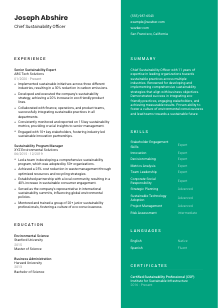
Navigating green pastures, but your CV doesn't reflect your ethical compass? Grow your inspiration with this Chief Sustainability Officer CV example, created with Wozber free CV builder. Learn how to shape a career vision that aligns with corporate responsibility, propelling your environmental leadership to its full potential!
A Chief Sustainability Officer is usually brought in when sustainability has to move from aspiration into enterprise execution. Hiring teams look for leaders who can set a company-wide direction, turn environmental goals into operating decisions, and show measurable results across areas such as emissions, supply chain practices, product development, and employee adoption. Your CV needs to show that you have led that kind of change at scale, not just supported isolated initiatives.
The first scan often comes down to whether your CV makes the business side of sustainability easy to read. Wozber's free CV builder helps you shape an ATS-compliant CV around the language of the role, so strategy ownership, cross-functional leadership, reporting metrics, and stakeholder influence surface clearly in both human review and ATS screening. That clarity matters when a company is deciding whether you can lead sustainability as an enterprise priority.
At senior sustainability level, the header should remove friction immediately. It needs to present you as an executive candidate, make contact easy, and address any practical requirement the employer named, without adding clutter.
Use your full name as the most prominent text in the header. For an executive role, this should feel straightforward and confident rather than styled for effect. A clear presentation helps frame the rest of the document around your leadership profile and makes it easier for boards, executive recruiters, and HR teams to identify your application quickly.
Place "Chief Sustainability Officer" directly under your name when that is the role you are targeting. This immediately positions your CV in the right executive lane and aligns your background with strategy leadership, stakeholder influence, and enterprise sustainability oversight rather than a narrower program or compliance function.
List a phone number you answer, a professional email address, and, if relevant, a website or LinkedIn profile. At this level, hiring teams may move quickly from CV review to outreach for confidential conversations, so accuracy matters. Avoid casual email handles and make sure every link reflects the same leadership brand shown in your CV.
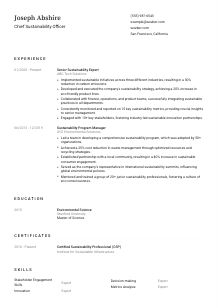
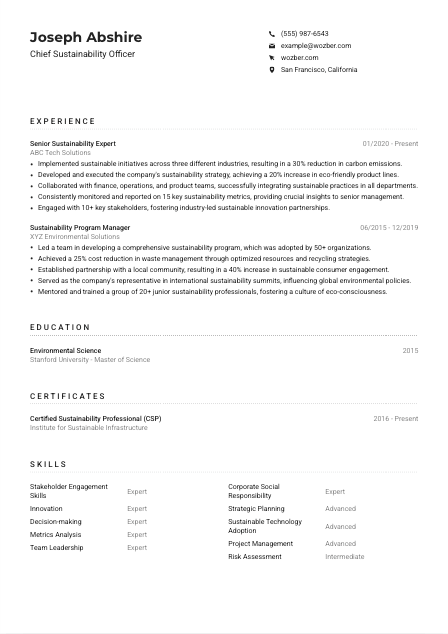
If the employer has named a location requirement, include it clearly in your header. Here, San Francisco, California is part of the stated criteria, so showing that match removes an avoidable question early. Keep this practical. Location is a tailoring point for the specific opening, not a universal requirement for every Chief Sustainability Officer role.
A LinkedIn profile or professional site can strengthen your application if it expands on work such as ESG reporting, decarbonization programs, supply chain initiatives, or public speaking in sustainability forums. Make sure the content matches your CV. If your profile includes board work, published thought leadership, or major sustainability outcomes, it can add useful context beyond the page.
This section should do three things well: identify you, make contact easy, and confirm any stated logistical requirement. Once that is in place, the rest of the CV can stay focused on strategy, execution, and measurable sustainability outcomes.




For a Chief Sustainability Officer, experience is where the hiring case is won. Titles matter, but the real proof comes from the scale of your initiatives, the functions you influenced, the metrics you tracked, and the business results you delivered through sustainability strategy.
Read the posting for the handful of themes that should shape your bullet points. In this case, those include building sustainability strategy, integrating practices across departments, reporting key metrics to senior leadership, engaging stakeholders, and educating employees. Once you identify those themes, rewrite your experience so each major role speaks to them in concrete terms rather than broad sustainability language.
List your positions in reverse chronological order, including title, company, and dates. For an executive-track sustainability CV, progression matters. Hiring teams want to see how you moved from program ownership into enterprise influence, whether through larger operational scope, more senior stakeholders, broader industry exposure, or responsibility for strategy and reporting at leadership level.
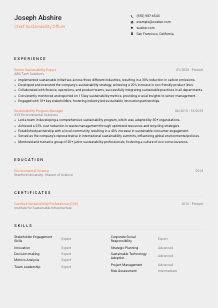
Your bullets should show what changed because of your leadership. Use numbers where they are native to the work, such as emissions reduction, waste reduction, cost savings, supplier participation, product portfolio shifts, training reach, or the number of sustainability KPIs tracked. The sample CV does this well with results like a 30% reduction in carbon emissions and a 20% increase in eco-friendly product lines. That kind of phrasing tells a board or executive team what your sustainability programs actually achieved.
Chief Sustainability Officers rarely succeed through standalone initiatives. Your experience should show how you worked across operations, finance, procurement, product, legal, HR, or supply chain to embed sustainability into core decisions. A bullet about collaborating with finance, operations, and product teams is stronger than one that simply says you "led sustainability efforts" because it shows how change was implemented inside the business.
Not every sustainability accomplishment deserves equal space. Lead with examples that reflect strategic ownership, enterprise reporting, stakeholder engagement, and measurable adoption of sustainable practices. If you have earlier experience in narrower environmental or program roles, keep it concise unless it directly supports the executive story. The aim is to make your recent record look clearly relevant to a leadership seat, not to document every project you have ever touched.
When this section is working, a hiring team can quickly see that you have set sustainability direction, led cross-functional change, and produced measurable business and environmental results. That is the standard your experience needs to meet.
Education matters here as a credibility baseline, especially when the role calls for a degree in environmental science, sustainability, business, or a related field. For a Chief Sustainability Officer, the section should confirm relevant academic grounding without pulling focus from your executive track record.
Start by checking whether the posting names a specific academic background. Here, a bachelor's degree in Environmental Science, Sustainability, Business, or a related field is required. If you hold one of those degrees, make sure it is clearly listed so the qualification is easy to confirm in an ATS scan and during a quick recruiter review.
List each degree with the institution, degree name, field of study, and graduation year or date. Keep the format consistent and easy to skim. At executive level, the value is in clarity, not extra detail. A clean structure helps reviewers confirm credentials quickly before moving back to the experience section, where most of the decision weight sits.
If your education bridges sustainability and business, make that visible. The sample combination of an Environmental Science master's and a Business Administration bachelor's works well because it supports both environmental expertise and business alignment. You do not need the exact same combination, but if your studies strengthen your ability to connect sustainability goals with commercial decisions, let that show.
Most senior candidates do not need to list coursework. Include it only if it adds something specific, such as climate policy, ESG reporting, supply chain sustainability, sustainable finance, or lifecycle assessment, and only when that detail supports the role you are targeting. Otherwise, keep the section lean and let your operating experience carry the weight.
Honors, research projects, or memberships can be included if they clearly reinforce your sustainability profile. For example, a graduate research project on emissions reduction or circular economy strategy may add value. Still, avoid overloading the section. For a CSO application, education should support your credibility, not compete with your professional achievements.
This section should confirm that you meet the academic baseline and, where possible, reinforce your ability to connect sustainability knowledge with executive decision-making. Keep it concise and directly relevant.
Certifications can add useful weight in sustainability leadership hiring, especially when they reflect current standards, recognized frameworks, or specialised expertise. They work best when they support your executive story rather than trying to replace it.
If a certification is listed in the posting, make it easy to find. In this role, Certified Sustainability Professional or an equivalent credential is highly preferred, so that belongs near the top of the section. This is one of the clearest ways to show alignment with a specific requirement without adding explanation elsewhere on the page.
Prioritise certifications tied to sustainability strategy, ESG, environmental management, climate risk, reporting standards, or infrastructure and systems thinking. A long list of loosely related certificates can weaken the section. Select the ones that best support your authority to shape company-wide sustainability programs and guide senior leadership discussions.
Show the year earned and, if relevant, the active period. This helps hiring teams understand whether a credential is current, maintained, or long established. In the example, listing the CSP with an ongoing date range signals continued relevance and active standing, which is useful for a role expected to stay current with evolving sustainability practices.
Sustainability leadership keeps shifting with regulation, reporting standards, carbon accounting methods, supply chain expectations, and stakeholder scrutiny. If you have pursued recent learning in materiality assessment, climate disclosure, responsible sourcing, or sustainable operations, include the strongest items. That tells employers you are keeping your framework current, not leading from outdated assumptions.
Relevant credentials can sharpen your profile, especially when they align with the posting and support the scope of work you lead. Use this section to show current professional depth in sustainability, not to pad the CV.
A Chief Sustainability Officer skills section should read like an executive capability map. It needs to capture how you lead sustainability across the business, how you work with stakeholders, and how you translate environmental goals into operational decisions and measurable outcomes.
Start with the language in the posting. Here, leadership, stakeholder engagement, strategy development, implementation of sustainable initiatives, and monitoring sustainability metrics are all central. Those should guide your selection. You can also infer adjacent capabilities such as ESG reporting, cross-functional collaboration, change management, and sustainability training if they are supported by your experience.
List the capabilities most relevant to an executive sustainability function rather than generic strengths. For this type of role, strategic planning, stakeholder engagement, metrics analysis, corporate social responsibility, risk assessment, and team leadership are much more useful than broad claims like "hardworking" or "excellent communicator." The sample skills section works because it stays close to the work of leading sustainability programs and influencing decisions.
A shorter, sharper list is usually stronger than an exhaustive inventory. Group your best-fit skills around leadership, analytical oversight, sustainability practice, and execution. Every item should connect back to something you could defend in an interview with examples, whether that is building reporting frameworks, guiding sustainable technology adoption, or managing cross-functional initiatives.
This section should reinforce what the rest of the CV already proves: that you can set sustainability direction, work across senior stakeholders, and manage the metrics and change efforts that make strategy stick.
Language ability matters in sustainability roles when the work involves broad stakeholder groups, employee education, international partners, or regional operations. Keep this section simple and relevant to the communication demands of the position.
If the employer specifies a required language, list it clearly with your proficiency. Here, English is essential, so it should appear first. This is especially useful for roles that involve executive reporting, board communication, supplier conversations, and training across the organisation, where precision matters.
Extra languages can strengthen your profile when the organisation works across regions, serves multilingual markets, or collaborates with global partners. For a sustainability executive, that can be relevant in supply chain engagement, partnership building, public-facing work, or cross-border policy discussions. Add them when they genuinely support your candidacy.
Describe your level plainly with terms such as Native, Fluent, Advanced, or Conversational. Avoid vague labels. Decision-makers need a realistic sense of how comfortably you can present, negotiate, train, or build relationships in each language.
If you speak multiple languages, think about how that supports the role's operating context. In some CSO positions, it can help with supplier engagement, investor-facing conversations, NGO collaboration, or employee training across regions. In others, English alone may be enough. Let the section reflect the actual communication footprint of the job you are targeting.
Do not overbuild this section unless language skills are central to the role. A concise list is enough. For the example CV, English and Spanish work well because they add practical communication range without distracting from the candidate's strategy and leadership profile.
When listed well, languages show where you can communicate effectively across teams, regions, and stakeholder groups. Keep the focus on professional usefulness, not decoration.
The summary should quickly establish your level, your sustainability leadership scope, and the kind of outcomes you are known for. For this role, a few targeted lines can signal whether you bring strategic ownership, measurable execution, and enough influence to shape company-wide practice.
Review the posting before writing a single line. In this case, the summary should point toward senior sustainability leadership, measurable initiative delivery, cross-functional integration, stakeholder engagement, and alignment with business objectives. That gives the section direction and keeps it from turning into a generic executive profile.
State who you are in professional terms right away. A line such as "Chief Sustainability Officer with 11 years of experience leading enterprise sustainability strategy" works because it establishes level and domain immediately. The sample summary does this effectively by leading with years of experience and a clear sustainability leadership identity.
Use the next lines to mention the kinds of wins the employer is hiring for. That may include implementing sustainability strategies tied to business goals, improving environmental performance, embedding practices across departments, or reporting meaningful metrics to leadership. Keep the proof specific enough to feel credible, even if you are not listing full numbers in every sentence.
Aim for a concise paragraph of three to five lines. Skip buzzwords, mission statements, and broad claims about passion. At this level, a summary should sound grounded in accountability, influence, and results. It should invite the reader into the experience section with a clear expectation of enterprise-level sustainability leadership.
A well-written summary tells the reader, within seconds, that they are looking at a sustainability leader who can connect environmental ambition to business execution. That is exactly the impression this section should create.
You now have a structure that speaks to how Chief Sustainability Officers are actually hired: through strategic scope, measurable environmental and business results, cross-functional influence, and credible communication with senior stakeholders. Use that structure to tighten every section around what you have led, changed, and reported.
Wozber's AI CV builder can help you align your language with the posting, refine wording around sustainability metrics and leadership scope, and produce an ATS-friendly CV template that stays easy to read. With careful tailoring and ATS optimisation, your CV should make one point unmistakable: you are ready to lead sustainability at enterprise level.