



Use Wozber and land your dream job
Create CV
No registration required
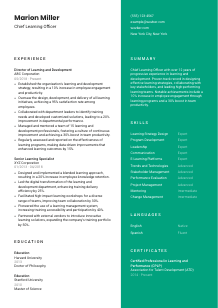
Shaping knowledge, but your CV feels like a cram session gone wrong? Unlock your potential with this Chief Learning Officer CV example, created with Wozber free CV builder. Learn how to clearly present your learning leadership to match your job goals, educating your career to straight-A success!
Chief Learning Officer hiring centers on one hard question: can you turn learning into business performance at scale. Boards, CEOs, and senior executives expect this role to shape capability strategy, improve adoption, guide leadership development, and show that learning investments move engagement, productivity, retention, or readiness in measurable ways. Your CV should make that enterprise-level scope visible, not read like a list of training tasks.
A tailored CV changes how quickly that scope comes through. When your language reflects the employer's priorities, whether that is learning strategy, team leadership, program effectiveness, or cross-functional partnership, an ATS-compliant CV is far more likely to surface the right experience early. Wozber's free CV builder helps organise those requirements into clear, role-aligned sections so hiring teams can immediately see your command of learning strategy and organizational impact.
For a Chief Learning Officer, the personal details section should look clean, credible, and executive-level. Keep it practical, but do use it to remove any friction around title alignment, contact access, and location when the employer has stated a geographic requirement.
Use your full name in a larger, readable font so it anchors the page immediately. At this level, presentation matters because your CV is often reviewed alongside other senior leaders. A clear header sets the tone for the strategic and operational depth that follows.
Place "Chief Learning Officer" directly below your name when that is the role you are pursuing. This creates immediate alignment with the search and helps distinguish you from adjacent profiles such as Director of Learning and Development, Head of Talent Development, or Chief People Officer.
List a phone number you answer reliably and a professional email address in a simple format. Executive searches move through interviews, stakeholder meetings, and follow-up conversations quickly, so accuracy matters. If you include a website or LinkedIn profile, make sure it reflects the same leadership brand and career timeline as the CV.
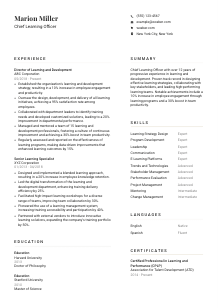
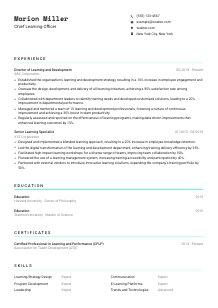
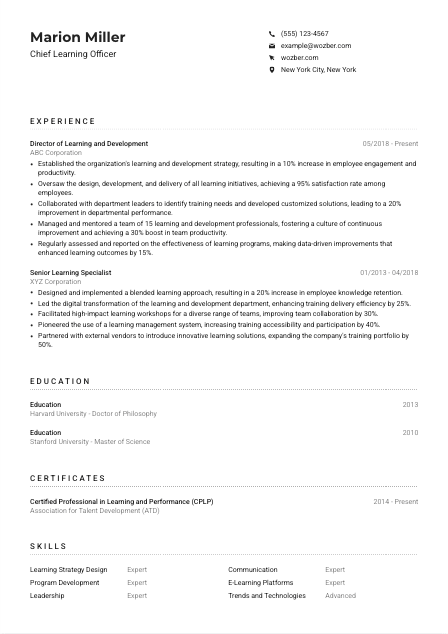
If the employer specifies a location, include your city and state exactly and plainly. In the example, "New York City, New York" supports the stated Greater New York City area requirement. For other applications, only mirror location when it is relevant to the role, relocation plan, or hybrid expectations.
A LinkedIn profile, portfolio site, or speaker page can strengthen your application when it shows enterprise learning strategy, thought leadership, board-facing work, or conference speaking. Skip it if it is outdated or thinner than the CV itself. Every link should reinforce your credibility in learning transformation, leadership development, or L&D operations.
This section does not need flair. It needs accuracy, title alignment, and the right practical details so the reader can move straight to your record of building learning strategy, leading teams, and driving outcomes.




The experience section carries the most weight for a Chief Learning Officer. Hiring teams want to see how you set learning direction, influence senior stakeholders, build capable teams, and improve business results through training, capability development, and learning operations.
Read the posting for the work themes behind the title. For a Chief Learning Officer, that often means enterprise learning strategy, customised solutions for business units, team leadership, and program measurement. Build your bullets around those priorities so your background reads as directly relevant rather than broadly L&D-adjacent.
Start with your most recent role and make the climb into senior leadership easy to follow. Include title, organisation, and dates for each position. For this kind of search, the timeline should make it obvious that you have moved from program ownership into enterprise oversight, budget influence, or team management.
Chief Learning Officer CVs need bullets that show what changed because of your work. Strong examples include enterprise engagement gains, better knowledge retention, improved training participation, stronger departmental performance, or faster rollout of digital learning. The sample CV does this well by tying strategy, program delivery, and stakeholder partnership to results like a 10% increase in engagement and a 20% improvement in departmental performance.
Metrics make executive L&D work easier to trust. Use numbers tied to learner reach, satisfaction scores, adoption rates, completion rates, productivity changes, retention, leadership pipeline health, or team size. In the example, figures such as a 95% satisfaction rate and management of a 15-person L&D team give concrete scope to the leadership claim.
Every bullet should strengthen your case for leading organizational learning, not just delivering isolated training. Remove routine tasks unless they show strategic planning, change leadership, digital learning transformation, vendor management, or measurable improvement. If a line does not help the reader picture you setting learning direction across the business, replace it.
By the end of this section, the reader should be able to see enterprise-level strategy, cross-functional influence, and measurable learning outcomes. That is the combination that moves a Chief Learning Officer CV into the serious-candidate pile.
Education matters for a Chief Learning Officer because the role often combines instructional expertise, organizational development judgment, and executive leadership. Your academic background should confirm that foundation quickly and clearly.
If the posting requires a master's degree in Education, Learning and Development, or a related field, make sure that qualification is easy to spot. List the most relevant advanced degree first when it supports the requirement directly. This particular job asks for a master's as a baseline, so that credential should never be buried.
For each degree, include the institution, degree, field of study, and graduation year. Senior CVs benefit from clarity more than decoration. Clean formatting helps both ATS parsing and fast human review, especially when reviewers are checking minimum qualifications before moving deeper into your experience.
When your degree is closely tied to education, learning science, organizational development, or a related field, let that relevance work for you. In the example, both the master's in Education and the doctorate in Education reinforce deep domain grounding. You do not need to explain why they matter if the connection is already obvious.
Most senior candidates can skip coursework unless it adds targeted value, such as learning analytics, curriculum design, adult learning theory, organizational psychology, or educational technology. Include it only when it strengthens a transition, clarifies a specialty, or supports a requirement not yet visible elsewhere.
Honors, research, dissertation topics, or teaching appointments can help if they connect to executive L&D work. For example, research in workforce development, leadership learning, or assessment design can reinforce your strategic credibility. Leave out academic detail that does not contribute to the case you are making for senior learning leadership.
This section should quickly establish that you meet the academic bar and have serious grounding in how people learn, develop, and perform at work. Then let your experience carry the heavier proof.
Certifications are not always mandatory for a Chief Learning Officer, but the right ones can reinforce professional credibility, current practice, and continued engagement with the field. They are most useful when they support the kind of enterprise learning work you want to lead.
Look for certifications tied to talent development, learning strategy, facilitation, coaching, instructional design, or performance improvement. A credential such as CPLP, now commonly recognized through ATD's certification framework, directly supports senior learning and development leadership because it reflects established professional standards.
List certifications that strengthen your profile as a leader of learning systems, not just a participant in training delivery. Programs connected to change management, coaching, learning technologies, assessment, or organizational effectiveness can all be relevant when they reflect the scope of the role you are targeting.
If a certification requires renewal or continuing education, show the active date range. That helps communicate that your knowledge is current, especially in areas shaped by fast-moving platforms, digital delivery models, and evolving workforce capability practices. The sample CV's ongoing certification dates do this clearly.
Chief Learning Officers are often expected to understand modern learning ecosystems, from LMS and digital content strategy to analytics, skills frameworks, and AI-supported learning workflows. If you are adding new credentials, prioritise ones that reflect where enterprise learning is headed rather than generic management courses.
Well-chosen certifications tell the reader that your knowledge of learning and development is active, not dated. They work best when they support your broader story of strategic, modern, data-aware leadership.
The skills section should read like the operating toolkit of a senior L&D executive. That means a mix of strategy, delivery oversight, stakeholder influence, team leadership, and the systems or platforms that support learning at scale.
Start by pulling required and repeated terms from the posting, then match them to skills you genuinely use. For this job, that includes learning strategy, program design, leadership, communication, and knowledge of current learning technologies and practices. Exact phrasing helps ATS matching when it reflects real experience.
Put the most relevant capabilities first, especially those tied to executive decision-making and cross-functional delivery. Skills such as Learning Strategy Design, Program Development, Stakeholder Management, Performance Evaluation, and Change Management show far more about Chief Learning Officer readiness than a long list of tactical tools on their own.
Do not overload this section with every platform, workshop method, or soft skill you have ever used. Curate the list so each skill supports your record in areas like learning transformation, team leadership, measurement, and business alignment. In the example, the blend of strategy, leadership, e-learning platforms, and performance evaluation creates a balanced picture without becoming cluttered.
A well-edited skills list should confirm the patterns already visible in your experience: strategy, leadership, modern learning capability, and measurable program oversight. If it reads that way, it is doing its job.
Language ability matters for a Chief Learning Officer when communication is central to the role, especially in organizations with distributed teams, global workforces, or multilingual learner groups. Keep this section straightforward and relevant to the employer's needs.
When a posting specifies language expectations, reflect them clearly. Here, effective communication in English is required, so English should appear first with an accurate proficiency level. That is especially important in a role that involves executive communication, stakeholder alignment, and organisation-wide learning messaging.
Use standard labels such as Native, Fluent, Intermediate, or Basic. Avoid vague wording. Hiring teams need a quick read on whether you can present strategy, coach leaders, facilitate sessions, or write learning communications at the level the role demands.
Additional languages can strengthen your profile if the organisation works across regions or serves diverse employee populations. In the example, Spanish adds useful reach beyond the required English. Include extra languages when they expand your ability to lead learning across cultures, business units, or geographies.
Do not overstate fluency. A Chief Learning Officer may be expected to present to executives, facilitate difficult conversations, or guide adoption during organizational change, so language claims need to hold up in real interaction.
If you have led enterprise learning across international teams, supported multilingual rollouts, or adapted training for different regional audiences, your language section can reinforce that story. Keep it brief here, then let the experience section show how those capabilities were applied.
This section should quickly confirm that you can communicate at the level the role requires and, where relevant, support learning across broader populations. Accuracy matters more than volume.
Your summary should give a senior reader a fast, accurate picture of your leadership range. For a Chief Learning Officer, that means connecting years of progression in L&D with strategy ownership, measurable program results, and the ability to lead teams and influence the business.
Before writing, identify the two or three themes the employer cares about most. In this case, those include enterprise learning strategy, high-quality program delivery, team leadership, and data-driven improvement. Build the summary around those themes so it sounds targeted from the first line.
Your first sentence should establish seniority quickly. A line such as "Chief Learning Officer with over 12 years of progressive experience in learning and development" works because it immediately confirms depth in the field. If you also meet a leadership threshold, mention that naturally within the next sentence.
After the opener, include achievements or capabilities that show strategic impact. Strong examples include raising engagement, improving learning effectiveness, leading digital learning transformation, or building higher-performing L&D teams. The sample summary works because it pairs broad leadership claims with outcomes such as a 10% rise in engagement and a 30% boost in team productivity.
Aim for 3 to 5 lines with specific language, not broad leadership slogans. Senior summaries work best when they sound like a distilled version of your actual record. If a phrase does not add information about learning strategy, leadership scope, or measurable results, cut it.
A sharp summary should make the reader expect enterprise learning leadership, credible metrics, and strong cross-functional influence in the sections that follow. When it does that, your CV starts with the right executive signal.
A Chief Learning Officer CV should show more than experience in training. It should connect learning strategy to business priorities, show how you lead teams and stakeholders, and prove that your programs improve outcomes the organisation can measure.
Use Wozber to shape that story into an ATS-friendly CV format, align your language with the job description, and tighten each section around what matters most for senior L&D hiring. The final document should make it easy to judge your readiness to lead learning across the enterprise.