



Use Wozber and land your dream job
Create CV
No registration required
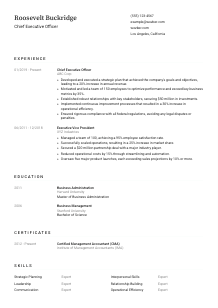
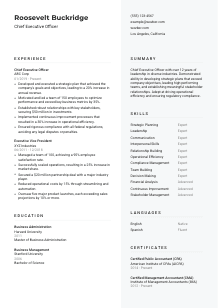
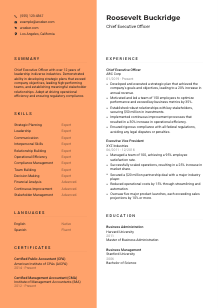
Steering companies, but feel your CV is navigating in circles? Check out this Chief Executive Officer CV example, created with Wozber free CV builder. It shows how to anchor your leadership feats to align with executive expectations, ensuring your CEO journey always sets sail to the C-suite shores!
CEO CVs are read through the lens of enterprise performance. Boards and hiring committees look for leaders who can set direction, scale operations, improve financial results, steady the organisation through change, and keep governance and compliance under control. Generic leadership language does not carry much weight here. What matters is clear proof of growth, operating discipline, stakeholder trust, and decisions that moved the business.
A tailored CV changes the first read from broad executive promise to role-specific leadership proof. When your summary, experience, and skills mirror the language of strategy, financial outcomes, stakeholder management, and regulatory oversight used in the posting, an ATS-compliant CV is much easier to rank and route correctly. Wozber's free CV builder helps structure that alignment cleanly so hiring teams can quickly see whether your background fits the scale, governance demands, and growth agenda of the CEO seat.
At the CEO level, the personal details section does one practical job. It identifies you clearly, presents you as a senior candidate from the first line, and removes friction for board members, recruiters, and investors who may all review the CV at different stages.
Place your full name at the top in a clean, prominent format. For executive hiring, this line acts as the header for your leadership record, so keep it straightforward and professional rather than styled with extra descriptors or credentials that belong elsewhere.
Add "Chief Executive Officer" directly beneath your name when that is the role you are targeting. This creates immediate alignment with the search and supports ATS matching. If your current title differs, such as Executive Vice President, your target title can still clarify the level you are pursuing.
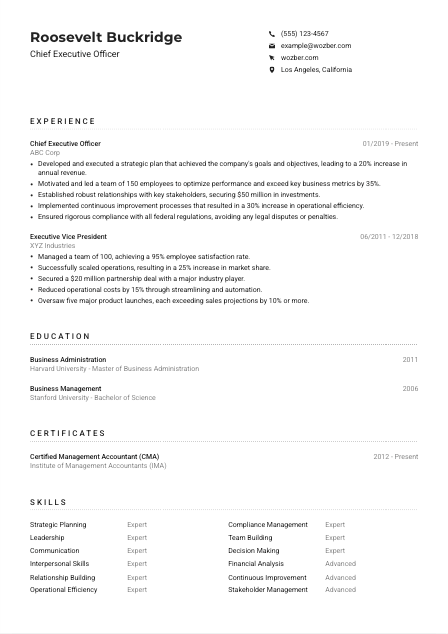
Include your phone number, professional email address, and location. For this position, Los Angeles, California is relevant because the posting specifically asks for a local or relocation-ready candidate. If location is a requirement in another search, make that easy to confirm from the top of the page.
A LinkedIn profile or personal executive bio page can reinforce board-facing credibility, especially if it includes company scale, transaction history, speaking engagements, or governance work. Make sure the roles, dates, and achievements match the CV exactly.
Do not include age, marital status, headshot, or other personal data unrelated to executive performance. CEO hiring decisions centre on strategic leadership, financial judgment, stakeholder management, and operating results, so keep the section focused on information that supports those conversations.
This section should confirm who you are, the role you are pursuing, and how to reach you without distractions. For a CEO CV, that clean start sets the tone for everything that follows.




The experience section carries the most weight on a CEO CV. This is where you show how you led organizations, improved performance, handled scale, managed stakeholders, and translated strategy into measurable business outcomes.
Start by isolating the operating themes in the job description. Here, the major priorities are strategic planning, scaling organizations, positive financial outcomes, team leadership, stakeholder relationships, innovation, and compliance. Use those themes to decide which roles, bullets, and metrics deserve space on the page.
List positions in reverse chronological order and make the scope visible fast. Include titles, company names, dates, and then show the breadth of your authority through team size, business unit reach, revenue influence, market expansion, transformation work, or board exposure. In the example, moving from Executive Vice President to Chief Executive Officer creates a clear progression into enterprise leadership.
Each bullet should connect an executive action to a business result. Strong CEO bullets often show strategy execution, restructuring, capital raises, margin improvement, turnaround work, partnerships, market share growth, or operating efficiency. The sample does this well with points like securing $50 million in investments and improving operational efficiency by 30%, because they show both leadership action and company-level impact.
Numbers make executive claims credible. Use metrics tied to how senior leaders are evaluated, such as revenue growth, EBITDA improvement, cost reduction, market share, headcount led, capital secured, customer growth, or compliance outcomes. The example's 20% annual revenue increase, 35% performance improvement, and 15% cost reduction are the kind of metrics that help a board quickly understand your range.
CEO CVs need focus. Prioritise achievements that match the company agenda in front of you, especially strategy, finance, scaling, governance, and people leadership. If a bullet is interesting but does not strengthen your case for enterprise oversight or business results, remove it and use the space for higher-value proof.
After this section, a hiring team should be able to see the scale you led, the business results you delivered, and the stakeholders you influenced. That is the standard your experience section needs to meet.
Education matters differently at the CEO level. It rarely wins the role on its own, but it does support your business foundation, strategic training, and alignment with stated degree requirements in the search brief.
When a posting asks for a bachelor's degree and prefers a master's or MBA, list your highest relevant credential first. For executive roles, an MBA is often worth leading with because it reinforces strategic, financial, and organizational training that boards expect to see.
Include the institution, degree, field of study, and graduation year or date format consistent with the rest of the CV. Keep the presentation crisp. In the example, the MBA and business management degree are enough to satisfy the educational requirement without extra explanation.
If the posting specifies business, management, or a related field, make sure that connection is obvious. You do not need to over-explain a closely aligned degree, but you should not leave the reviewer guessing whether your academic background meets the search criteria.
Additional academic detail is optional for a senior candidate. Include honors, board governance programs, finance programs, or strategy coursework only if they strengthen your case for the role. At CEO level, relevance matters more than volume.
If you have completed executive education in governance, mergers and acquisitions, digital transformation, risk management, or leadership, include it when it supports the mandate of the role. Ongoing learning is most persuasive when it connects to board work, enterprise growth, or regulatory complexity.
Your education section should confirm that you meet the formal requirements and bring the business training expected of a senior leader. Brief, relevant, and credible is the right approach here.
Certifications are not always central on a CEO CV, but they can add weight when they reinforce financial oversight, governance judgment, or operational credibility. Use them selectively and tie them to the needs of the role.
For a CEO search that emphasizes financial acumen, certifications such as CMA or CPA are directly relevant because they reinforce budgeting, reporting, forecasting, and financial control. They are especially useful when the role calls for strong strategic and fiscal leadership.
Choose certifications that strengthen your case for this particular mandate. Finance and accounting credentials are a good fit for this posting. In another CEO search, governance, risk, healthcare, technology, or industry-specific credentials might be more useful.
List the certification name, issuing body, and date or active period. Current credentials suggest continued professional standing and matter more than an old course certificate with little executive relevance.
If you are working toward a certification, include it only when it adds genuine value to the search. For a CEO CV, that usually means a credential tied to finance, governance, audit, compliance, or industry regulation rather than a broad professional development course.
This section should deepen your profile, not pad it. The best certifications on a CEO CV make your financial, governance, or industry credibility easier to trust at a glance.
The skills section should read like a snapshot of how you operate at the top of an organisation. Focus on capabilities tied to strategy, financial performance, governance, operational execution, and leadership across stakeholders.
Pull skill language from the job description and from the actual work CEOs are expected to lead. In this case, that includes strategic planning, financial analysis, stakeholder management, team leadership, compliance management, operational efficiency, and communication.
CEO hiring is not based on soft skills alone or technical strengths alone. Your list should combine enterprise capabilities such as strategic planning, financial acumen, and decision-making with leadership traits that matter in practice, including communication, relationship building, and team development across senior stakeholders.
Do not fill this section with broad management terms or skills better demonstrated in your bullets. Choose the capabilities most relevant to the search and keep them at an executive level. The example's mix of strategic planning, stakeholder management, operational efficiency, and compliance management is a solid model because it reflects boardroom priorities and day-to-day executive oversight.
A focused skill list should reinforce the themes already visible in your experience. Strategy, finance, people leadership, and governance should all be easy to spot.
Language skills matter on a CEO CV when they affect stakeholder communication, market reach, employee leadership, or international operations. Keep this section practical and tied to business use rather than treating it as a personality detail.
If the posting explicitly requires English, place it first and state your proficiency clearly. For a CEO, that signals readiness for board communication, investor conversations, company-wide messaging, and regulatory discussions.
Additional languages can support cross-border expansion, multilingual teams, partnership work, or customer relationships. In the example, Spanish adds potential value in a large and diverse market, though it is an advantage rather than a universal requirement for every CEO role.
Choose plain ratings such as Native, Fluent, Advanced, or Conversational. That gives enough context without overexplaining, and it helps interviewers understand where you can lead directly versus where you may rely on translation or local teams.
If the company operates across regions, sells internationally, or has multilingual workforces, language skills deserve more prominence. If the search is domestic and English-only, keep this section short and factual.
For senior executives, language skills are most valuable when they improve trust, clarity, and decision-making across stakeholders. Present them as a business asset that helps you lead people, partnerships, and markets more effectively.
This section works best when it shows how you communicate across the organisation or the market. Clear proficiency labels and relevant business context are enough.
The summary needs to establish your executive range in a few lines. It should quickly connect your years of leadership, scale of responsibility, financial impact, and strategic strengths to the mandate in front of you.
Start with your title or leadership profile and your years of senior experience. For a CEO CV, phrases like "Chief Executive Officer with 12+ years of executive leadership experience" work because they establish level immediately and align with the requirement for 10 years of executive leadership.
Choose two or three outcome areas that match the role, such as scaling organizations, improving revenue, leading high-performing teams, securing investment, or driving operational improvement. The sample summary covers strategic plans, team leadership, stakeholder relationships, efficiency, and compliance, which maps closely to the posting.
Aim for a short paragraph, not a biography. Use concise language and include measurable context where it fits naturally, especially if you have standout growth, investment, or transformation results that set the tone for the rest of the CV.
Reflect the wording of the search brief in natural language. If the posting emphasizes strategic planning, financial outcomes, innovation, and regulatory compliance, those themes should appear in your summary when they are true to your background. This helps both ATS optimisation and human readers scanning for executive alignment.
By the time someone finishes these opening lines, they should understand your executive level, your strongest outcomes, and why your background fits the company agenda. That is the job of a CEO summary.
A CEO CV should show the business you led, the scale you handled, the stakeholders you influenced, and the results you delivered. When each section points back to strategy, financial performance, organizational leadership, and compliance, the document starts to read like an executive track record instead of a list of positions.
Wozber's free CV builder can help you shape that record into an ATS-friendly CV format, refine language with AI support, and check alignment with an ATS CV scanner before you apply. The finished CV should make one thing clear fast: you are prepared to lead the organisation at the level the role demands.