



Use Wozber and land your dream job
Create CV
No registration required
Managing supply chains, but your CV's out of stock? Check out this Chief Procurement Officer CV example, created with Wozber free CV builder. Learn how to clearly present your sourcing strategies to match job requirements, ensuring your professional journey stays plentiful and cost-effective!
Procurement leadership is judged in real business terms. A Chief Procurement Officer is expected to protect margin, build supplier leverage, keep contracts compliant, and make sourcing decisions that hold up under operational pressure. Your CV should make that executive scope visible quickly, especially through cost reduction results, supplier strategy, negotiation outcomes, and the size of the teams or spend you have led.
Screening for this role often turns on whether your background reads as enterprise procurement leadership or as a narrower purchasing profile. A targeted CV, built with Wozber's free CV builder and shaped for ATS optimisation, helps surface the language hiring teams look for first: procurement strategy, supplier performance, contract negotiation, KPI reporting, and cross-functional influence. That makes it easier to see whether you can run procurement as a business function, not just manage transactions.
This section is brief, but it still carries useful information in senior procurement hiring. It should confirm who you are, how to reach you, and whether you meet any practical screening requirements without distracting from your leadership record.
Use your full name prominently and keep the presentation clean. For an executive CV, the header should read like the top line of a board-ready document: direct, polished, and easy to scan. Avoid nicknames or overly styled formatting that can make the CV look less senior.
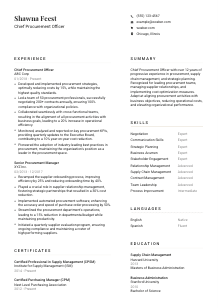
Place "Chief Procurement Officer" directly below your name when that is the role you are pursuing. Matching the title helps position your background at the right level from the first line. If your current title is slightly different, such as VP of Procurement or Head of Strategic Sourcing, you can still target the CPO title as long as the experience below supports executive ownership of procurement strategy, supplier governance, and cost performance.
List a direct phone number, a professional email address, and optionally a LinkedIn profile or personal website if it reflects the same career story as your CV. Senior hiring teams may cross-check board exposure, procurement transformation work, or major supplier initiatives, so any linked profile should reinforce your executive track record rather than add noise.
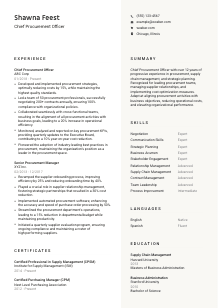
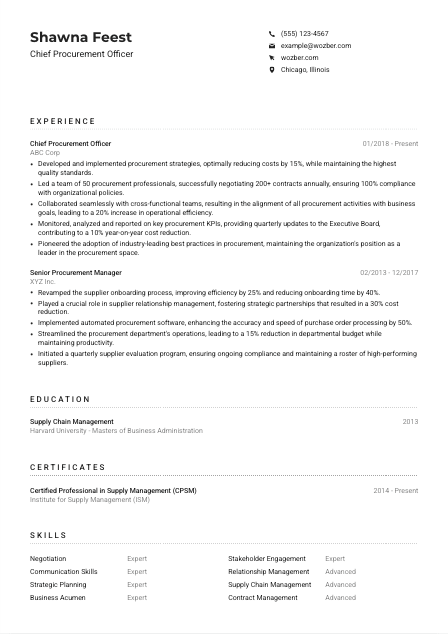
If the employer specifies a location requirement, include the relevant city and state in your header. In the example, listing "Chicago, Illinois" immediately answers a stated screening point. If you are relocating, you can indicate that clearly instead of leaving the employer to guess.
Do not include age, marital status, photo, or other non-job-related personal information. Executive procurement hiring should stay focused on commercial judgment, supplier management, compliance leadership, and business impact, not background details that have no bearing on the role.
Your personal details should remove basic friction and confirm practical fit. Once that is handled, the rest of the CV can stay focused on sourcing strategy, negotiation strength, supplier performance, and leadership scale.




For a Chief Procurement Officer, experience is where the decision usually gets made. Hiring teams want to see whether you have led procurement beyond daily purchasing, shaped category or enterprise sourcing strategy, improved cost structure, and reported performance in terms that senior leadership cares about.
Read the posting closely and mark the responsibilities that define success in the role. Here, the emphasis falls on procurement strategy, cost optimisation, supplier performance, contract negotiation, compliance, cross-functional alignment, and KPI reporting. Those themes should guide which achievements you feature and what language you use to describe them.
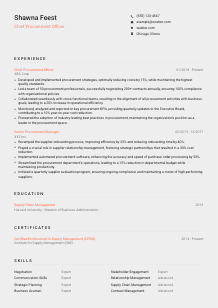
List positions in reverse chronological order and make the most relevant leadership work do the heavy lifting. For each role, focus on results that show strategic sourcing, supplier management, commercial negotiations, and operational improvement. The example does this well by leading with a 15% cost reduction tied to procurement strategy rather than a generic statement about overseeing purchasing.
Quantify achievements with metrics that reflect how procurement performance is actually measured. That may include savings percentages, spend under management, contract volume, supplier consolidation, onboarding speed, compliance rates, inventory improvements, or procurement cycle time. In the sample CV, "200+ contracts annually," "100% compliance," and quarterly KPI reporting all help translate leadership into concrete business performance.
Do not crowd the section with older or less relevant experience if it does not support executive procurement leadership. Prioritise roles that show strategic ownership, supplier relationship management, transformation work, and collaboration with finance, operations, legal, or manufacturing. If earlier positions are included, keep them brief unless they explain a clear progression into enterprise procurement leadership.
A Chief Procurement Officer is expected to lead a function, not just negotiate well personally. Include team size, governance responsibilities, process improvements, executive reporting cadence, and cross-functional influence. The example's mention of leading 50 procurement professionals and providing quarterly updates to the Executive Board is useful because it shows organizational scale as well as results.
The strongest experience section shows that you have already run procurement with strategic, financial, and operational accountability. Cost reductions, supplier outcomes, compliance discipline, and leadership scope should be easy to spot in every recent role.
Education matters in senior procurement hiring, especially when the posting calls for a business, supply chain, or related degree. At the executive level, this section is usually straightforward, but it should still align cleanly with the employer's stated requirements.
Start with the highest or most relevant qualification, especially if the posting prefers advanced education. In this case, a bachelor's degree is required and a master's degree is preferred, so an MBA or graduate degree in supply chain management should appear first when you have one. The example CV does this by leading with an MBA in Supply Chain Management.
List degree, field of study, institution, and graduation year in a format that is easy to scan. Executive recruiters and ATS systems should be able to pick up the credential quickly without digging through extra wording. Keep the presentation simple and consistent.
If your degree is in Business, Supply Chain Management, or a closely related field, name that clearly. This helps when employers are screening for formal grounding in procurement, sourcing, operations, or commercial management. If your concentration is especially relevant, such as supply chain within an MBA, include it rather than leaving it implied.
For a Chief Procurement Officer, coursework is rarely necessary unless it directly supports a specialised target, such as manufacturing procurement, global supply chain, or data-driven operations. Honors, thesis work, or executive programs can be included if they reinforce strategic or analytical depth, but keep the emphasis on relevance rather than volume.
Advanced procurement leaders often combine formal education with ongoing training in supply management, contract law, supplier risk, or operational excellence. If you have completed relevant executive education, list it when it adds value. It helps show that your thinking has kept pace with changes in sourcing models, compliance expectations, and supply chain volatility.
This section should confirm that you meet the academic baseline and, where relevant, show added depth through graduate study or executive learning. For a CPO CV, that is usually enough.
In procurement, respected certifications can strengthen an executive CV because they point to formal expertise in supply management, sourcing standards, and professional development. They are especially helpful when the job posting names specific credentials.
Check the posting for named credentials and list those first when you hold them. Here, CPSM and CPM are called out as highly desired, so they should be easy to find on the page. When an employer includes certification language this directly, matching it can improve both ATS alignment and recruiter confidence.
Prioritise certifications tied to supply management, sourcing, supplier governance, contract management, or operational improvement. A shorter list of highly relevant credentials is stronger than a long list of loosely related courses. For this role, procurement-specific certifications carry far more weight than general training items.
Add the year earned and, if applicable, indicate whether the credential is current. That helps employers understand whether the certification reflects active professional standing. In procurement leadership, current credentials can support credibility when the role involves policy oversight, supplier compliance, and executive accountability.
Procurement has changed significantly with supplier risk management, digital sourcing tools, sustainability expectations, and tighter compliance standards. Ongoing certification maintenance or recent credentials can show that your approach is current. That matters more at executive level, where your decisions influence sourcing policy and competitive positioning across the business.
Relevant credentials will not replace a strong leadership record, but they do reinforce it. When they match the posting and sit alongside measurable procurement results, they add another layer of credibility.
The skills section should read like an executive procurement profile, not a generic leadership list. Hiring teams are looking for the mix of commercial, operational, and stakeholder skills that allow a Chief Procurement Officer to lower cost, protect quality, manage suppliers, and align sourcing decisions with business goals.
Start with the capabilities the employer already named. In this description, that includes supply chain management, contract negotiation, supplier relationship management, and strong English communication. You can also add adjacent executive skills that are clearly supported by your background, such as strategic sourcing, KPI reporting, procurement transformation, or category management.
Only list skills that are supported elsewhere in the CV through scope, outcomes, or leadership examples. If you claim negotiation expertise, your experience section should show contract wins, savings, or supplier terms improved. The sample CV handles this well by pairing skills like strategic planning and stakeholder engagement with measurable procurement outcomes in the experience section.
Keep the section tight and relevant. A focused mix of strategic planning, contract management, supplier relationship management, team leadership, and process improvement tells a much clearer story than a long inventory of broad business traits. The best skill list should reinforce how you run procurement, influence cross-functional decisions, and improve cost and supplier performance.
Every skill on the page should connect back to a real procurement responsibility or result. When the list is targeted, it helps the employer picture you leading sourcing strategy, supplier negotiations, and functional performance from day one.
Language skills are not always a major section on an executive CV, but they can matter in procurement. Clear communication affects negotiations, supplier relationships, executive reporting, and cross-border coordination, so include languages in a way that reflects actual business use.
If the posting calls for a specific language, list it first with an accurate proficiency level. Here, high-level English communication is required, so English should appear prominently. For a Chief Procurement Officer, this supports more than conversation. It signals readiness for contract discussions, board reporting, supplier escalation, and cross-functional decision-making.
Additional languages can be valuable when your procurement work involves international suppliers, global sourcing, or regional stakeholder management. Include them when they are real working assets. In the example, Spanish adds useful context for supplier communication in broader markets, but it should remain secondary to the required English proficiency.
Use clear levels such as Native, Fluent, Intermediate, or Basic. Overstating language ability creates risk in executive hiring, especially if the role involves negotiations, presentations, or vendor management where precision matters. Keep the assessment honest and business-relevant.
If a language has helped you manage suppliers, navigate international contracts, or work across regions, the language section can quietly reinforce that global exposure. You do not need to over-explain it, but the value is stronger when the rest of the CV already shows cross-border sourcing or international supplier relationships.
If you are studying a language that supports your target market or supplier base, include it only when the progress is genuine and relevant. For senior roles, fluency claims should stay credible and specific. A developing language skill is useful, but it should not distract from the executive procurement experience at the centre of the CV.
For this kind of role, language ability matters when it improves negotiation, supplier communication, or executive reporting. List it clearly, keep it honest, and let it support the broader procurement story.
The summary needs to position you at the right level within a few lines. For a Chief Procurement Officer, that means signaling years of progression, strategic procurement ownership, supplier and contract leadership, and commercial results without slipping into vague executive language.
Before drafting the summary, identify the few hiring themes that matter most in the posting. Here, those include strategic procurement, cost reduction, supplier performance, leadership, and cross-functional alignment. Use those priorities to decide what belongs in the opening lines and what can wait for the experience section.
Begin with a concise description of who you are professionally. If accurate, state your years of experience in procurement and supply chain leadership, and make sure the language points to enterprise-level responsibility. The example summary works because it immediately establishes 12+ years in procurement, supply chain management, and strategic planning.
Add the business outcomes that matter most for a CPO search, such as material cost reductions, procurement transformation, supplier relationship gains, or stronger alignment with company goals. Keep these claims specific enough to sound credible. If you have delivered double-digit savings, improved supplier performance, or built procurement functions that supported growth, bring that into the summary directly.
Aim for a compact paragraph of roughly four to five lines. Avoid generic descriptors like "dynamic leader" unless they are supported by real outcomes nearby. The summary should read as a precise executive snapshot that prepares the reader for the metrics, contracts, teams, and strategic initiatives detailed later in the CV.
A well-written summary tells the reader, within seconds, that you operate at CPO level and have the record to support it. Once that foundation is clear, the rest of the CV can prove it through savings, supplier outcomes, governance, and leadership scale.
A Chief Procurement Officer CV should leave no doubt about the scale of your leadership, the quality of your supplier strategy, and the commercial impact of your decisions. When each section points back to cost control, negotiation strength, compliance, and cross-functional influence, the document reads like an executive case for hire.
Use Wozber's free CV builder, ATS-friendly CV templates, and ATS CV scanner to shape that experience into a clear, ATS-compliant CV that matches the language of the role. The final result should make it easy to judge one thing quickly: whether you can lead procurement as a strategic business function.