



Use Wozber and land your dream job
Create CV
No registration required
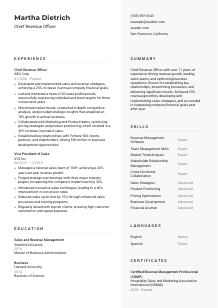
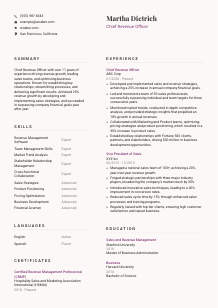
Driving business growth, but your CV isn't bringing in top revenue? Check out this Chief Revenue Officer CV example, created with Wozber free CV builder. It shows how to highlight your strategic sales acumen in a way that speaks to company needs, writing your career trajectory with digits that just keep going up!
Revenue leadership gets judged in business terms fast. A Chief Revenue Officer CV has to show how you built growth, shaped commercial strategy, and aligned sales execution with company goals. Broad claims about leadership are not enough here. Hiring teams want to see the scale you owned, the revenue outcomes you drove, and how you influenced pricing, positioning, partnerships, and go-to-market decisions.
Early CV screening for CRO roles often turns on whether your commercial scope is immediately legible. Wozber's free CV builder helps you organise that scope into an ATS-compliant CV that uses the same revenue language employers search for, so your background reads clearly as executive ownership rather than senior sales support. That distinction matters when a company is hiring someone to carry the number.
At the CRO level, the header is simple, but it still does important work. It should present you as an executive candidate who is easy to contact, correctly positioned for the role, and already aligned with any practical requirements named in the posting.
Use your full name as the most prominent text in the header. Keep the styling clean and professional so it feels consistent with an executive-level application. For a Chief Revenue Officer, the first visual cue should suggest senior ownership, not decorative formatting.
Place "Chief Revenue Officer" directly under your name if that is the role you are pursuing. Matching the target title helps hiring teams and ATS filters connect your background to the opening right away, especially when your recent title might be close but not identical, such as VP of Sales or Head of Revenue.
List a reliable phone number and a professional email address. At this level, small errors create unnecessary friction, so check every character. If you include a website, make sure it supports your executive profile, such as a polished personal site or a strong LinkedIn presence with revenue results, board-facing scope, and leadership history.
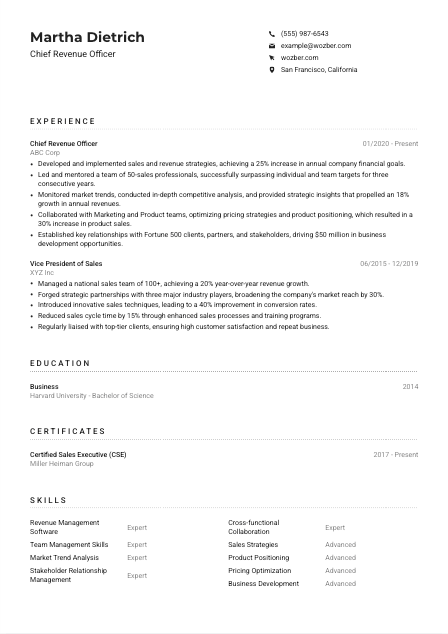
If a company specifies a location requirement, reflect it clearly in your header. In this example, San Francisco, CA appears as a stated condition, so listing San Francisco, California immediately removes doubt about availability. Only do this when it is true or when relocation is already decided.
A LinkedIn profile or professional website can strengthen your application when it reinforces the same commercial story as the CV. For a CRO, that usually means visible leadership tenure, board-level scope, market expansion wins, or speaking and thought leadership tied to revenue growth. Leave it out if it is outdated or inconsistent.
This section should confirm who you are, what role you are targeting, and whether any practical requirement such as location is already covered. For a Chief Revenue Officer search, that clarity keeps attention on your revenue track record.




The experience section carries most of the decision weight for a Chief Revenue Officer. Companies are looking for executive ownership of growth, not just participation in sales activity. Your bullets should show how you set strategy, led teams, improved commercial performance, and translated market insight into measurable revenue outcomes.
Start by identifying the business responsibilities the company is hiring for. In this posting, that includes revenue strategy, team leadership, competitive analysis, cross-functional collaboration with Marketing and Product, and relationship-building with major clients and partners. Those themes should appear in your experience bullets in language that reflects your real work history.
List positions in reverse chronological order and make the progression clear. CRO hiring teams look for growth in commercial scope, such as moving from regional sales leadership to national ownership, then to enterprise-wide revenue strategy. The sample CV does this well by moving from Vice President of Sales into a Chief Revenue Officer role with broader financial and cross-functional responsibility.
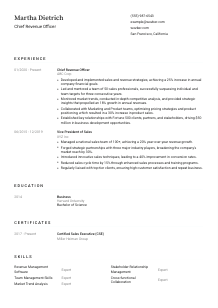
Each bullet should answer a business question: what changed because you led it? Use action verbs tied to revenue performance, market expansion, pricing strategy, forecast improvement, retention, or pipeline conversion. "Developed and implemented sales and revenue strategies, achieving a 25% increase in annual company financial goals" works because it connects strategic ownership to a concrete result.
Revenue leadership is measured in numbers, so include them naturally. Useful metrics for this level include annual revenue growth, quota attainment, deal size, market share, conversion lift, sales cycle reduction, retention gains, business development value, and team scale. The example's "$50 million in business development opportunities" and "30% increase in product sales" make the impact easy to understand in executive terms.
Keep the spotlight on roles that show strategic revenue ownership, executive collaboration, and leadership of sizable teams or accounts. Earlier experience can stay brief unless it adds something directly relevant, such as building a new market, launching a pricing model, or leading a turnaround. The point is to show a consistent record of commercial leadership, not a full career archive.
Your experience section should leave no doubt that you have carried meaningful revenue targets, led teams against them, and influenced the levers that move growth. That is the core proof a CRO CV needs to deliver.
Education matters differently at the CRO level than it does early in a career. It is usually a qualification check first, then a credibility marker. Present it clearly, match it to the posting where relevant, and let it support your commercial leadership story without taking focus away from your revenue results.
If the job description asks for a bachelor's degree in Business, Marketing, or a related field, make that easy to spot. If a master's degree is preferred, include it clearly when you have one. In the example, a business bachelor's and an MBA in Sales and Revenue Management line up cleanly with the role's stated expectations.
List degree, field of study, school, and graduation year in a straightforward order. Executive CVs still need ATS readability, and this section should be easy to scan in seconds. Avoid extra wording that makes the details harder to parse.
When your degrees directly support commercial strategy, finance, marketing, or revenue management, present that relevance naturally through the field of study. A degree in Business, Marketing, Economics, or an MBA can reinforce readiness for pricing, forecasting, market analysis, and executive decision-making.
Most CRO candidates do not need course lists, but there are cases where they help. If your academic work included pricing strategy, market analytics, channel management, or financial modeling and it strengthens a transition into a revenue leadership role, a brief mention can work. Keep it selective.
Honors, major research, or leadership roles in business organizations can stay if they still add signal, especially for candidates whose graduate education is a notable part of their executive profile. If your career accomplishments are already extensive, keep this section lean and let experience lead.
This section should quickly confirm that you meet the academic expectations of the role and, where relevant, reinforce your grounding in business and revenue strategy. Then the CV can move back to the commercial results that matter most.
Certifications are usually supplemental for a Chief Revenue Officer, but they can sharpen your profile when a company values formal sales or revenue management training. Use this section to support your executive positioning with credentials that actually relate to growth strategy, sales leadership, pricing, or revenue operations.
Some CRO postings list certifications as preferred rather than required. Here, certification in Sales or Revenue Management is a plus, so relevant credentials deserve space. When a posting mentions them, including the right certification can strengthen alignment without overstating its importance.
Choose certifications tied to the levers a CRO manages, such as sales execution, strategic account leadership, pricing, revenue optimisation, or go-to-market effectiveness. The example uses Certified Sales Executive and Certified Revenue Management Professional, which fit the role's focus on revenue growth and commercial strategy.
Include the year earned and, if relevant, an active validity range. That helps the reader understand whether the credential is current. For executive roles, clean presentation matters as much as the certification itself.
This section can also show that your commercial approach stays current. If you have completed newer training in revenue operations, forecasting systems, pricing strategy, or executive sales leadership, it can signal continued engagement with how modern revenue teams run.
Certifications should strengthen your case as a revenue executive, not fill space. Include the ones that connect clearly to sales leadership, revenue management, and strategic commercial decision-making.
A Chief Revenue Officer skill section should read like an executive operating profile, not a broad list of generic strengths. Focus on the commercial, analytical, and leadership capabilities that shape revenue performance across teams, markets, and customer segments.
Start with the capabilities named or implied in the job description. Here, that includes revenue management software, leadership, cross-functional alignment, market analysis, pricing, product positioning, and stakeholder management. Those are the skills that connect directly to daily CRO decisions and hiring criteria.
A credible CRO skills section includes both high-level strategic capabilities and the tools or operating areas behind them. Pair items like revenue strategy, business development, and forecasting with practical areas such as revenue management software, pricing optimisation, and market trend analysis. The sample CV handles this balance well.
Choose skills that support the specific version of the CRO role you are targeting. A SaaS growth-stage CRO might emphasize ARR growth, pipeline management, churn reduction, and RevOps systems. A more enterprise commercial role may lean harder on channel strategy, executive partnerships, and complex deal leadership. Skip skills that do not support the target scope.
Your skills section should make it easy to see how you manage growth in practice, from market analysis and pricing to team leadership and executive collaboration. That is what makes the list useful at CRO level.
Language ability matters when the role calls for it or when the business operates across regions, investor groups, or multinational clients. For a Chief Revenue Officer, this section is usually brief, but it should still reflect the communication demands of the position accurately.
If the posting specifies a language requirement, list it first and use a clear proficiency label. In this case, high proficiency in English is necessary, so English should be prominent and unambiguous. That removes any uncertainty around executive communication, board interaction, and client-facing leadership.
After the required language, list additional languages that could support the business. If you work with international customers, regional sales teams, or cross-border partnerships, languages such as Spanish, French, or Mandarin may add value. Keep the order practical rather than decorative.
Additional languages are most useful when they connect to territory ownership, partnership development, or expansion efforts. In the example, Spanish may strengthen the profile for organizations serving multilingual markets or broader Americas teams, even though it is not a stated requirement.
Stick to labels like Native, Fluent, Intermediate, or Basic. Executive CVs benefit from precision, and these terms are easy for hiring teams and ATS systems to interpret.
Do not overplay language skills unless they are relevant to the role's market footprint. If the company is expanding internationally or the CRO will manage teams across regions, multilingual ability can support your case. If not, keep the section concise and factual.
For CRO applications, language skills should clarify communication capability, market reach, or regional leadership potential. If English proficiency is required, make that visible first and keep the rest grounded in business relevance.
The summary is where you establish your commercial identity in a few lines. For a Chief Revenue Officer, it should quickly cover years of experience, leadership scope, and the kind of growth outcomes you are known for, while matching the language of the target role closely enough to read well in both ATS and human review.
Before writing, identify the two or three themes the role emphasizes most. For this posting, those are revenue growth, executive team leadership, and cross-functional strategy. Your summary should bring those ideas together so the reader immediately understands your operating level.
Start with your title or executive identity and your years of experience. Phrases like "Chief Revenue Officer with 11+ years in sales and revenue leadership" work because they frame both level and domain right away. This is especially useful if your background includes adjacent titles such as VP of Sales, Commercial Director, or Head of Growth.
Include one or two concrete outcomes that show you can drive the number. The sample summary does this effectively by citing 25% revenue growth and repeated success against company financial goals. Choose metrics that reflect strategic impact, such as recurring revenue growth, market expansion, enterprise pipeline gains, or team performance across multiple years.
Aim for a short paragraph that sounds like an executive introduction, not a bio. Avoid vague phrases about being dynamic or results-driven unless they are supported immediately by scale, scope, or measurable outcomes. In four to six lines, the reader should understand what revenue environment you have led and what kind of growth you deliver.
A strong CRO summary should quickly connect your experience, leadership range, and revenue results. When that opening is sharp, the rest of the CV reads as proof of executive commercial ownership.
Your Chief Revenue Officer CV should now show the commercial story clearly: how you built strategy, led teams, influenced pricing and positioning, and delivered measurable growth. That is what companies need to see when they are hiring someone to own revenue at the executive level.
Use Wozber's free CV builder to shape that story into an ATS-friendly CV format, then refine it with the ATS CV scanner so the language, structure, and role-specific terminology match the opportunity you are targeting. The final result should make your readiness to lead revenue unmistakable.