



Use Wozber and land your dream job
Create CV
No registration required
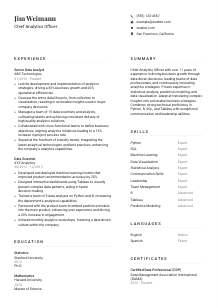
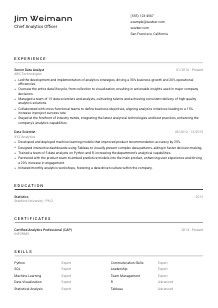
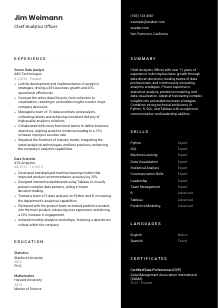
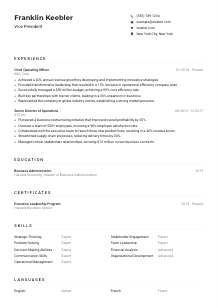
Decoding data, but your CV seems encrypted? Unravel this Chief Analytics Officer CV example, created with Wozber free CV builder. Learn how to distill your data-driven insights into job-aimed metrics, putting your analytics acumen at the forefront of career success!
Chief Analytics Officer hiring turns on one question fast: have you used analytics to shape business direction, not just produce reports. At this level, a CV has to show enterprise impact through decisions, operating improvements, team leadership, and the ability to turn modeling work into actions executives can use.
When that story is tailored well, your background reads less like a senior data specialist and more like an analytics executive. Wozber's free CV builder helps you align your language with the posting, build an ATS-compliant CV, and surface the mix of strategy, technical depth, and leadership that hiring teams need to see first.
For a Chief Analytics Officer, the header should confirm executive presence and remove friction. Keep it clean, professional, and aligned with any practical requirements the employer has already stated.
Use your full name as the clearest identifier on the page. A simple, readable presentation works best here because the role already carries enough authority through your title, experience, and results.
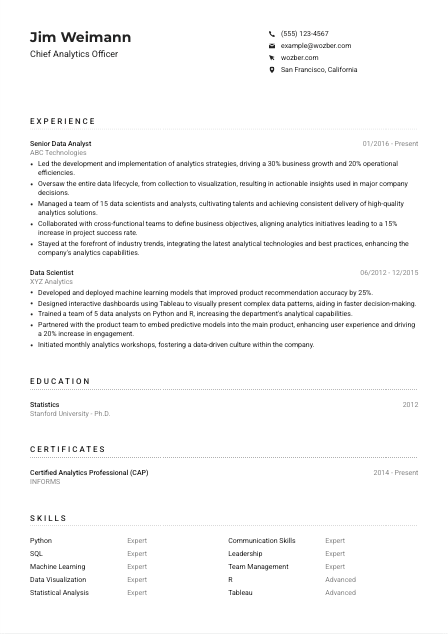
Place "Chief Analytics Officer" directly under your name when that is the role you are pursuing. This helps position you immediately for executive analytics leadership and mirrors the title hiring teams are scanning for in both human review and ATS searches.
Make it easy to reach you without crowding the header with extras.
If a posting names a location requirement, reflect it accurately in your header. In this example, listing "San Francisco, California" immediately answers a stated filter and avoids unnecessary questions about relocation or availability.
Include a LinkedIn URL or personal site if it strengthens your candidacy. For analytics leaders, this can reinforce board-facing credibility through publications, speaking, data leadership initiatives, or a consistent career history.
Your personal details should confirm that you are reachable, relevant, and aligned with the basics of the search. Once that is clear, the rest of the CV can focus on strategy, scale, and business results.




This section carries most of the weight for a Chief Analytics Officer. Hiring teams want to see how you led analytics functions, influenced company performance, and built teams or systems that made data useful across the business.
Read the posting for the few responsibilities that define the job's centre of gravity. Here, the key themes are analytics strategy, business growth, operational efficiency, cross-functional alignment, team leadership, and command of the full analytics lifecycle. Those are the themes your bullets should reflect first.
List your most recent roles first and make the progression visible. For executive analytics hiring, movement from hands-on modeling and analysis into broader leadership, team management, and strategic ownership helps explain why you are ready for a C-level seat.
Replace task-heavy descriptions with outcomes tied to business performance. A Chief Analytics Officer CV should show what changed because of your work, whether that meant revenue growth, lower operating costs, stronger forecasting, faster decisions, or better product performance. The sample CV does this well by tying analytics strategy to company growth and efficiency gains.
Metrics make executive analytics work concrete. Use numbers that reflect business impact and leadership scope, such as revenue growth, efficiency improvements, model lift, project success rate, team size, or adoption of dashboards and predictive tools. "Drove 30% business growth" and "managed a team of 15" give a much clearer picture than broad claims about leadership.
Trim accomplishments that do not support analytics leadership. Even earlier roles should highlight transferable proof such as machine learning deployment, stakeholder partnership, data visualization, or mentoring analysts. The goal is a throughline from technical depth to enterprise influence.
Your experience section should show a clear rise from analytics execution into organizational leadership. When each role demonstrates stronger business ownership, your CV starts to read like a Chief Analytics Officer profile instead of a collection of analytics jobs.
At this level, education usually confirms technical foundation rather than carrying the application on its own. Still, for analytics leadership roles, the degree section should quickly show the quantitative background behind your strategic decisions.
Start with the educational baseline in the posting. This role asks for a bachelor's degree in a quantitative field, with a master's or Ph.D. preferred. If you hold degrees in mathematics, statistics, computer science, or related disciplines, make those fields easy to spot right away.
List your education in reverse chronological order so the most advanced degree appears first. For senior analytics roles, a master's or Ph.D. can strengthen your positioning by signaling deeper grounding in statistical thinking, modeling, or research methods.
Use the formal degree title and field exactly as awarded. Precision matters in analytical professions, and it also helps ATS systems match your background to requirements such as Statistics, Mathematics, or Computer Science. The example CV does this cleanly with a Ph.D. in Statistics and earlier mathematics degrees.
Most Chief Analytics Officer candidates do not need coursework bullets, but relevant concentrations can help when they reinforce your profile. Topics such as statistical modeling, machine learning, econometrics, optimisation, or data systems may be worth including if they support the work you now lead.
Keep extras brief and only include them if they strengthen executive credibility. Dissertation topics, research distinctions, or major analytical projects can be useful when they connect to predictive modeling, experimentation, or large-scale data analysis.
Your education section should quickly answer whether you have the quantitative foundation expected for senior analytics leadership. Once that is established, let your experience carry the larger executive story.
Certifications are usually secondary for a Chief Analytics Officer, but the right ones can support your credibility in analytics practice, governance, or ongoing professional development. Use them to reinforce the profile, not to compensate for thin experience.
Start with the posting. Here, a data science or related certification is listed as a plus rather than a requirement, so certificates should support your candidacy without taking up too much space. Prioritise those that strengthen your leadership in analytics rather than generic course completions.
List credentials that connect to analytics strategy, advanced data practice, or recognized professional standards. Certifications such as CAP or CDP work well because they signal commitment to the discipline and familiarity with structured analytics methods, as shown in the sample CV.
Show the year earned and, if relevant, the current validity period. In a fast-moving field shaped by new tooling, governance expectations, and machine learning practices, date transparency helps show that your knowledge is current.
Senior analytics leaders are expected to stay current on methods, platforms, and responsible AI practices. If you pursue additional credentials, favor those that deepen your command of areas such as machine learning, data leadership, cloud analytics, or model governance.
Well-chosen certifications add another layer of professional credibility. Keep the section focused so it complements your strategic experience and technical authority.
A Chief Analytics Officer needs more than a tool list. Your skills section should show the blend of technical command, analytical judgment, and leadership range required to guide data science teams and influence business strategy.
Use the job description to identify the capabilities that matter most. In this case, statistical analysis, machine learning, predictive modeling, data visualization, leadership, and communication all belong near the top because they reflect both technical depth and executive reach.
Do not present yourself as only a strategist or only a hands-on analyst. A strong CAO skills section often combines tools like Python, R, SQL, and Tableau with capabilities such as team management, cross-functional communication, analytics strategy, and translating insights into business action.
Keep the list focused on skills that support the target role. Long inventories dilute the message, especially at executive level. A compact set of high-value skills makes it easier to see your fit for leading analytics programs, mentoring teams, and guiding data-driven decisions across functions.
Your skills section should make it obvious that you can move from modeling and data interpretation to executive communication and organizational leadership. That range is central to Chief Analytics Officer hiring.
Language skills matter most here when they support communication with executives, teams, clients, or global stakeholders. For analytics leaders, clarity in explaining findings and recommendations is often more important than the number of languages listed.
If the posting specifies language proficiency, include it clearly. This role calls for strong command of English, which matters because executive analytics work depends on explaining technical findings in plain business terms.
List English at the top with an accurate proficiency level. For a senior role that involves strategy discussions, stakeholder alignment, and team leadership, this helps confirm that you can communicate at the level the role demands.
Additional languages are useful when they support international teams, regional markets, or client-facing work. They are a bonus, not a substitute for analytics leadership, so keep them concise and relevant.
Use clear labels such as Native, Fluent, Intermediate, or Basic. Overstating language ability can create problems later, especially if the role involves board presentations, team leadership, or cross-border collaboration.
If the business works across multiple regions, language range can support collaboration and adoption of analytics initiatives across teams. The sample CV includes Spanish as an added capability, which is a useful bonus without distracting from the core English requirement.
List languages in a way that supports the role's communication demands. For a Chief Analytics Officer, the main point is that you can explain complex analysis clearly and lead conversations that move the business forward.
The summary should quickly establish that you are an analytics executive who influences business outcomes. In a few lines, it needs to connect strategic leadership, technical credibility, and measurable impact.
Read the posting closely and decide what kind of analytics leader it is asking for. Here, the emphasis is on setting analytics strategy, improving operations, leading teams, and converting complex analysis into business action. That should shape the first line of your summary.
Start with your professional identity and experience level, such as more than 10 years in analytics with senior leadership responsibility. This immediately places you in the right tier for a Chief Analytics Officer search.
Include the analytical methods and executive contributions most relevant to the role. Statistical analysis, predictive modeling, machine learning, data visualization, and translating insights into growth or efficiency are all strong summary material when they reflect your actual background.
Aim for 3 to 5 lines that are packed with signal. The sample summary works because it combines tenure, leadership, technical tools, and business impact without drifting into generic language. That is the standard to aim for.
A well-written summary tells the reader, in seconds, what level you operate at and what kind of analytics organisation you can lead. Get that right, and the rest of the CV lands with much more force.
A Chief Analytics Officer CV should show that you can lead the analytics function, guide technical teams, and turn data into decisions that improve growth, efficiency, and execution. Every section should reinforce that through clear business outcomes, relevant tools, and leadership scope.
Use Wozber's free CV builder to shape that story into an ATS-friendly CV format, refine your wording with AI support, and check alignment with an ATS CV scanner. The final result should make it easy to judge your readiness to lead analytics at the executive level.




