



Use Wozber and land your dream job
Create CV
No registration required
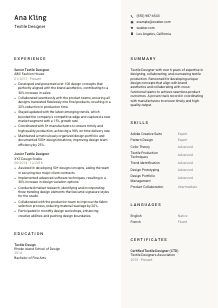
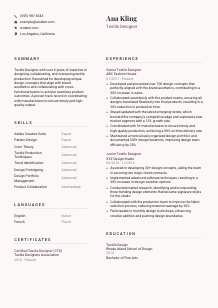
Weaving wonders, but your CV feels frayed? Check out this Textile Designer CV example, created with Wozber free CV builder. Learn how to blend your pattern prowess with job requirements, so your career story has the right touch and thread to impress!
Textile design hiring usually turns on a practical question fast: can you create prints, patterns, and material concepts that look distinctive on screen and still hold up through sampling and production? A CV for this field needs to show creative range, yes, but also how your ideas moved from concept boards and repeats into usable textiles, product lines, or commercially successful collections.
When that translation is clear, recruiters and product teams can quickly separate surface-level design experience from work that fits an actual development pipeline. Wozber's free CV builder helps shape that story into an ATS-compliant CV by aligning your wording with the posting, so your portfolio-minded creativity and production awareness are both easy to read from the first scan.
For Textile Designer roles, the header does more than identify you. It confirms basic eligibility, points hiring teams to your portfolio, and removes friction before they review your pattern work, software background, or production experience.
Set your name as the most visible text on the page. Textile design is a visual field, but your CV header should stay simple and polished rather than overly styled. A clean presentation suggests good editorial judgment, the same kind of judgment employers want in layout boards, colour stories, and portfolio curation.
Place "Textile Designer" directly under your name when that is the job you want. This removes ambiguity if your past titles vary, such as print designer, surface designer, or fabric designer. In a quick CV review, that label helps the team connect your experience to the opening immediately.
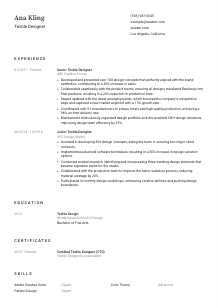
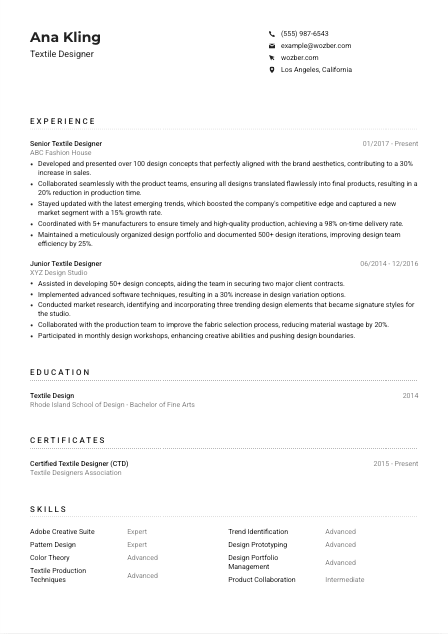
Some Textile Designer openings have location-based requirements because the work involves on-site collaboration with product teams, sample reviews, or supplier coordination. In the example posting, Los Angeles, California is explicitly required, so listing Los Angeles, California in the header helps confirm you meet that filter right away.
If you have an online portfolio, personal site, or strong LinkedIn profile, include it here. For a Textile Designer, this matters more than it does in many other professions because employers often want to see print repeats, colour development, material experimentation, and finished product application alongside the CV.
Keep this section precise, professional, and tailored to the posting. When your header confirms who you are, where you are based, and where your design work can be reviewed, the reader can move straight to your creative and production credentials.




Hiring managers in textile design look for more than taste. They want proof that your concepts supported brand direction, worked across development cycles, and translated into sellable, manufacturable output. Your experience section should make that process visible.
Start by marking the responsibilities and tools that appear repeatedly in the posting. For this role, that includes developing design concepts aligned to brand aesthetics, collaborating with product teams, understanding textile production, following trends, and working with manufacturers. Those are the themes your bullets should reflect, using the same terminology when it matches your actual work.
List your positions from most recent to oldest. For each role, include your job title, company name, and employment dates. In design hiring, this helps the reader quickly see your progression from supporting pattern development or research work into leading concept creation, cross-functional collaboration, or supplier-facing responsibilities.
Focus each bullet on work that matters in textile design: concept development, repeat design, trend research, material selection, production handoff, vendor communication, or collection support. Then tie that work to an outcome. The sample CV does this well by linking design concepts to a 30% sales increase and product-team collaboration to a 20% reduction in production time.
Numbers give hiring teams useful context when they reflect how textile design is measured. Good examples include number of concepts developed, collections supported, manufacturers coordinated, production lead-time improvements, sell-through impact, waste reduction, or on-time delivery rates. Metrics like documenting 500+ design iterations or coordinating with 5+ manufacturers show scope in a way that feels native to the job.
Prioritise experience that strengthens your case for the target role. Textile Designer CVs benefit most from work involving pattern creation, colour development, CAD software, fabric construction awareness, trend interpretation, and collaboration with development or production teams. If an older role is less relevant, trim it to the pieces that still show transferable design judgment or manufacturing awareness.
The most convincing experience section connects creative decisions to commercial or production outcomes. If a hiring team can see how your designs supported the brand and held up through development, you are giving them the information they need.
In textile design, education often matters because it points to formal training in pattern development, colour theory, fabric behaviour, and design process. Even when experience carries the most weight, your degree helps frame the technical base behind your creative work.
Read the posting closely and mirror the degree requirement where it genuinely applies. Here, the employer asks for a bachelor's degree in Textile Design, Fashion Design, or a related field. If your degree is directly aligned, make that easy to spot instead of burying it under less relevant academic detail.
Include your degree, field of study, school, and graduation year. That is usually enough for an experienced Textile Designer. The example CV keeps this section concise by listing a Bachelor of Fine Arts in Textile Design from Rhode Island School of Design, which immediately supports the role's educational requirement.
If your program focused on textile design, surface design, fashion textiles, print development, or related study, name that specialization clearly. Hiring teams often scan for direct alignment with pattern, fabric, and product-facing design work, so specificity helps.
Early-career candidates can strengthen this section with relevant coursework, capstone projects, or honors tied to weave construction, print design, dye methods, digital textile design, or material innovation. Once you have several years of professional experience, keep these additions selective and role-linked.
Student exhibitions, collaborative collections, sponsored projects, or research into sustainable materials can be worth adding when they support the kind of textile work you want next. Keep them brief and relevant. The point is to deepen your design foundation, not to turn the section into a full school profile.
Present your education as the training behind your design decisions. When the degree, field, and any relevant specialization are easy to find, the section quietly supports the rest of your CV.
Certificates matter most in textile design when they sharpen your professional profile. They can reinforce technical depth, specialised training, or continuing education in areas like textile processes, sustainability, CAD tools, or industry standards.
Some openings require specific certifications, while others treat them as optional. This posting does not require one, so certifications are supporting material rather than a deciding factor. That means you should only include credentials that add something meaningful to your design background.
Prioritise certificates tied to textile design, fabric development, colour systems, print software, sourcing, or production knowledge. A credential such as the sample's Certified Textile Designer can help reinforce specialization, especially when your target roles blend creative work with manufacturing coordination.
Add the issue date, and if relevant, the active range or renewal period. In a field shaped by changing software workflows, materials, and production methods, dates help show that your training is current rather than historical.
Update certifications as your career shifts. If you are moving toward performance textiles, sustainable sourcing, digital print workflows, or more advanced production oversight, this section should reflect that direction. Keep it aligned with the work you want recruiters to picture you doing next.
A short, relevant certification section can strengthen your profile without crowding the page. Use it to highlight specialised training that supports your design, technical, or production-facing experience.
A Textile Designer skills section should read like a practical toolkit, not a generic list of creative strengths. Employers want to see the mix of software, visual judgment, and production knowledge that lets you move from concept to manufacturable design.
Start with the technical and functional skills the employer names. In this case, that includes Adobe Creative Suite, textile production processes, colour and pattern ability, and collaboration with product teams. Add closely related skills only when they reflect real experience, such as repeat design, CAD development, prototyping, or trend research.
Arrange the section so it reflects actual practice. You might group design software, textile-specific technical skills, and collaboration or development skills. The sample CV handles this well by mixing tools like Adobe Creative Suite with craft-specific areas such as Pattern Design, Colour Theory, Textile Production Techniques, and Design Prototyping.
Do not overload this section with every tool or soft skill you have ever used. A focused Textile Designer profile is stronger when the skills support the role's likely workflow: concept creation, print and colour development, production feasibility, supplier communication, and documentation. Keep the list tight enough that every item adds to that picture.
Choose skills that reflect how textile design is actually executed, reviewed, and produced. When the section combines software fluency with pattern, colour, and production knowledge, it supports both ATS alignment and human review.
Language ability matters in textile design when the role involves cross-functional communication, supplier interaction, client presentation, or international production. Even when English is the only stated requirement, listing languages clearly helps define how you work across teams and markets.
If the posting names a language requirement, lead with it. Here, strong English proficiency is required, so English should appear clearly with an accurate proficiency level. That matters because design presentations, specification notes, and production communication all depend on precise language.
Put the languages you use most confidently and most professionally at the top. If you regularly communicate with overseas vendors, attend trade events, or work with multilingual teams, that ordering can help recruiters understand where your communication strengths will be most useful.
Additional languages are worth including when they support sourcing, manufacturing relationships, or global brand work. In the example CV, French adds useful range, even though it is not required. For some employers, that could be a plus in supplier communication or international market exposure.
Choose clear levels such as native, fluent, intermediate, or basic. Avoid overstating ability. In roles that involve vendor emails, specification clarification, or team presentations, an inflated language claim can create immediate problems once you are on the job.
Not every Textile Designer job will need multiple languages, but some will involve global manufacturing partners or market-facing collaboration. If language skills support that kind of environment, keep them. If they do not add anything relevant, let the section stay simple.
Treat this section as part of your collaboration profile. Clear language information helps employers understand how you can communicate across design, development, and production settings.
The summary is where you frame the kind of Textile Designer you are before the reader reaches your full work history. In a few lines, it should position your level, your design strengths, and your connection to production or brand outcomes.
Start with the core themes in the posting, then shape your summary around them. Here, the through-line is clear: concept development, brand alignment, software fluency, production understanding, and collaboration. Those themes should guide the wording instead of generic claims about creativity.
Open with your title and years of experience, then define your specialty. For example, "Textile Designer with 6+ years of experience creating brand-aligned prints and coordinating designs through production" says more than a broad statement about passion for design.
Choose strengths that map directly to the work, such as pattern development, colour direction, textile production knowledge, manufacturer coordination, or trend-led concept creation. The sample summary works because it balances creative contribution with cross-functional execution and production oversight.
Aim for a short paragraph that can be scanned in seconds. Remove filler phrases and keep each sentence doing a job. The best summaries give a hiring manager an immediate sense of whether you can design for the brand, collaborate with product teams, and support the path to final production.
A sharp summary helps the reader understand your design profile before they reach the details. Keep it concise, specific, and grounded in the kind of textile work you are ready to do next.
A Textile Designer CV works best when it shows more than artistic taste. It should connect your pattern and colour work to product development, production feasibility, and brand results in terms a hiring team can scan quickly.
Use each section to clarify a different part of that story, from location and portfolio access to measurable design outcomes, relevant training, and the tools you use to move ideas into production. Wozber's AI CV builder and ATS CV scanner can help you tailor that content to the job description, surface missing requirements, and shape an ATS-friendly CV format that keeps your real experience easy to read.
When the CV is finished, the employer should be able to see your creative range, your technical grounding, and how your designs perform beyond the concept stage.