



Use Wozber and land your dream job
Create CV
No registration required
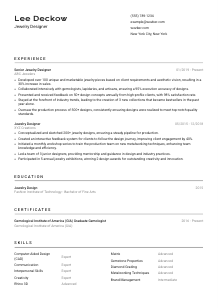
Fashioning exquisite pieces, but your CV lacks sparkle? Check out this Jewelry Designer CV example, made with Wozber free CV builder. It shows how to thread your artistic brilliance through the facets of a job description, presenting a career as dazzling as your creations!
Jewelry design CVs fall flat when they read like generic creative portfolios. Hiring teams want to see how you move from concept to finished piece, how well you understand stones and metals, and whether your designs can succeed in production as well as on paper. Your CV should make that design judgment visible, not hide it behind broad claims about creativity.
A tailored CV also helps separate pure concept talent from designers who can collaborate with gemologists, artisans, suppliers, and clients without losing the integrity of the piece. Using Wozber's free CV builder and an ATS-friendly CV format helps you align your wording with the posting while keeping your CAD experience, material knowledge, and client-facing design work easy to read in both ATS screening and human review.
Jewelry design is a relationship-driven field. Clients, production partners, and hiring managers all need quick confidence that they can reach you, place you in the right market, and review your work without friction. Keep your personal details clean, professional, and directly tied to how this role is hired.
Your name should be the clearest element at the top of the page. Use a professional font and slightly larger sizing so it reads like a recognizable byline, not decorative text. In a design field, polished presentation matters, but readability matters more than styling.
Place "Jewelry Designer" directly under your name if that is the role you are pursuing. This immediately positions you for the opening and keeps your CV aligned with ATS filters and recruiter searches. If your recent title was more senior, such as "Senior Jewelry Designer," you can still use the target title when it accurately reflects the job you want.
List a phone number and email address that are easy to scan and easy to trust. Avoid casual usernames. If you include a website or portfolio link, make sure it leads straight to relevant work such as rendered concepts, finished collections, sketches, or client-ready presentations rather than a cluttered landing page.
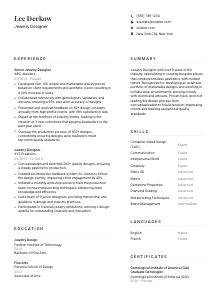
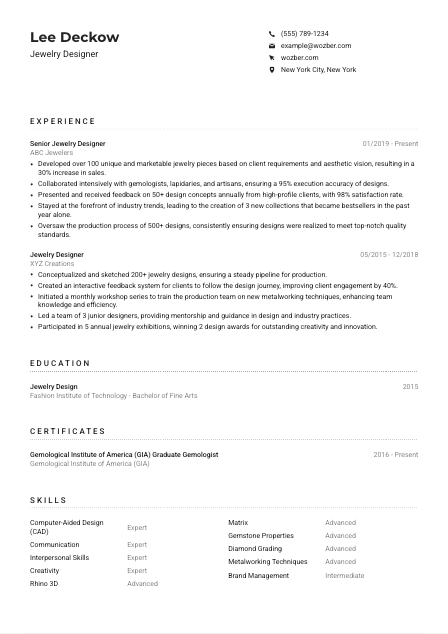
If the employer specifies a city requirement, include your city and state clearly. Here, "New York City, New York" addresses the location requirement right away and removes a common screening question. If you are relocating, state that plainly instead of leaving the employer to guess.
For jewelry design, a portfolio link is often as important as your phone number. Include it only if it is current and shows the kind of work you want to be hired for, such as bespoke pieces, commercial collections, bridal, fine jewelry, or CAD-driven development. Treat it as proof of design range and execution standards, not as an extra add-on.
This section should answer practical questions fast: who you are, what role you do, where you are based, and where your work can be reviewed. That clarity helps the reader move quickly to your design experience and portfolio.




In jewelry design, experience is not just a list of employers. It shows whether you can turn a brief into sketches, CAD models, production-ready specifications, and finished pieces that satisfy both the client and the market. Use this section to show design volume, collaboration, commercial results, and production oversight.
Before rewriting your experience bullets, pull out the actual work pattern in the job description. Here that includes developing unique pieces, collaborating with gemologists and artisans, presenting concepts to clients, tracking trends, and reviewing production quality. Those cues tell you which parts of your background to emphasize and which accomplishments belong near the top of each role.
Use reverse chronological order and include company name, title, and dates for each position. Jewelry hiring often values progression, so make it easy to see growth from designer to senior designer, lead designer, or collection-focused roles. A straightforward structure keeps the focus on your body of work and responsibilities.
Each bullet should show what you designed, who you worked with, and what happened as a result. Good examples include creating custom pieces, launching collections, translating client vision into approved concepts, or refining designs through stone and metal constraints. The sample CV does this well by pointing to over 100 marketable pieces, high client satisfaction, and close collaboration with gemologists and lapidaries.
Metrics give shape to your contribution. Useful numbers in this field include number of designs developed, collections launched, approval rates, production accuracy, sales lift, repeat client volume, exhibition wins, or quality outcomes across production runs. A bullet such as a 30% sales increase or oversight of 500+ designs tells a hiring manager far more than "created beautiful pieces."
Prioritise experience tied to design development, CAD, materials knowledge, client presentations, vendor or artisan coordination, and production review. If an older role does not help prove those strengths, shorten it. Every bullet should reinforce that you can create jewelry that is visually compelling, technically feasible, and commercially relevant.
Your experience section should leave no doubt that you can design, communicate, revise, and oversee execution. When those points are backed by volume, outcomes, and collaboration detail, your CV reads like a working designer's record rather than a list of duties.
Formal training matters in jewelry design because it grounds your creative work in technique, materials, and design discipline. Even with several years of experience, employers still look for relevant study in jewelry design, fine arts, or related fields, especially when the job posting names a degree requirement.
If the posting requires a bachelor's degree in Jewelry Design, Fine Arts, or a related field, place that qualification prominently. Match the wording as closely as your background allows. A "Bachelor of Fine Arts in Jewelry Design" speaks directly to the requirement and should appear before less relevant credentials.
List school name, degree, field of study, and graduation year or date range. Keep the layout simple and consistent. For a visually oriented profession, neat structure matters because it reflects professional discipline without distracting from the content.
If you have multiple degrees, diplomas, or design programs, put the strongest jewelry-related credential first. In the example, the Bachelor of Fine Arts in Jewelry Design does the most work because it aligns directly with the role, while the Fine Arts associate degree adds supporting foundation.
You do not need to turn this into a transcript, but selected coursework can help if it strengthens your fit. Include it when it supports skills such as CAD modeling, gemstone studies, metal fabrication, rendering, or collection development and when that knowledge is not already obvious elsewhere on the CV.
For a role asking for 5+ years of experience, your education section should be concise. Remove older school details, student awards, or beginner-level coursework unless they are unusually relevant. Let education confirm your foundation while your experience carries the heavier proof of design capability.
This section should quickly show that your creative instincts are backed by formal study in design, materials, and visual development. Then the reader can move on to the part that matters most for a mid-career jewelry designer: your portfolio-backed experience.
Certifications are especially useful in jewelry design when they strengthen your understanding of gemstones, grading, sourcing, or specialised craft knowledge. They are not mandatory in every opening, but the right credential can sharpen your profile when the role involves stone selection, quality discussions, or close collaboration with gem experts.
Focus on credentials that deepen your authority in areas tied to the role. For this job, knowledge of gemstone properties and diamond grading is part of the brief, so a credential such as GIA Graduate Gemologist adds clear value. It tells the employer you can speak the language of materials as well as design.
A short list of respected certifications is stronger than a crowded section of loosely connected courses. Include the credentials that help explain your design decisions, material judgment, or production communication. Leave out anything that does not add weight to the kind of jewelry work you want to do.
Dates help the reader understand whether the credential is current, ongoing, or earned earlier in your career. This matters in areas such as grading standards, sourcing practices, and technical education. A clean date range is enough. There is no need to over-explain.
Jewelry design evolves with materials, market tastes, and production methods. If you complete new coursework in CAD, stone identification, bench techniques, or luxury product knowledge, update this section. Current learning shows that your design practice is active and informed by industry changes.
The right certification section gives extra confidence in your technical judgment. When it supports the exact kind of work named in the posting, it becomes more than a credential line. It helps explain why your designs can hold up in real production and client conversations.
A jewelry designer's skill section should show more than taste and creativity. It needs to capture the tools, material knowledge, and collaboration skills that shape finished pieces. Keep it focused on what helps you develop, present, revise, and realize designs successfully.
Start with the language in the posting and note both technical and interpersonal requirements. Here that includes jewelry CAD, gemstone properties, diamond grading, metalworking techniques, communication, and collaboration. Those are the terms to reflect if they genuinely match your background.
List technical tools such as Rhino 3D, Matrix, or other jewelry-specific CAD platforms alongside material expertise like gemstone knowledge and metalworking. That combination matters because employers are hiring for designers who can create visually compelling concepts and understand how those concepts translate into stones, settings, and finished construction.
Do not overload this section with every creative or business skill you have used. Choose the skills most relevant to the position and support them elsewhere in the CV through experience bullets. In the example, CAD, Rhino 3D, Matrix, gemstone properties, diamond grading, and communication all reinforce the responsibilities named in the posting.
Your best skill section shows range across software, materials, and communication. That mix tells the reader you can move comfortably between concept development, technical refinement, and collaborative execution.
Language skills matter in jewelry design when the role includes client meetings, supplier coordination, artisan communication, or international exposure. Even when only one language is required, listing your proficiency clearly can remove uncertainty around presentations, feedback sessions, and day-to-day collaboration.
If English competency is required, list English clearly and use an accurate proficiency level such as Native, Fluent, or Professional. This matters in a role where you may need to present design concepts, explain revisions, and discuss material choices with clients and production partners.
Place the required or most useful language first, then add others that may support the market or client base you work with. A clean order helps the reader understand how you communicate in professional settings without searching through the section.
Extra languages can strengthen your profile, especially if you work with international suppliers, luxury clients, exhibitions, or global fashion markets. They are not a substitute for design ability, but they can support relationship-building and smoother cross-border communication.
Choose clear levels and avoid overstating fluency. In client-facing design work, language ability becomes obvious quickly during concept reviews, sourcing discussions, and feedback meetings. Accurate labeling protects your credibility.
If a language has helped you work with overseas vendors, attend trade shows, or present collections to international buyers, it is worth listing. For example, French may be useful in luxury or fashion-adjacent circles, but it should appear as an added strength rather than distract from the required English competency.
List the languages that help you communicate in real design and production settings. That gives the employer one more reason to trust you in client discussions, supplier coordination, and collaborative creative work.
Your summary should sound like an experienced jewelry designer describing the kind of work they do best. In a few lines, it needs to connect your years of experience with your design strengths, technical fluency, and the kind of outcomes you produce. Keep it specific enough to feel credible and broad enough to fit the target role.
Start with your title and years of experience, then add the focus of your work. For example, you might reference bespoke design, commercial collections, bridal, luxury accessories, or CAD-led product development. This gives immediate context instead of a vague statement about being creative or passionate.
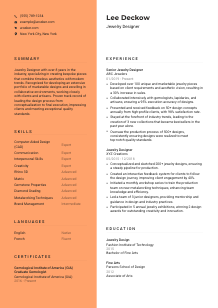
Match your summary to the job's actual needs. If the employer wants marketable designs, client collaboration, CAD proficiency, and production oversight, those ideas should appear in your opening paragraph when they are true for you. The sample summary works because it links bespoke design, marketable pieces, collaboration, and end-to-end execution.
Aim for three to five lines with specific language such as design development, gemstone knowledge, collection success, client presentations, or quality-focused production review. Avoid general claims that could apply to any creative professional. The reader should be able to picture the kind of jewelry work you do.
End on a practical contribution, such as creating commercially viable collections, translating client vision into wearable pieces, or guiding designs from sketch through final realization. That closing line should point to how you work, not just how you describe yourself.
A well-written summary gives the employer a fast read on your design identity, technical range, and collaborative value. When it matches the role closely, it sets up the rest of the CV to confirm that impression with specifics.
A jewelry designer CV should show more than artistic taste. It should make clear that you can develop original concepts, work confidently with CAD and materials, respond to client input, and protect quality through production. When each section points to that pattern, the document starts to read like a professional design record rather than a generic creative CV.
Use Wozber's AI CV builder to sharpen that alignment, strengthen ATS optimisation, and organise your experience in an ATS-compliant CV that keeps your portfolio-backed strengths easy to find. The result should make one thing easy to judge: you can create jewelry that is both beautiful and buildable.