




Use Wozber and land your dream job
Create CV
No registration required
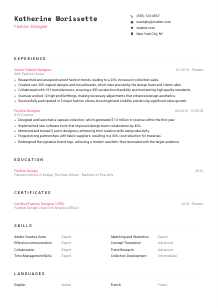
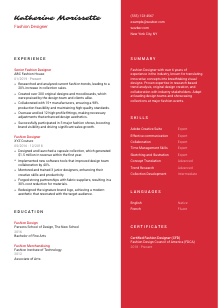
Sketching style journeys, but your CV lacks the runway flair? Tailor your contours with this Fashion Designer CV example, created with Wozber free CV builder. Learn how to thread your design dexterity into job blueprints, stitching your career as chicly as your creations!
Fashion design CVs are read with one question in mind very early: can this designer turn trend insight into collections that work beyond the sketchbook. Hiring teams look for proof of concept development, visual communication, fittings, and production follow-through, because strong taste alone does not carry a collection from mood board to showroom or runway.
A tailored CV makes that progression easier to follow, especially when an ATS is sorting for terms tied to design software, trend research, fittings, and collaboration with manufacturers. Wozber's free CV builder helps organise those details into an ATS-compliant CV that surfaces how you design, refine, and deliver work in a real fashion business.
In fashion hiring, the header does not need personality tricks. It needs to identify you clearly, connect you to the target role, and remove basic friction around contact, portfolio access, and any location requirement named in the posting.
Set your name at the top in a clean, readable style. Fashion is a visual industry, but your CV header is not the place to experiment with decorative typography that could distract from the rest of the page or create parsing issues in an ATS-friendly CV format.
Place "Fashion Designer" directly under your name if that is the job you are targeting. This keeps your positioning clear and helps when recruiters or applicant systems scan quickly for role alignment. If your background is more specialised, such as womenswear, technical design, or accessories, use that only when it fits the opening.
Keep this section practical and professional so a hiring manager, recruiter, or design director can reach you without delay.
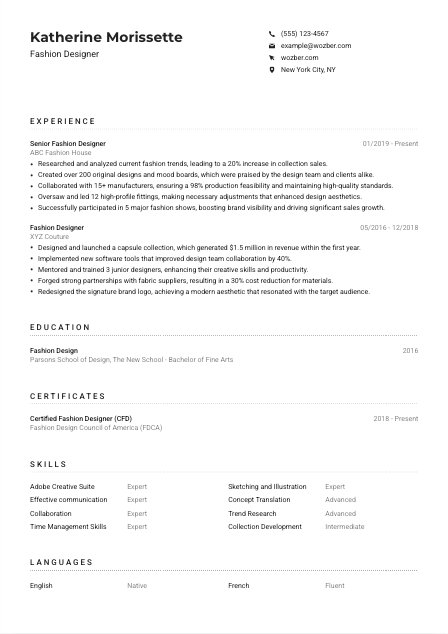
If a role specifies a city requirement, show your city and state clearly. In the example here, New York City, NY matters because the job asks for candidates based there. That is a tailoring choice tied to this opening, not a universal rule for every fashion design job.
For many fashion roles, your portfolio carries as much weight as the CV itself. Include a working link to a site or portfolio page that shows sketches, mood boards, collections, fittings, technical development, or show work that matches the kind of design role you are pursuing.
Your personal details should make three things obvious within seconds: who you are, what role you are targeting, and how to review your work. If that information is clean and complete, the hiring team can move straight to your collections, process, and results.




Fashion design experience is strongest when it shows the full path from research to finished product. Hiring teams want to see how you shaped concepts, worked with internal and external partners, handled fittings, and contributed to collections that sold, shipped, or raised brand visibility.
Start by marking the parts of the posting that describe actual day-to-day work. For a Fashion Designer, that often includes trend research, mood boards, original design development, production coordination, fittings, and event or show participation. Those are the experiences your bullets should bring forward first, instead of listing generic design responsibilities.
List your most recent design work first, then move backward. For each role, include your title, employer, and dates. This helps hiring teams quickly understand your level, whether you progressed from assistant or designer roles into senior ownership, and how recently you handled collection development or production-facing work.
Every bullet should show a concrete contribution. Name the work, the process, and the outcome. The sample CV does this well by pairing tasks with deliverables, such as creating more than 200 original designs and mood boards, collaborating with manufacturers, and leading fittings. That kind of wording shows both creative output and execution.
Quantify what changed because of your work. In this field, useful metrics include collection sales, number of designs created, number of fittings led, production feasibility rates, supplier savings, event participation, or revenue from a launch. A bullet like "led trend research that contributed to a 20% increase in collection sales" carries much more hiring value than "responsible for trend analysis."
Keep the section focused on relevant fashion work. If a bullet does not help explain your design eye, workflow, collaboration, technical ability, or collection impact, remove it. Even interesting side tasks should stay off the page if they pull attention away from the kind of fashion design work the employer needs filled now.
By the time someone finishes your experience section, they should understand how you research, design, refine, and deliver collections in a commercial setting. Make that progression visible, and your CV starts reading like someone who can contribute from the first design review.
Education matters in fashion design because it helps establish technical foundation, design training, and familiarity with how collections are developed. When a posting asks for a bachelor's degree in Fashion Design or a related field, your education section should answer that requirement without making the reader hunt for it.
Lead with the credential that best matches the posting. If the role asks for a bachelor's degree in Fashion Design, place that degree at the top when you have it. In the example, the Bachelor of Fine Arts in Fashion Design directly addresses the academic requirement.
List the school, degree, field of study, and graduation year in a consistent structure. Fashion hiring teams do not need extra decoration here. They need to identify your training quickly and move back to the portfolio, design work, and production experience.
Use the exact field name when it aligns with your background. "Fashion Design" should appear clearly if that is your degree area. If your degree is adjacent, such as textile design, apparel design, or fashion merchandising, present it accurately and let your experience section carry the rest of the match.
Early-career designers can include standout coursework, thesis collections, competitions, or school collaborations with brands or manufacturers. More experienced designers can usually keep this section lean unless a specific academic project is highly relevant to the role or market segment.
If you have distinctions, awards, or a recognized industry credential, make sure they are visible either here or in the certificates section. They are supporting proof of training and professional development, especially when they connect to apparel design, technical execution, or collection work.
This section should settle the degree question in a few seconds. Once that is clear, the rest of the CV can focus on the work employers care about most: design output, production judgment, and commercial results.
Certificates are secondary to portfolio quality and professional experience in most fashion design searches, but the right one can strengthen your profile. They work best when they show current industry engagement, specialised training, or a clear extension of your design practice.
Choose certificates tied to fashion design, apparel construction, technical design, software proficiency, sustainable fashion, textile knowledge, or other directly relevant areas. Skip general certificates that do not add anything to how you design or collaborate in a production environment.
Fashion changes quickly, and recent learning carries more weight than vague credential lists. Include the year earned or active date range. The sample CFD entry works because it shows both the credential name and that it remains current.
If your target roles are moving toward digital fashion tools, sustainability, luxury ready-to-wear, or technical product development, your certificates should move with that direction. This section is one place where continuing education can show how your design practice is developing.
A short list of credible, relevant credentials is stronger than a crowded block of marginal courses. Each item should earn space by connecting to design capability, production understanding, or industry specialization.
Certificates will not replace a thin portfolio or weak experience bullets, but they can sharpen your positioning. Keep them current, relevant, and clearly connected to the kind of fashion design work you want next.
The skills section should read like the working toolkit behind your collections. For fashion design roles, that means a practical mix of design software, sketching ability, concept development, communication, and the collaboration skills needed to move from idea to production.
Start with the capabilities named in the posting, then add adjacent skills you genuinely use. Here, Adobe Creative Suite, sketching, illustration, communication, collaboration, and time management all belong because they reflect how fashion designers present concepts, iterate with teams, and meet development calendars.
Do not stack this section with software alone. Fashion design hiring usually blends visual ability with execution and coordination. Alongside Adobe tools, include skills such as trend research, mood board creation, fittings, concept translation, supplier collaboration, or collection development when they match your experience.
Prioritise the skills most likely to matter in the first screening pass. A concise list of relevant capabilities is easier to scan than a long inventory. If you are applying through an ATS CV scanner, matching the job language naturally here can also improve alignment without turning the section into a keyword dump.
Your skills section should make the hiring team expect disciplined, production-aware design work. If the list reflects how you actually research, create, present, revise, and collaborate, it is doing its job.
Language ability matters in fashion when the job involves presentations, cross-functional communication, supplier coordination, or international exposure. Keep this section practical and tied to how language supports your work.
If the job calls out a language, list it clearly and use an honest proficiency level. In this case, English is explicitly required, so it should appear first or near the top of the section.
Do not bury a required language under optional ones. Hiring teams need to know quickly whether you can present concepts, discuss revisions, handle meetings, and write clearly in the working language of the role.
Extra languages can be useful when your work involves international suppliers, global fashion weeks, overseas production partners, or multilingual clients. French, Italian, or other languages can add value when they reflect real communication ability and relevant market context.
Terms like "Native," "Fluent," "Professional," or "Conversational" are enough. Avoid vague wording. The reader should understand right away how comfortably you can handle design reviews, emails, presentations, or vendor communication in that language.
For jobs centered on domestic design teams, languages may be a small supporting detail. For roles with global sourcing or international brand exposure, they can become more important. Let the posting determine how much emphasis this section deserves.
Language skills should clarify how you communicate in the settings that matter for the role, whether that is an internal design review, a supplier call, or a client presentation. Keep the section accurate and useful.
Your summary needs to establish your level, your design strengths, and the kind of work you have handled before the reader reaches the first job entry. In fashion, a good summary quickly links creative direction with commercial and production reality.
Read the posting closely and identify the two or three themes that matter most. For this role, trend research, original design creation, software fluency, collaboration, fittings, and event participation are stronger summary material than broad statements about passion or creativity.
Open with a direct line that tells the reader how long you have worked in fashion and what kind of designer you are. The example summary starts well with "Fashion Designer with over 6 years of experience," which immediately establishes professional level.
Use the next lines to show how you work and what your work produces. Mention strengths such as trend analysis, original concept development, mood boards, fittings, manufacturer collaboration, or collection launches, especially when you can tie them to outcomes like sales growth, production feasibility, or stronger brand visibility.
Aim for a short paragraph that sounds grounded in actual fashion work. Three to five lines are usually enough. Avoid inflated language and focus instead on the combination of creative judgment, technical execution, and collaboration that defines your profile.
Your summary should give a design director or recruiter a fast, accurate read on your level and working style. If those opening lines connect your creative strengths to collection execution and business results, the rest of the CV has a strong foundation.
A Fashion Designer CV should now show more than taste or title progression. It should make your process visible, from research and concept development to fittings, production coordination, and collection impact.
Use Wozber's AI CV builder, ATS CV scanner, and ATS-friendly CV templates to align your wording with the posting, surface missing requirements, and present your experience in an ATS-friendly CV format. The final result should make it easy to judge whether you can design work that is both original and ready for production.




