



Use Wozber and land your dream job
Create CV
No registration required
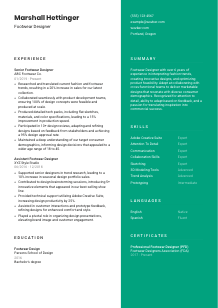
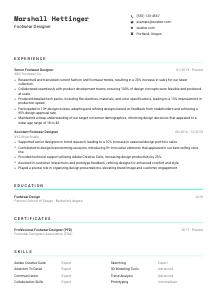
Sketching trendy shoe silhouettes, but your CV feels out of fashion? Step into this Footwear Designer CV example, created with Wozber free CV builder. Learn how to lace your creative flair with job criteria, ensuring your career journey is as sleek and innovative as the kicks you design!
Footwear design sits at the intersection of trend instinct and production discipline. Hiring teams want to see more than taste. They need proof that you can turn market research, consumer insight, sketches, materials, and construction details into shoes that can actually move through development and reach the floor.
That is why CV tailoring matters so much in this field. When your wording reflects how footwear programs are really built, from trend research to tech packs and cross-functional reviews, Wozber's free CV builder helps you shape an ATS-compliant CV that surfaces the right terms and gives a clearer read on your design range, technical process, and commercial judgment.
Footwear hiring often moves quickly from CV to portfolio review, so your contact details need to be clean, credible, and immediately usable. This section is simple, but it still carries practical signals about professionalism, availability, and whether you meet any location-based requirement in the posting.
Set your name in a clear, readable format that feels polished rather than decorative. In design hiring, your portfolio will carry the visual storytelling. Your CV header should make it easy to identify you, save your details, and move to your work samples without friction.
Place "Footwear Designer" beneath your name when that is the role you are pursuing. It helps frame the rest of the CV around footwear-specific work such as trend translation, sketching, material direction, and product development collaboration instead of leaving you looking broadly like a fashion or accessories candidate.
Include a phone number you answer, a professional email address, and any link you actively maintain. For footwear roles, a portfolio link is especially valuable because hiring managers often want to compare your CV claims with actual sketches, renders, line plans, outsole ideas, or finished product examples.
Some footwear jobs are tied closely to in-office design reviews, sample evaluations, or collaboration with development teams. Here, the employer asks for Portland, Oregon, so listing Portland, Oregon in your header immediately removes a practical question. If a future posting does not mention location, keep this line accurate but avoid treating one city requirement as universal.
If you include LinkedIn or a personal site, make sure it reflects the same story as your CV. A footwear portfolio should show more than polished final images. Include process work such as trend boards, colour exploration, line drawings, material selections, tech pack excerpts, or prototype iterations so your cross-functional design ability is visible.
Keep this section concise, accurate, and aligned with the posting. It should make you easy to contact and easy to place in the footwear design pipeline before anyone even opens your portfolio.




This is the section that usually decides whether a Footwear Designer looks commercially ready. Hiring teams read your experience for evidence that you can research trends, develop concepts, communicate construction clearly, respond to feedback, and work with product development so strong ideas survive manufacturing constraints.
Read the posting for the actions behind the title. In this case, the priorities include trend research, innovative yet marketable design, detailed tech packs, collaboration with product development, and adaptation during design reviews. Those are not buzzwords. They are the actual workflow stages your bullets should reflect.
List your roles in reverse chronological order with job title, company, and dates. Then make the bullets do the heavier work by showing what kind of footwear work you handled, how far you carried concepts through development, and who you worked with along the way, whether merchandisers, developers, material teams, or stakeholders in review meetings.
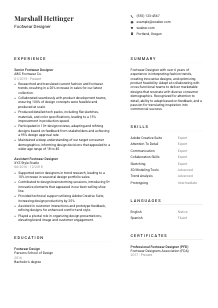
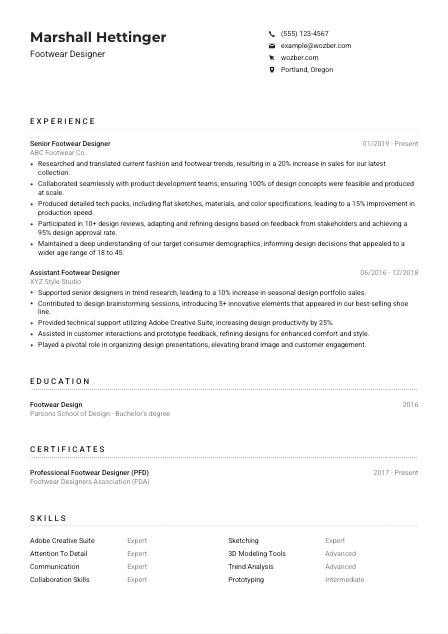
Generic design language gets ignored fast. Focus on achievements tied to sell-through, approval rates, collection performance, development speed, or improved feasibility. The sample CV does this well by linking trend research to a 20% sales increase and tech pack quality to a 15% improvement in production speed. Those numbers make the design work feel connected to business results and factory execution.
Not every bullet needs a percentage, but footwear CVs benefit from measurable context. That might include number of seasonal styles developed, approval rate in design reviews, reduction in sample rounds, speed to production, revenue impact, or adoption across target consumer segments. Metrics help show that your sketches led to outcomes, not just concepts.
Prioritise experience that proves you can translate trend direction into product. If you have adjacent work in fashion, accessories, or retail, keep only the parts that show transferable value such as material knowledge, consumer research, rendering, or client presentations. Save general duties and weaker bullets for another version of your CV.
The best experience sections make it easy to follow your work from concept to approval to production. When that chain is visible, your CV reads like someone who can contribute on day one.
Education matters in footwear hiring because it helps establish your formal grounding in design principles, materials, construction, and visual communication. Once you have a few years of experience, this section becomes shorter, but it still needs to show that your training supports the kind of product work the role requires.
If the posting asks for a bachelor's degree in Footwear Design, Fashion Design, or a related field, make sure your most relevant degree is easy to find. A direct match, such as the sample's Bachelor's degree in Footwear Design, checks an important box quickly and keeps the review focused on your work rather than your academic fit.
List the degree, field of study, school, and graduation year or date. Recruiters and hiring managers often review this section quickly, so a clean structure helps them confirm your background without searching for the basics.
If your degree is directly tied to footwear, accessories, fashion, industrial design, or a related product discipline, spell that out clearly. The field of study often tells more than the degree label itself, especially when the role involves sketching, rendering, and technical communication with development teams.
Coursework is most useful early in your career or when your degree title is broad. Include subjects that support footwear work, such as footwear construction, materials, colour theory, CAD, 3D modeling, technical drawing, or consumer-focused design research. Leave it out if your experience already covers that territory well.
You do not need to turn this into a full school profile. Add honors, design competitions, thesis projects, or collaborative studio work only when they reinforce your direction as a footwear designer and connect to the role's needs, such as innovation, presentation ability, or technical development.
This section should confirm that your design training supports the work on the page. Once that is clear, your experience and portfolio can carry the rest.
Certifications are rarely the deciding factor for a Footwear Designer, but the right ones can sharpen your profile. They are most helpful when they reinforce software capability, technical development knowledge, or ongoing engagement with the craft and business of footwear.
Start with the posting. This role does not require a certificate, so there is no need to pad the section. Use it only when the credential supports a real capability, such as advanced Adobe workflow, 3D footwear modeling, material specialization, or industry-specific training.
Choose credentials that connect directly to the work. A footwear design certification, digital rendering program, or technical course in product development carries more weight here than a general creative workshop. The sample's Professional Footwear Designer credential works because it stays close to the role rather than drifting into broad fashion branding.
Dates help show whether the training is current, especially for software, digital design tools, or technical methods that evolve over time. If the certificate is active or renewed, include that detail in a clean, readable way.
One or two relevant credentials are enough. This section works best when it shows you have kept building the skills that affect footwear work today, whether that is 3D design, rendering, materials knowledge, or better communication of specs for production teams.
Add certificates when they strengthen your technical credibility or show recent growth in footwear design practice. If they do not sharpen your match for the role, keep the section lean.
Footwear teams look for a mix of creative range and technical reliability. Your skills section should show that you can generate concepts, communicate them clearly, and work through the practical demands of development, revisions, and production preparation.
Read the posting closely, then translate it into skill categories. Here that means design software proficiency, sketching and rendering, 3D modeling, attention to detail, communication, collaboration, and consumer-aware trend research. These skills matter because they map directly to daily footwear design tasks.
Lead with the skills that support concept creation and handoff to development. Adobe Creative Suite, 3D modeling tools, sketching, rendering, tech pack creation, materials and colour specification, trend analysis, and prototyping are all stronger than broad terms like "creative" or "team player." The sample skills list is strongest where it names concrete tools and process-based abilities.
Use straightforward skill names rather than long descriptive phrases. That helps both human readers and ATS optimisation. If you are using Wozber's AI CV builder or ATS CV scanner, compare your wording with the posting so the skills section naturally includes the software, design methods, and collaboration language the employer is using.
Every skill listed here should connect to something you can show in your experience or portfolio, whether that is a render, a tech pack, a review cycle, or a line that reached production.
Language ability matters in design roles when it affects presentations, customer conversations, supplier communication, or cross-market collaboration. For footwear positions, this section is usually brief, but it should still reflect the communication demands named in the posting.
This posting asks for proficiency in English for customer interactions, so English needs to appear clearly on the CV. When a language is named in the description, treat it as a requirement rather than an optional detail.
Use simple levels such as Native, Fluent, Intermediate, or Basic. If you present design concepts, join cross-functional meetings, or speak with customers, accuracy matters. Overstating language ability can become obvious very quickly in interview or presentation settings.
Additional languages can help in global footwear environments, especially when brands work across international factories, regional markets, or multilingual consumer groups. Spanish in the sample CV is a good example of a second language that can add practical value without distracting from the required English proficiency.
Do not overbuild this section if language is not central to the role. For most footwear design CVs, a short list with clear proficiency levels is enough unless the position involves heavy international communication or market-specific work.
If a second language supports vendor conversations, customer-facing work, or trend research across markets, it can strengthen your candidacy. The key is relevance. List languages that support the way you actually work, not just every language you have studied.
Language skills should confirm that you can communicate where the job requires it. Keep the emphasis on clear proficiency and practical relevance.
Your summary sits at the top of the CV, so it has one job: establish what kind of footwear designer you are and what you consistently deliver. In a few lines, it should connect your experience level, design strengths, and business impact without repeating half the skills section.
Before writing, identify the core through-line of the position. For this one, that means translating trends into marketable footwear, collaborating across functions, producing detailed design documentation, and responding well to review feedback. Your summary should reflect that kind of operating range, not just say you are passionate about design.
Start directly. A line such as "Footwear Designer with 6+ years of experience" gives immediate context and tells the reader where to place you. Then add your strongest area of contribution, whether that is trend-led concept development, commercial product design, performance footwear, lifestyle collections, or technical package execution.
Choose strengths that the rest of the CV can support. Strong examples here include trend research, sketching and rendering, Adobe Creative Suite, 3D modeling, tech pack development, cross-functional collaboration, or consumer-informed design decisions. The sample summary works because it ties experience to marketable design and team collaboration instead of staying vague.
Close with the kind of impact you bring, such as helping collections perform commercially, improving production readiness, or creating product that resonates with a defined consumer group. Keep the whole section to 3 to 5 lines so it reads like a focused introduction rather than a paragraph from a cover letter.
A strong summary tells the hiring team, within seconds, whether you look like someone who can take a concept from trend insight to production-ready footwear. Use Wozber's free CV builder, ATS-friendly CV templates, and ATS CV scanner to sharpen that positioning and keep every section aligned with the job. Your CV should now make your design process, technical fluency, and commercial awareness easy to read.
A Footwear Designer CV works best when it connects creative direction to execution. Trend awareness, sketching ability, software fluency, tech pack accuracy, and collaboration with development teams all need to show up as part of one coherent product story.
Use Wozber to build that story in an ATS-friendly CV format, tailor your language to the posting, and check alignment with an ATS CV scanner before you apply. When the CV is done well, hiring teams can quickly see that you are ready to contribute to real footwear lines, not just generate attractive concepts.