




Use Wozber and land your dream job
Create CV
No registration required
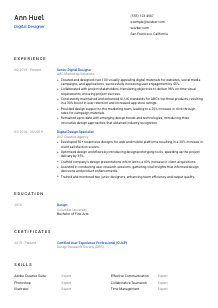
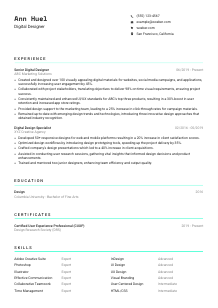
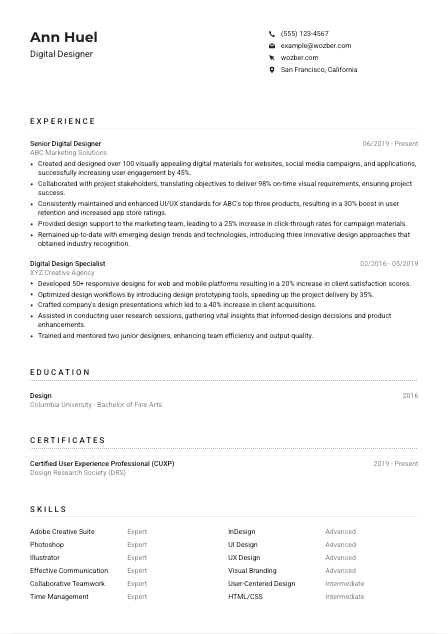
Digitally crafting graphics, but your CV feels pixelated? Check out this Digital Designer CV example, created with Wozber free CV builder. It shows how to blend your creative flair with job requisites smoothly, designing a career path that's always high-resolution and perfectly in focus!
Digital design work gets reviewed through the quality of the output and the thinking behind it. Hiring teams want to see that you can move between brand visuals, product surfaces, campaign assets, and user experience decisions without losing consistency. Your CV needs to show that range in practical terms, from the platforms you design for to the results your work produced.
A tailored CV changes how quickly your background reads as relevant for digital design instead of adjacent creative work. When the language reflects web, social, app, UI/UX, and cross-functional delivery, both reviewers and an ATS can place you faster. Wozber's free CV builder helps shape that alignment in an ATS-friendly CV format so your experience reads clearly as design work that supports product, marketing, and user engagement.
This section should feel clean, current, and easy to act on. For digital designers, the basics matter, but so does one extra detail many other roles can skip: a direct path to your portfolio or professional site, where the visual work and interface thinking live.
Place your name at the top in a readable format that feels polished, not decorative. Digital design roles value visual judgment, but your CV header is still an information block first. Keep it simple, easy to scan, and consistent with the visual restraint you would use in a landing page header or app interface.
Add "Digital Designer" directly under your name when that is the role you are applying for. This immediately connects your CV to the job description and helps separate you from broader profiles like Graphic Designer or UI Designer. If your current title differs slightly, keep your official title in experience and use the target title in the header when it accurately reflects your work.
Include a phone number you answer, a professional email address, and links that open cleanly. Broken links and outdated contact details create doubt fast, especially in a profession where precision matters. If you include a portfolio, make sure the URL is short, current, and points to work that reflects digital campaigns, web layouts, product screens, or other relevant outputs.
Some digital design roles are flexible, and some are tied to a studio, product team, or local collaboration model. Here, listing San Francisco, California directly supports a stated requirement. Handle location this way when it is clearly requested, but do not treat city matching as a universal rule for every Digital Designer application.
For digital design, a portfolio link is often as important as your contact details. It should reinforce the same story your CV tells. If your experience highlights UI/UX improvements, campaign assets, and responsive design, your portfolio should show those categories clearly. A website link, like the one in the example CV, works well when it leads straight to selected work rather than a generic homepage.
Your personal details should make it easy to contact you, place you correctly for the role, and review your work without extra searching. For a Digital Designer, that means clean basics plus a portfolio link that supports the kind of digital output the job actually requires.




This is the section where digital designers distinguish themselves from general creative candidates. Hiring teams look for platform-specific work, collaboration with product or marketing partners, and outcomes tied to engagement, usability, launch support, or brand consistency across screens.
Before editing bullets, identify the work patterns in the posting. In this case, the role combines digital asset creation, UI/UX standards, stakeholder collaboration, and support for marketing and product teams. Your experience section should mirror those areas using your real projects, tools, and results rather than generic statements about being creative or detail-oriented.
For every position, list your title, company, and dates in a way that is easy to scan. That structure matters because reviewers often read experience quickly before they study the bullets. A title like "Senior Digital Designer" or "Digital Design Specialist" already frames scope, while the company name can hint at whether your work was agency, in-house, product-led, or campaign-focused.
Your strongest bullets should connect what you designed, where it appeared, and what changed because of it. Good digital design bullets mention outputs such as websites, social campaigns, app screens, responsive layouts, feature-release assets, or visual systems, then tie them to performance. The example CV does this well with points like designing more than 100 digital materials and increasing user engagement by 45%, which gives the reader both volume and business impact.
Quantified results are especially persuasive when they reflect how digital design is measured. Engagement lift, click-through rate, user retention, app ratings, delivery speed, campaign performance, satisfaction scores, and on-time completion all make sense here. The sample bullets use several of these naturally, including a 25% increase in click-through rates and a 30% boost in user retention, which tells a much stronger story than saying the work was "successful."
Prioritise experience that shows screen-based design, UX awareness, collaboration, and brand application across digital touchpoints. Older print-heavy or loosely related creative work can stay, but it should not dominate if you also have web, app, or campaign design experience. If you have mixed experience, lead each bullet with the digital part of the work, such as responsive design, prototyping, social creative, or UI improvements.
Your experience should make it easy to see where you have designed, what platforms you supported, how you worked with stakeholders, and what your design choices improved. An ATS-friendly CV format from Wozber helps those achievements stay structured and readable while keeping the focus on real digital design results.
Digital design hiring usually leans heavily on portfolio and experience, but education still matters when a role asks for a specific degree background. This section should confirm your formal training without taking space away from the work you have already shipped.
If the posting calls for a bachelor's degree in Design, Fine Arts, or a related field, make sure that information is easy to find. Use the full degree name and field exactly as earned. In the example, "Bachelor of Fine Arts" in Design aligns neatly with the requirement and removes any ambiguity about academic background.
List degree, school, and graduation date in a clean order. Digital design roles do not need an overbuilt education section unless you are early in your career. Treat it like a well-structured content block in a UI. Clear hierarchy, no clutter, and no unnecessary description unless it adds relevant context.
Avoid shortening or paraphrasing your degree if the exact wording strengthens alignment. "Bachelor of Fine Arts in Design" or "Bachelor's degree in Visual Communication" gives a reviewer immediate context about your training. Accuracy also helps when applicant tracking systems scan for degree-related requirements.
Relevant coursework can help if you are newer to the field or if your degree title is broad. Classes in user-centered design, interaction design, typography, digital media, visual systems, or web design can reinforce your preparation for digital work. Once you have several years of professional experience, coursework should stay secondary to shipped work and measurable outcomes.
Awards, design competitions, leadership roles, or extracurricular work are useful when they show craft, initiative, or collaboration. Include them if they add substance, especially for early-career candidates. For a designer with several years of agency or in-house experience, keep this section lean unless the distinction is genuinely notable.
This section should quickly establish that you meet the academic baseline and have formal grounding in design. For most Digital Designer CVs, that is enough. Let the portfolio and experience carry the heavier proof of execution.
Design tools, UX practices, accessibility expectations, and digital workflows change fast. Certifications are useful when they show current learning in areas that affect your day-to-day work, especially user experience, interface design, research, or platform-specific tools.
Start with the posting. Many Digital Designer roles do not require certifications, but some value UX, accessibility, or specialised platform credentials. In this example, no certificate was mandatory, so the right move is to use certifications as supporting proof rather than treating them as a central qualification.
List credentials that connect to the work you want to do. For a role involving UI/UX standards and user-centered design, a UX-related certification is more valuable than a generic course completion. The example CV's Certified User Experience Professional credential supports the job's emphasis on user experience best practices and makes the candidate's design scope look broader than pure visual production.
Add the year earned, and if relevant, the validity period. This helps employers see whether the learning is current. In digital design, recent study in areas like UX, prototyping, accessibility, or design systems often carries more weight than older software certificates that no longer reflect current workflows.
Use this section to show that your design practice is evolving with the field. Courses or certifications in accessibility, motion design, Figma workflows, user research, or mobile interaction patterns can all strengthen a modern Digital Designer profile when they match the target role. Update the section as your toolset and focus areas change.
Certificates work best when they sharpen your positioning. For Digital Designers, that usually means showing stronger UX depth, newer platform knowledge, or current methods that support better visual and product decisions. Wozber's ATS CV scanner can help you see whether those credentials reinforce the language used in the job description.
A digital design skills section should show both execution and collaboration. Employers expect visual software fluency, but they also look for UI/UX judgment, user-centered thinking, and the ability to work with product managers, marketers, developers, and other stakeholders.
Start with the tools, methods, and working habits named in the job description. Here, that includes Adobe Creative Suite, Photoshop, Illustrator, InDesign, user-centered design, UX best practices, communication, and collaboration. Those are the terms your skills section should reflect when you genuinely have them, because they match how the work is scoped and screened.
Do not reduce your skills list to software only. Digital design roles sit at the intersection of craft and collaboration, so pair tools with applied capabilities such as UI design, UX design, visual branding, responsive design, prototyping, and stakeholder communication. The example CV does this well by combining Adobe tools with communication, teamwork, UI, UX, and user-centered design.
Order matters because reviewers often skim this section for an instant match against the role. Lead with the tools and design capabilities named in the posting, then follow with complementary strengths. For this kind of role, Adobe Creative Suite and the core applications should appear before broader supporting skills, while UX and collaboration should still remain visible near the top.
Your skills section should read like the toolkit of someone who can design for digital platforms, support campaigns and product work, and collaborate smoothly across teams. Wozber's ATS-friendly CV template helps keep those skills structured so the most relevant capabilities surface quickly.
Language skills matter in digital design when the role depends on stakeholder communication, design briefs, presentations, research sessions, or cross-functional teamwork. If a posting names a required language, treat it as a qualification, not a side note.
Look for direct language requirements in the job posting before you decide how much space this section deserves. Here, spoken and written English proficiency is explicitly required, so English should be listed clearly and without ambiguity. That matters because digital designers often present concepts, document rationale, and collaborate across product and marketing teams.
Lead with the language the employer asked for and state your level plainly. If English is required and you are fully fluent, place it at the top of the section. The example CV uses "Native" for English, which works because it immediately covers the stated requirement.
Additional languages can be useful when the company serves multilingual audiences or works across regions. They may also help in research, campaign adaptation, or collaboration with broader teams. In the example, Spanish adds extra versatility, but it stays secondary to the required English proficiency.
Choose labels such as Native, Fluent, Advanced, Intermediate, or Basic and be prepared to work at that level. Overstating language ability becomes obvious quickly in meetings, design critiques, or written communication. Clear self-assessment is especially important in roles that rely on presenting ideas and handling feedback well.
Only expand this section when language ability connects to the role's working reality. For many Digital Designer positions, one required language is enough. For others, multilingual communication can support user research, global campaigns, localization reviews, or collaboration with international teams. Keep the emphasis where it belongs.
For a Digital Designer, language details should confirm that you can communicate clearly in the environment the role requires. When another language adds reach across audiences or teams, include it. When it does not, keep the section brief and accurate.
Your summary sits at the top of the CV, so it needs to establish your design lane fast. For digital design roles, that means years of experience, the kinds of platforms you work on, your grasp of UX-informed design, and the business results your visuals or interface work support.
Shape your summary around the work the employer needs done. For this job, that means digital materials, UI/UX standards, user-centered design, cross-functional collaboration, and support for both marketing and product initiatives. A summary that only says you are creative or passionate is too broad to position you well.
Start with your title and years of experience, then narrow into your strongest areas. "Digital Designer with 7+ years of experience across web, social, and product design" is more useful than a generic creative introduction because it immediately frames platform range and seniority. The example summary handles this well by combining years of experience with visual design, user experience, and collaboration.
Use the summary to mention the kind of impact your design work has had. That could be stronger engagement, better retention, smoother launches, improved campaign performance, or more consistent UI standards. Keep the claims grounded in what the rest of the CV supports. If your experience includes metrics like engagement growth or UX improvements, hint at that here without turning the summary into a bullet list.
Aim for three to four sentences or a compact paragraph. Every line should add something concrete about your design practice, tools, scope, or results. If a sentence could also describe a copywriter, marketer, or general creative professional, rewrite it until the digital design focus is unmistakable.
A strong summary gives the reader an immediate sense of your platform experience, design strengths, and the kind of outcomes your work supports. With Wozber's ATS-friendly CV template and ATS CV scanner, you can align that opening language more closely to the role so your CV reads as a direct match for digital design work.
Your CV should now present you as someone who can design for screens, work within brand systems, improve user experience, and collaborate across product and marketing teams. That is the combination many Digital Designer roles are trying to confirm quickly.
Use Wozber's free CV builder to shape that story into an ATS-compliant CV, refine the wording with role-specific terminology, and keep the structure clean in an ATS-friendly CV format. The final result should make your design scope, software fluency, and business impact easy to recognize.




