



Use Wozber and land your dream job
Create CV
No registration required
Breathing life into sketches, but your CV stays static? Check out this Animator CV example, created with Wozber free CV builder. Learn how to reel in your animation skills to match job storyboards, so your career trajectory is as captivating as your character arcs!
Animation hiring gets practical fast. Studios want to see whether you can turn direction into polished motion that holds up in review, fits the visual style, and survives the technical realities of production. Your CV sits beside the portfolio and should make that working value clear, especially around animation quality, software fluency, collaboration, and revision work.
When those details are tailored to the posting, your background reads less like a generic creative profile and more like a production-ready match. Wozber's free CV builder helps shape that into an ATS-compliant CV by aligning your wording with the role's terminology, so teams can quickly see where your 2D or 3D animation experience, tool stack, and feedback process match the work in front of them.
Studios move quickly, and the header of your CV should answer the practical basics without friction. Keep this section clean, professional, and easy to scan so the hiring team can move straight to your animation work, software background, and project history.
Use your name as the clearest visual anchor on the page. It should be slightly larger than the rest of the text and easy to read, like a proper title card rather than a decorative graphic. In a creative field, restraint helps. Save visual flair for the portfolio and keep the CV header polished and professional.
Place "Animator" directly under your name if that is the role you are pursuing. If your background is more specialised, terms like "3D Animator" or "Character Animator" can work when they match the posting and your actual experience. For this opening, the straightforward title keeps your CV aligned with the role from the first line.
List a phone number, a professional email address, and any link that helps the team review your work or background. Accuracy matters here more than style. A missed digit or broken link can stall an application before anyone reaches your reel, production credits, or software experience.
If a role calls for a specific location, include it clearly in your contact details. The example posting asks for Los Angeles, California, so listing "Los Angeles, California" removes an immediate point of uncertainty. If location is not required in another application, city and state are usually enough unless relocation or remote eligibility needs explanation.
For animators, a portfolio or demo reel link often carries more weight than a generic profile page. Include a website, reel, or LinkedIn only if it is current and supports the kind of work you want to be hired for, whether that means character acting, motion graphics, previs, or polished 3D shots. Make sure the link leads directly to material that reflects your present skill level.
This section should confirm who you are, how to reach you, and whether you meet any practical requirement such as location. Once that is clear, the studio can focus on the work itself.




This is where hiring teams look for proof that you can deliver animation inside a real pipeline. They want to see the kind of work you handled, the volume or scope, the software environment, how you collaborated with art and design, and what happened after your shots or sequences went through review.
Before you write a bullet, isolate the role's actual priorities. For an Animator, that usually means animation quality, command of timing and motion, software proficiency, collaboration with art or design, and the ability to refine work after feedback or troubleshoot issues. In the provided posting, those priorities are explicit, which gives you a clear checklist for shaping your bullets.
List your positions in reverse chronological order so the studio sees your latest pipeline experience first. Include company name, title, and dates. If your most recent work involved studio production, client delivery, or high-volume animation output, that should lead the section because it best reflects how you currently perform.
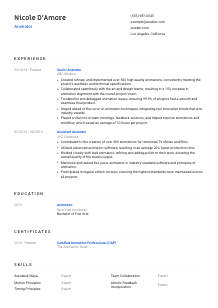
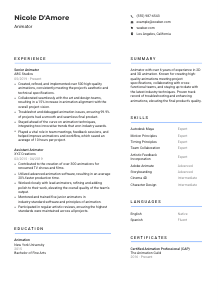
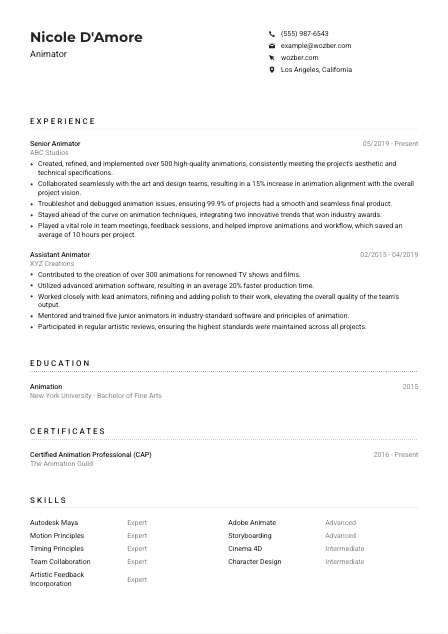
Focus each bullet on work that an animation lead or recruiter can picture in production. Strong lines mention what you animated, how you improved quality, where you collaborated, or how you solved a post-production issue. The sample CV does this well with bullets like creating and implementing over 500 animations and improving alignment with the project vision through close work with art and design teams.
Metrics make the work easier to understand when they reflect the realities of the job. Useful numbers include animation volume, production speed, revision savings, reduction in defects, delivery reliability, or time saved per project. In the example, 99.9% smooth final product quality and 10 hours saved per project tell a clearer story than broad claims about impact ever could.
Keep the emphasis on animation work and closely related responsibilities such as polish passes, troubleshooting, mentoring junior animators, review participation, or software-based workflow improvements. If you include adjacent creative work, make sure it strengthens your case for animation production rather than distracting from it. Every bullet should help a studio understand how you contribute to finished animated work.
A useful experience section reads like production history, not a list of duties. It should show what you animated, how you worked with others, and what improved because you were on the project.
Formal education is rarely the most important section for an experienced animator, but it still matters when a posting names a degree requirement or when your training explains your technical and artistic foundation. Present it clearly so the recruiter can confirm the basics without hunting for them.
Check whether the posting asks for a specific academic background and mirror that information where it applies. Here, the employer asks for a bachelor's degree in Animation, Multimedia Design, or a related field. A Bachelor of Fine Arts in Animation, like the example CV shows, covers that requirement directly and should be easy to spot.
List the degree, field of study, school, and graduation year in a clean structure. There is no need to over-design this section. Hiring teams reviewing animation candidates care more about whether the requirement is met than about extra wording around the institution.
If your degree included a concentration in 2D animation, 3D animation, motion design, character animation, or visual storytelling, include that when it supports the role you are targeting. This is especially useful if the posting leans toward one area of production or if your job history does not yet fully show that specialty.
If you are early in your career, notable coursework, thesis films, capstone projects, or collaborative productions can help demonstrate shot work, story development, rigging familiarity, or software use. For more experienced animators, those details should appear only if they remain directly relevant to the target role or type of studio.
Academic awards, festival recognition, or school-based animation distinctions can strengthen this section when they reflect real craft or competitive achievement. Keep them if they add signal. If you already have several years of studio experience, they should stay brief and secondary to your production results.
Your education section should quickly confirm that you meet the posted requirement and, when useful, show the training behind your animation craft. Clarity is enough here.
Certifications are optional in many animation roles, but they can still help when they reinforce software depth, continuing training, or commitment to current production methods. Treat this section as support for your experience, not a substitute for it.
Choose certifications that connect to the studio's needs, such as animation software, motion design tools, pipeline skills, or recognized professional development in the field. The example certificate works because it supports an established animation profile rather than padding the CV with unrelated credentials.
Dates matter when a certification is recent, active, or tied to evolving tools and workflows. Animation software changes, production pipelines shift, and newer training can show that your techniques are current. If a certificate is older but still respected, keep it if it adds value and does not crowd out stronger qualifications.
Studios notice animators who keep learning. Training in updated Maya workflows, motion graphics systems, procedural tools, or current 2D and 3D techniques can support your candidacy, especially when the role values adaptability and staying current with trends. Add certifications that show meaningful development, not just course accumulation.
A short certification section can strengthen your profile when it reflects current tools or respected training. Keep every item relevant to the kind of animation work you want to do next.
The skills section should give a fast read on how you work. For an Animator, that means pairing software knowledge with core animation principles and the collaboration habits that keep reviews, revisions, and delivery moving.
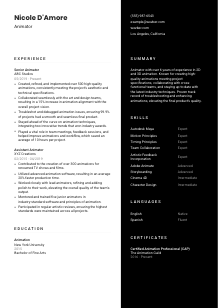
Start with the terms the posting uses, then add closely related skills you genuinely use. In this case, Autodesk Maya, Adobe Animate, Cinema 4D, motion, timing, storytelling, and cross-functional collaboration are all relevant. That mix tells the studio both what tools you can open and what animation judgment you bring to the work.
Animation hiring rarely stops at software names. Include the principles and production behaviors that shape the final result, such as timing, motion principles, storyboarding, feedback incorporation, or working with art and design teams. The example CV handles this well by combining software with craft-based and collaboration-based skills instead of listing tools alone.
Resist the urge to turn this into a complete inventory of everything you have touched. Prioritise the software, techniques, and collaboration skills most relevant to the role you want now. A tighter list reads better in an ATS-friendly CV format and gives hiring teams a clearer picture of your animation strengths.
A hiring manager should be able to scan this section and understand your software range, your animation fundamentals, and how you function inside a creative team. If those three things are visible, the section is doing its job.
Animation is collaborative work. Notes pass between animators, art directors, designers, editors, and producers, so language ability matters most when it affects reviews, feedback, and day-to-day coordination.
If the job posting names a required language, list it clearly and near the top of this section. Here, English fluency is specifically requested, so your CV should show that without ambiguity. The example does that by listing English as Native, which immediately answers the requirement.
Additional languages can be useful in international studios, distributed teams, client-facing work, or productions with multilingual stakeholders. Include them when they are real strengths. They are not the core of an Animator application, but they can broaden where and how you collaborate.
Choose clear levels such as Native, Fluent, Advanced, Intermediate, or Conversational, and stay accurate. Language claims are easy to test in interviews, team calls, and written feedback loops, so precision matters more than optimism here.
This section should quickly answer whether you can handle the language demands of reviews, feedback, and production communication. For many animation roles, that simple confirmation is enough.
The summary sits at the top of the CV and should quickly establish your animation range, level of experience, and the kind of production value you bring. Skip vague self-description and use those lines to connect your background to the work the studio needs done.
Pull out the few ideas that matter most for the role, then reflect them in your opening lines. For this Animator position, the key themes are 2D or 3D animation experience, software proficiency, strong motion and timing fundamentals, collaboration, and quality refinement. Those should shape the summary more than generic creative adjectives.
State who you are and how much relevant experience you bring. A line like "Animator with over 6 years of experience in 2D and 3D animation" works because it is direct and immediately useful. The example summary does this well by establishing seniority before moving into strengths.
After the opening, mention the abilities that matter most to the target studio, such as delivering high-quality animations, collaborating across art and design, troubleshooting issues, or improving final output. You can also reference tool fluency if the posting strongly emphasizes a platform like Maya or Adobe Animate. Keep these points tied to actual work, not personality language.
Aim for a short paragraph that reads quickly and sets up the rest of the CV. Four well-chosen lines will usually do more than a longer block full of general claims. The best summaries make a recruiter expect the right kind of experience bullets beneath them.
Your summary should tell the studio what kind of animator you are, how much production experience you have, and why your background matches the work. Once that is clear, the rest of the CV has a strong frame.
An Animator CV works when it translates creative ability into production terms: the software you use, the animation principles you apply, the teams you work with, and the results you help deliver. With Wozber's free CV builder, ATS CV scanner, and ATS-friendly CV templates, you can shape those details into an ATS-compliant CV that stays readable for both systems and studio reviewers.
The final check is simple. Your CV should make it easy to see that you can step into the pipeline, take direction, refine the work, and ship animation that meets the brief.




