



Use Wozber and land your dream job
Create CV
No registration required
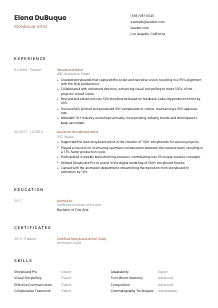
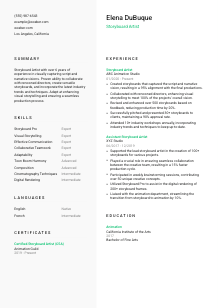
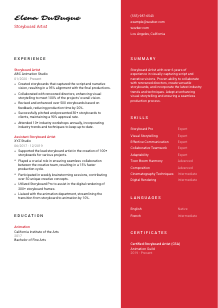
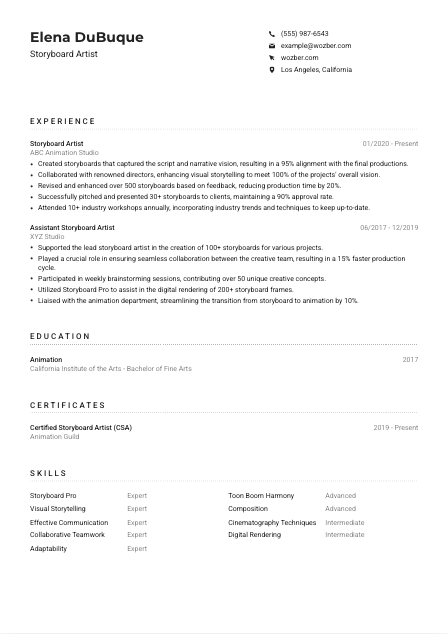
Illustrating narratives, but your CV isn't gaining plot twists? Check out this Storyboard Artist CV example, created with Wozber free CV builder. It shows how to frame your visual storytelling skills to match the job narrative, ensuring your career arc never hits a blank panel!
Storyboard artists sit at the point where script, camera language, and production reality meet. Hiring teams want to see whether you can translate narrative beats into clear visual sequences, take direction without losing story logic, and build boards that help directors, writers, and animators move faster once production starts.
When the CV is tailored well, your background reads less like general art experience and more like production-ready storyboarding. Wozber's free CV builder helps shape that into an ATS-compliant CV by aligning your wording with the posting's terminology, so your use of tools, revision workflow, and visual storytelling judgment are easier to pick up quickly.
Studios usually decide within seconds whether the top of the CV looks production-ready. For a storyboard artist, that means clear contact details, the right role title, and easy access to a portfolio or website that shows sequencing, shot choices, and storytelling range.
Place your name at the top in a clean, readable format. Keep it more prominent than the rest of the header so it anchors the page immediately, much like a title card that establishes who the work belongs to.
Use the job title directly under your name when it accurately reflects your background, such as "Storyboard Artist." This helps hiring teams and ATS filters connect your CV to the production role right away, especially when studios are sorting candidates across design, layout, animation, and board positions.
Include a current phone number, a professional email address, and a portfolio link if you have one. For storyboard work, the portfolio often matters as much as the CV, so make sure the link is clean, clickable, and leads straight to boards, animatics, or visual storytelling samples rather than a generic landing page.
If a job states a location requirement, reflect it clearly in your header. In the example, listing Los Angeles, California answers the employer's stated need without adding extra explanation. For other applications, only include location details that support the role you're pursuing.
Skip personal information that has no bearing on storyboard hiring, such as marital status, date of birth, or unrelated identifiers. Use the header space for information that supports actual review flow, especially your title, contact details, and portfolio access.
This section should tell a studio exactly who you are, what role you do, and how to reach or review you. If those basics are handled neatly, the reader can move straight to your boards, credits, and production experience.




Experience is where storyboard candidates separate themselves from general visual artists. Teams want to know what kinds of productions you supported, how you collaborated with directors or writers, how you handled revisions, and whether your boards actually improved clarity, timing, or handoff to animation or live-action teams.
Before rewriting bullets, mark the exact responsibilities and requirements in the description. For storyboard roles, that usually means narrative interpretation, collaboration with directors and writers, revision speed, presentation skills, and familiarity with software such as Storyboard Pro or Toon Boom Harmony. Those are the themes your experience bullets should answer.
List positions in reverse chronological order with title, studio or company name, and dates. This gives hiring teams a fast read on your progression, whether you moved from assistant storyboard work into lead board ownership or built experience across TV, film, commercial, or animation pipelines.
Focus each bullet on work that shows how you contributed to the production process. Strong examples include translating scripts into sequences, improving alignment with the director's vision, revising boards under tight feedback cycles, or pitching scenes to clients and stakeholders. In the sample CV, bullets about 95% alignment with final productions and 30+ storyboard presentations work because they connect craft to production outcomes.
Metrics make storyboard work easier to understand when they match how the job is actually measured. You might quantify storyboard volume, approval rates, turnaround improvements, number of scenes revised, or production time reduced through clearer boards. The example's "500 storyboards" and "20% reduction in production time" give the reader a concrete sense of pace and value.
Keep the section centered on storyboarding, visual development, shot planning, and cross-functional collaboration. If you include adjacent work, tie it back to the storyboard pipeline, such as helping animation teams transition from boards to production or contributing visual concepts during early development. Every bullet should help explain why you can handle storyboard responsibilities on a working production.
A hiring team should finish this section knowing what you boarded, who you worked with, how you handled revisions, and what your work changed for the production. That is the level of detail that makes storyboard experience credible.
Education matters most here as a baseline qualifier and as context for your visual training. For storyboard roles, the useful part is not the school name alone but whether your degree supports skills tied to draftsmanship, composition, cinematography, sequential storytelling, and animation workflows.
If the job asks for a bachelor's degree in Animation, Fine Arts, or a related field, make sure that credential is easy to find. A degree such as a Bachelor of Fine Arts in Animation, like the one in the example, directly answers the requirement and should not be buried.
List the degree, field of study, school, and graduation year in a straightforward order. Keep the structure simple so reviewers can confirm qualifications quickly, especially when they are screening multiple candidates for the same production opening.
When your studies closely match the role, name that connection clearly. An animation or fine arts background suggests training in figure drawing, scene composition, motion, and story structure, which supports storyboard work more directly than a generic arts label.
Relevant coursework is most useful early in your career or when your professional history is still developing. If you include it, choose classes tied to visual storytelling, cinematography, character acting, editing language, or software-based storyboard production rather than broad foundation courses.
Awards, thesis films, collaborative studio projects, or leadership in animation programs can add value when they show practical storyboard ability or strong team-based production experience. Keep these details concise and relevant to the seniority of the role you want.
Your education section only needs to do a few things well. Confirm the degree requirement, reinforce your visual training, and support the story that you are prepared for professional storyboard work.
Certificates are rarely the deciding factor for storyboard hiring, but they can strengthen the CV when they show current software ability, formal craft development, or ongoing engagement with production methods. Used well, they add context rather than clutter.
Prioritise certifications that relate to storyboarding, animation production, visual storytelling, or software used in the field. A credential like "Certified Storyboard Artist (CSA)" helps because it reinforces specialization rather than adding a general creative certificate with little production relevance.
If the posting emphasizes tools, collaboration, or visual storytelling fundamentals, choose certificates that back up those areas. For example, software training in Storyboard Pro or Toon Boom Harmony is more useful here than unrelated design badges.
Include issue or renewal dates when the credential reflects current practice, active membership, or updated technical knowledge. In fast-moving production environments, recent training can signal that your workflow and software familiarity are current.
Studios value artists who keep sharpening timing, staging, acting, and cinematic language. If you continue taking workshops or certified training, focus on learning that improves how you board scenes, respond to direction, or adapt to evolving production tools.
This section should reinforce your seriousness about the craft, not try to carry the application on its own. A small number of relevant credentials is enough if they connect clearly to storyboard practice.
Storyboard hiring depends on a blend of software fluency and visual judgment. Your skills section should show that you can work inside the production pipeline, communicate ideas through frames and shots, and collaborate well enough to revise sequences without losing narrative clarity.
Pull both technical and artistic skills from the job description. Here, that includes Storyboard Pro, Toon Boom Harmony, visual storytelling, composition, cinematography techniques, and communication. Matching that language helps both ATS screening and human review because it reflects how storyboard work is actually discussed.
Lead with the skills that directly affect storyboard performance. Software is important, but so are story sense, shot composition, pacing, and the ability to work through feedback with directors, writers, and other creatives. The example CV does this well by pairing Storyboard Pro with core craft skills like visual storytelling and composition.
Avoid turning this into a catch-all list of every art or design skill you have. Choose the abilities that support storyboard execution and team workflow, then group them logically so the reader can scan tools, visual craft, and collaboration strengths without hunting for the essentials.
A useful skills section tells the reader which tools you use, how you think visually, and how you function in a collaborative production setting. That combination is what makes the section worth reading.
Language ability matters in storyboard work because boards are built through discussion, notes, revisions, and presentations. If a posting asks for strong English, treat that as a practical communication requirement tied to scripts, director feedback, pitch sessions, and written revision notes.
When strong English speaking and writing skills are listed, make English easy to see in this section. For storyboard artists, that supports more than conversation. It points to your ability to interpret scripts, discuss shot intent, and respond clearly during review rounds.
Additional languages can be worth listing if you work with international teams, co-productions, or clients across markets. They are a useful extra, but they should come after the required production language has been established clearly.
Label each language with a realistic level such as native, fluent, intermediate, or basic. In a role that may involve presentations or creative feedback sessions, overstating language ability can create problems quickly.
Some storyboard roles are entirely local and English-led. Others involve distributed animation teams, overseas partners, or multilingual clients. Include extra languages when they help explain your communication range in the kind of production environment you are targeting.
For visual storytelling roles, language ability supports faster feedback loops, clearer presentations, and smoother coordination across departments. If you speak more than one language, frame that as a collaboration advantage rather than a decorative extra.
This section works best when it clarifies how you communicate in real studio settings. For many storyboard applications, clear English proficiency is the key item, and any additional languages should support the kind of team or project scope you want.
The summary is your opening read on the page, and for storyboard roles it should establish craft, production context, and the kind of collaboration you handle well. A vague creative statement will not do much here. A sharp summary shows whether you can board stories that survive feedback and make it cleanly into production.
Open with your title and years of relevant experience, then anchor that experience in film, television, animation, or the formats you actually work in. That gives the reader immediate context for your range and seniority.
Choose two or three core strengths that match the role, such as visual storytelling, composition, cinematography awareness, revision workflow, or collaboration with directors and writers. The sample summary works because it highlights both narrative capture and team collaboration rather than relying on generic creative language.
Aim for a short paragraph that reads cleanly in one pass. Focus on what you board well, how you contribute in production, and where you add value. Save finer detail, software depth, and metrics for the experience section where they can be supported properly.
If the posting values adaptability or staying current with industry techniques, mention that in a practical way. For storyboard artists, this can mean keeping up with software workflows, cinematic trends, or presentation methods that improve how you communicate sequences to the team.
A strong summary should quickly tell the reader that you understand narrative, can work inside a real creative pipeline, and have the experience to contribute from the first round of boards. If it does that, the rest of the CV has a clear direction.
A storyboard artist CV works when it makes the production team's decision easier. Your experience should show how you interpret scripts, shape sequences, revise efficiently, and collaborate with directors, writers, and animation teams in a way that improves the final work.
Wozber's free CV builder gives you a practical way to organise that material into an ATS-friendly CV template, while its ATS CV scanner helps you line up job-specific language with your real experience. Once the CV is tailored well, a studio can quickly see whether your boards, workflow, and communication style match the production it needs.




