



Use Wozber and land your dream job
Create CV
No registration required
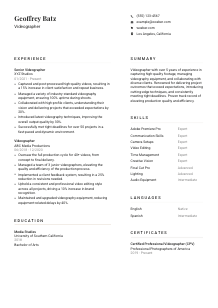
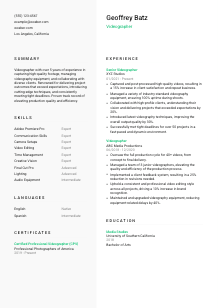
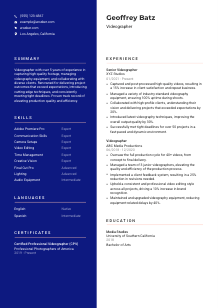
Capturing life's moments, but your CV seems a little out of frame? Pan over this Videographer CV example, created with Wozber free CV builder. Learn how to align your visual storytelling skills with job expectations, making your career reel as captivating as your camera shots!
Videography hiring moves quickly because the work is visible and the expectations are practical. Teams want to know whether you can walk onto a shoot, handle camera, lighting, and audio setups with confidence, shape raw footage into polished deliverables, and keep production moving when deadlines tighten. Your CV needs to make that operating range clear before anyone even opens your portfolio.
When the CV is tailored well, it separates a candidate who has filmed casually from one who can run professional production work, revise cleanly, and deliver on brand. Wozber's free CV builder helps you line up your experience with the job description in an ATS-friendly CV format, so the right tools, production scope, and editing strengths surface early and hiring teams can quickly see your value on set and in post.
For a videographer, the top of the CV should read like a professional contact slate. It needs to identify you fast, confirm you are reachable, and point employers toward the work samples that support your claims.
Use your full name as the most prominent text on the page. Keep it clean and easy to scan so it anchors the CV immediately, especially when a hiring manager is reviewing several production candidates in one sitting.
Place "Videographer" under your name if that is the role you are targeting. That direct match matters in both recruiter review and ATS parsing, and it keeps your positioning clear if your past titles include variations such as Senior Videographer, Video Producer, or Content Creator.
List a working phone number, a professional email address, and your location. In this example, Los Angeles, California is worth including because the posting specifically asks for local candidates. If a job has a similar on-site requirement, show that detail here instead of making the employer guess about availability.
A videographer CV is stronger when it connects directly to your reel, portfolio site, or selected project work. Make sure the link is current, loads properly, and reflects the kind of shoots you want more of, whether that is corporate video, promotional work, branded social content, or multi-camera event coverage.
Skip personal information that has no bearing on production work, collaboration, or availability. Use the space for what matters in this field: role title, contact information, portfolio access, and any location detail that helps confirm you can step into the assignment quickly.
Your personal details should tell an employer three things at a glance: who you are, how to reach you, and where to view your work. For videography roles, that clean setup removes friction before the conversation even starts.




Experience carries the most weight on a videographer CV because it shows how you work under real production conditions. Hiring teams look for proof that you can capture quality footage, manage equipment reliably, collaborate with clients or stakeholders, and turn edits around on deadline.
Read the posting for its actual production demands before rewriting your bullets. If the employer emphasizes multiple camera setups, lighting, audio equipment, client collaboration, and editing in Premiere Pro or Final Cut Pro, your experience section should mirror those areas with real examples from your work rather than generic statements about being creative or hardworking.
For every position, include your title, company name, and dates in reverse chronological order. That structure helps the reader place your level quickly, whether you have grown from videographer to senior videographer, taken on post-production ownership, or managed junior crew members across larger production schedules.
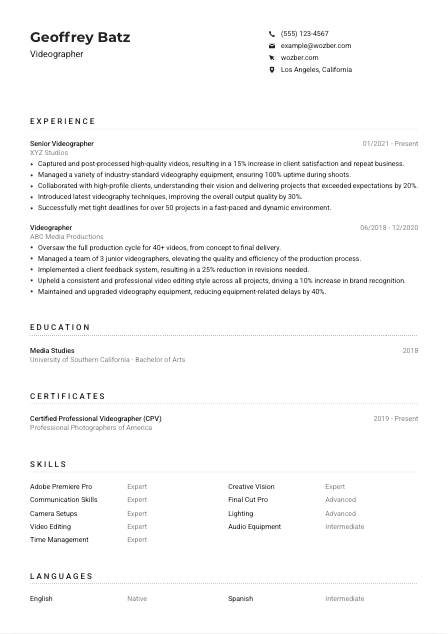
Each bullet should show what you produced, how you worked, and what changed because of it. The sample CV does this well with lines about capturing and post-processing high-quality videos, collaborating with clients, and improving satisfaction or repeat business. That approach is stronger than listing duties alone because it ties production work to client results and operational performance.
Metrics make videography experience more credible when they reflect how the work is actually measured. Useful examples include number of projects delivered, turnaround time, reduction in revision rounds, client satisfaction, equipment uptime, brand lift, or output quality improvements. The sample's "50+ projects," "100% uptime," and "25% reduction in revisions" are the kind of concrete details that help employers judge scope and consistency.
Focus your bullets on shooting, editing, equipment handling, stakeholder communication, creative execution, and deadline performance. If you have adjacent experience in social content, production coordination, or team leadership, include it only when it strengthens your case for the videographer role you want. Every line should move the reader closer to trusting you on set and in post.
A strong experience section shows more than time served. It should make your production range, editing judgment, client handling, and reliability under deadline easy to recognize from bullet one.
Education matters most here as background context for your production skills. It can support your CV well, especially if your degree, coursework, or training connects to media production, editing, storytelling, or visual communication.
Start with the degree, school, field of study, and graduation year or date. This role does not require a specific degree, but relevant education can reinforce your grounding in media, film, communications, or digital production. A Bachelor of Arts in Media Studies, like the example, fits naturally because it supports both storytelling and technical production work.
Most videography employers will spend more time on your reel and work history than on academic detail. Keep the section clean and readable, then expand only if your education included hands-on production training, editing labs, broadcast work, or portfolio-based coursework that strengthens your candidacy.
If you completed classes or workshops in cinematography, nonlinear editing, colour correction, sound design, or documentary production, include them when they connect directly to the role. This is especially useful for earlier-career candidates who need more proof of technical range beyond paid employment.
Awards, festival selections, scholarship recognition, or standout academic projects are worth naming if they show quality of execution. A student film award, editing distinction, or capstone project with measurable audience reach can add useful context when it reflects the same strengths employers want in client or branded work.
Videography tools and formats change fast. Recent workshops in drone videography, updated Premiere workflows, lighting technique, motion graphics, or short-form social video production can show that your skills are current, especially if your formal education is several years behind you.
Use education to reinforce your foundation, not to carry the application. For videography, this section works best when it adds context for your technical training, creative development, or ongoing growth in the craft.
Certifications are optional in many videography roles, but the right ones can strengthen your credibility. They are most useful when they support production technique, editing software proficiency, safety, or specialised gear and workflows.
Choose certifications that connect clearly to how videographers are hired. A credential such as Certified Professional Videographer can reinforce professional standards, while software or platform training can support your post-production credibility if the employer expects editing ownership.
Put the certificates most connected to the target role first. If the posting emphasizes Premiere Pro, Final Cut Pro, lighting, or camera operation, lead with certifications in those areas before less relevant learning that does not directly influence shoot quality or editing output.
Add the year earned and any active status if applicable. That helps employers see whether your training reflects current workflows and tools. In the sample, the CPV credential includes a current date range, which works well because it suggests ongoing professional standing.
If your current certifications are limited, target training that fills a real gap in your profile. Good options include advanced editing, colour grading, motion graphics, live production, drone operation where relevant and permitted, or audio capture for interview and on-location work.
Certifications should sharpen your profile, not pad it. List the ones that strengthen your credibility with cameras, editing systems, or production workflows employers already care about.
The skills section gives employers a quick read on your toolkit. For videography, that means a clear mix of production equipment knowledge, editing software, and the working habits that keep shoots and revisions on track.
Start with the skills the job description names directly. Here, that includes multiple camera setups, lighting, audio equipment, Adobe Premiere Pro or Final Cut Pro, deadline management, and collaboration. Those are stronger anchors than broad labels such as "creative" because they map to real production tasks.
Put your most job-relevant technical skills near the top, especially the software, equipment, and production competencies you can immediately bring to a shoot or edit timeline. The sample CV does this well by foregrounding Premiere Pro, camera setups, video editing, and lighting before secondary skills.
Do not turn this into a complete inventory of every platform or soft skill you have touched. Choose the skills that support the role most clearly, then balance hard skills with a few work-critical traits such as communication or time management. For a videographer, that balance matters because the role depends on both technical execution and smooth collaboration with clients, talent, and internal teams.
Your skills section should show that you can handle the gear, the edit, and the pace of the work. Keep it focused enough that an employer can quickly picture you contributing on set and in post-production.
Language skills matter in videography when they affect communication on shoots, client interviews, direction on set, or collaboration during revisions. This section is usually brief, but it can still answer an important requirement quickly.
Some postings ask for a specific language because the role involves client-facing communication, interviews, or collaboration across teams. In this case, strong English communication is explicitly required, so English should appear clearly in your languages section if it applies to you.
List the most relevant language at the top with an honest proficiency level such as Native, Fluent, or Professional. That makes it easy for employers to confirm you can handle production conversations, feedback rounds, and stakeholder communication without friction.
Additional languages can be useful when the work involves diverse crews, community-based shoots, multilingual talent, or broader audience reach. The sample includes Intermediate Spanish, which is a good supporting detail in a market where bilingual communication can sometimes help, even when it is not a formal requirement.
Use realistic ratings. If you can manage casual set communication but not client presentations or interviews, mark that honestly. Overstating fluency becomes a problem quickly in production environments where instructions need to be understood in real time.
For some videography roles, one required language is enough. For others, multilingual ability helps with documentary work, branded content, event coverage, or shoots involving varied communities. Keep the section if it strengthens how you would operate in the actual production setting.
Language entries should clarify how well you can communicate during planning, shooting, and revisions. For videography roles, that matters most when it affects client trust, on-set coordination, or audience reach.
Your summary should frame you as a working videographer, not just someone interested in video. In a few lines, it should establish your level, your production strengths, and the kind of results or environments you are used to handling.
Start with a direct statement that identifies you as a videographer and gives your approximate experience level. "Videographer with over 5 years of experience" works because it is immediate and credible. If you are earlier in your career, focus on the type of production work you handle rather than trying to sound more senior than you are.
Choose two or three strengths that align with the target role's core work. For this job, that would include capturing high-quality footage, working with professional camera, lighting, and audio equipment, editing in industry-standard software, and collaborating with clients or stakeholders to deliver the intended vision.
A summary becomes more convincing when it includes a measurable or observable result. That could be project volume, satisfaction gains, reduced revisions, consistent deadline delivery, or improved output quality. The sample summary works because it points to exceeded expectations, technique improvements, and dependable deadline performance without becoming too long.
Aim for a short paragraph that sounds grounded in production work. Avoid generic claims about passion or creativity unless you tie them to how you shoot, edit, solve problems, or deliver for clients. The summary should make the employer expect relevant bullets in the experience section, not repeat vague descriptors.
A good videographer summary gives a fast read on your level, your production toolkit, and the outcomes you tend to deliver. By the time the reader reaches your experience section, they should already understand the kind of shoots and edits you are trusted to handle.
A videographer CV works when it connects your tools, production experience, and client-facing delivery in a way that feels immediate and believable. Every section should support that picture, from your portfolio link and location details to your editing software, equipment handling, and measurable project results.
Before sending it out, compare your CV line by line with the job description and tighten any gaps in terminology, scope, or outcomes. Wozber's free CV builder can help you shape an ATS-compliant CV with strong wording, clear structure, ATS optimisation, and targeted revisions through its ATS CV scanner. The finished CV should make it easy to see that you can shoot professionally, edit reliably, and deliver work that meets the brief.