




Use Wozber and land your dream job
Create CV
No registration required
Calling the shots, but your CV isn't in focus? Check out this Film Director CV example, created with Wozber free CV builder. Learn how to spotlight your creative vision to match job expectations, making your directorial career the blockbuster it's meant to be.
Film directors are hired on more than taste. Hiring teams look for people who can shape a story into a coherent visual experience, direct performances under pressure, and keep a production moving when creative choices collide with budget, schedule, and stakeholder expectations. Your CV needs to make that range visible quickly, from the kind of projects you have led to the outcomes those projects delivered on screen and in production.
A tailored CV changes how your work is read. When the language reflects the posting's priorities, such as cinematography expertise, post-production oversight, and collaboration with cast, crew, and producers, it becomes much easier for both reviewers and an ATS to connect your credits to the role. Wozber's free CV builder helps organise those details into an ATS-compliant CV that surfaces the directing experience, production scope, and creative leadership a studio wants to see first.
For a Film Director, the header should read like professional opening credits. Keep it clean, accurate, and aligned with how productions, agencies, and hiring teams will contact you or review your portfolio.
Use your full name in a larger, readable font so it stands apart from the rest of the page. Directors often apply with a body of work behind them, and your name should be easy to scan whether someone is reviewing your CV beside a reel, IMDb page, or production portfolio.
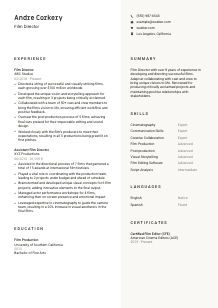
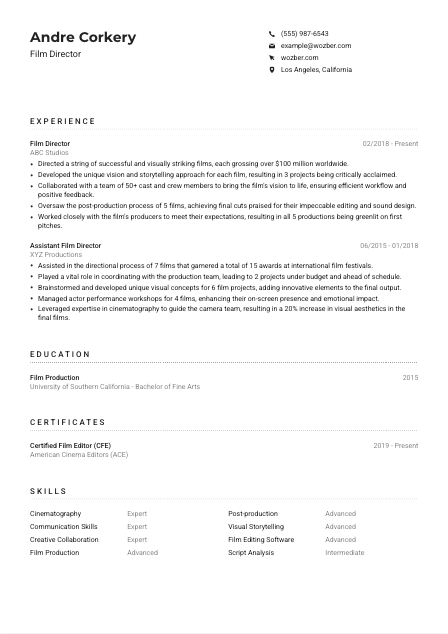
Place "Film Director" directly under your name when that is the role you are pursuing. This removes any ambiguity if your background includes adjacent credits such as Assistant Director, Creative Director, or Producer-Director. In the example CV, the title matches the posting exactly, which helps position the candidate immediately for directing work.
Include a phone number and professional email address you check regularly. Hiring discussions in film can move quickly between production companies, studio teams, and representatives, so broken contact details create unnecessary friction. If you use a personal domain or portfolio email, make sure it looks established and industry-appropriate.
Film hiring is often location-sensitive because productions, meetings, and prep work are tied to a working market. Here, listing "Los Angeles, California" directly supports a stated requirement. If a role is location-specific, showing that detail in your header can answer a practical question before it slows the application down.
A website, reel, or curated portfolio is especially valuable for directing roles because employers want to see visual judgment, tone, pacing, and performance direction, not just read about them. Link only to work that reflects the level of projects you want next, and make sure the site is current, easy to navigate, and consistent with the credits on your CV.
Your personal details should establish that you are a working director, easy to contact, and ready to be reviewed for the specific production context of the role.




This section carries the most weight for a Film Director. Credits matter, but hiring teams also want to understand your creative range, the scale of productions you have handled, how you worked with actors and department heads, and whether your projects landed with audiences, critics, or stakeholders.
Start by identifying the production realities named in the posting, then reflect them through your past work. For this role, that includes shaping the film's vision, guiding performances, working within budget and schedule, overseeing editing and sound, and collaborating with producers. Your bullets should mirror those priorities through real credits and outcomes rather than repeating job description language word for word.
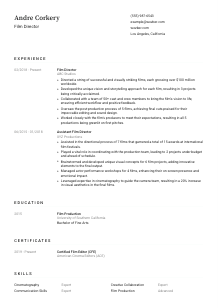
For every role, include your title, company or studio, and dates in reverse chronological order. That structure helps reviewers track your progression from supporting directing work into full project leadership. The example does this well by showing a move from Assistant Film Director into Film Director, which naturally supports the requirement for 5+ years in visual media direction.
Each bullet should show a directing contribution that only makes sense in film or visual media. Mention story development, visual style, actor direction, collaboration with cinematography teams, or post-production decisions when those were core to the job. In the sample, bullets such as developing a unique vision for each film and overseeing post-production on five films work because they connect creative leadership to finished output.
Quantify results with metrics that feel native to the industry. That could include box office performance, festival awards, number of films completed, crew size, budget efficiency, schedule adherence, first-pitch approvals, or audience reach. The sample CV uses several strong examples, including films grossing over $100 million worldwide, teams of 50+ cast and crew, and projects greenlit on first pitches.
Keep the section focused on work that supports your candidacy as a Film Director. Early roles are useful when they show a clear path into directing, especially if they include shot planning, actor coaching, visual concept work, or production coordination. Remove bullets that read like generic team participation and keep the ones that show authorship, leadership, and production judgment.
By the end of the experience section, a studio or producer should understand what kinds of projects you have led, how you work across production stages, and what results followed from your direction.
Education matters most here as a baseline qualification and as context for your training in film language, production methods, and visual storytelling. For experienced directors, this section should be concise, but it still needs to match the degree expectations in the posting when it can.
Check whether the posting asks for a specific educational background. In this case, a bachelor's degree in Film Production, Fine Arts, or a related field is listed, so your degree should be presented clearly enough that a reviewer or ATS can recognize the match immediately.
List your degree, field of study, school, and graduation year. That is usually enough for a director-level CV unless the employer specifically asks for more academic detail. The example's "Bachelor of Fine Arts" in "Film Production" from USC is a strong model because it is specific, recognizable, and easy to scan.
If your degree lines up closely with the role, do not bury the field of study. A background in Film Production or Fine Arts reinforces formal training in directing, cinematography, editing, and production workflows. Keep that alignment obvious, especially if your experience section already shows how you applied it professionally.
If you are earlier in your career, selected coursework, thesis films, capstone projects, or festival-screened student work can add useful context. For a more established director, those details are usually unnecessary unless they are unusually prestigious or directly relevant to the target role.
Honors, scholarships, film lab participation, or leadership in notable student productions can be worth mentioning if they show artistic range or production leadership. Keep these additions selective. They should support your professional trajectory, not turn the section into a campus activity list.
Your education should confirm that you meet the formal requirement and that your directing background rests on credible film training, not just a generic degree entry.
Certifications are rarely the deciding factor for a Film Director, but the right one can strengthen the technical side of your profile. They are most useful when they support post-production knowledge, editing fluency, safety, leadership, or another area the target role touches directly.
List certificates that connect to film production rather than unrelated general training. Editing, post-production, cinematography, production management, or specialised directing programs can all add weight when they reflect real working knowledge behind your credits.
Include the year earned, and if the certification remains active, show that clearly. Recency can matter in areas tied to evolving workflows, software, or production standards. It also shows that your technical knowledge has stayed current alongside your directing experience.
Update certifications as you gain more advanced training or as older credentials lose relevance. Film hiring will care more about the connection between the certificate and your actual body of work than about the sheer number of items listed here.
The sample CV includes a Certified Film Editor credential, which complements a role that asks for technical understanding of film production and oversight of post-production. That kind of certification works best when it supports responsibilities already shown elsewhere in your CV, such as editing, sound design review, or final-cut supervision.
Certifications should sharpen your profile, especially around technical craft, without distracting from the directing credits and production outcomes that carry more hiring weight.
A Film Director's skills section should show both creative command and production fluency. Employers are usually looking for a mix of visual judgment, on-set leadership, communication with cast and crew, and enough technical understanding to guide cinematography and post-production decisions with confidence.
Start with the skills the employer names explicitly, then add closely related capabilities you genuinely use. In this posting, cinematography expertise, interpersonal communication, collaboration, and technical film production knowledge are central. That gives you a clear framework for what belongs in the section.
Lead with the abilities that shape the work most directly, such as visual storytelling, actor direction, script analysis, cinematography, post-production oversight, and creative collaboration. The example CV balances this well by combining technical items like cinematography and film editing software with people-centered strengths like communication and collaboration.
Do not overload the section with every tool or soft skill you have used. A shorter list of relevant strengths reads better than a broad inventory. Choose skills that help explain how you move a film from concept to final cut, and leave out anything that does not support that story.
Your skills list should quickly show that you can lead the creative process, work effectively across departments, and handle the technical conversations that shape the final film.
Language ability can matter in film for directing actors, working across international crews, or handling stakeholder conversations in different markets. Even when only English is required, listing additional languages can still add practical value if they are relevant to the kind of productions you pursue.
If the posting specifies a language requirement, list that language prominently with an honest proficiency level. Here, high proficiency in English is required, so English should appear first and be labeled clearly, especially if you work in multilingual production environments.
Additional languages can support international co-productions, festival circuits, multilingual casts, or broader industry networking. Include them when you can actually use them in a professional setting. In the example, Spanish adds credible range without distracting from the core English requirement.
Terms such as "Native," "Fluent," "Advanced," or "Conversational" are easy to understand and help hiring teams gauge how you might operate in meetings, rehearsals, or production coordination. Avoid vague labels that overstate your command.
List a language because it helps you collaborate, direct, negotiate, or build rapport across productions, not because it looks impressive on the page. For directing roles, communication is practical. The value comes from giving notes clearly, understanding nuance in performance, and building trust with people on set.
If your work includes cross-border productions, international festivals, or multilingual casts, your language section can support that narrative. If it does not, keep the section brief. It should strengthen your profile, not pull attention away from your directing record.
Used well, languages can show broader production versatility and stronger communication range, both of which matter when a director is working across creative and cultural lines.
The summary is where you establish your directing identity in a few lines. For this role, it should quickly communicate experience level, the kind of production leadership you bring, and the outcomes that make your work worth a closer look.
Start with your title and years of experience, then ground it in film or visual media direction. That tells the reader immediately whether you meet a requirement such as 5+ years of directing experience and whether your background belongs in the same lane as the role.
Choose strengths that match the role's real demands, such as shaping visual storytelling, directing actors, managing collaboration across departments, or overseeing post-production. Keep these specific enough to distinguish you from producers, editors, or general creative leads.
A summary gains credibility when it includes results, whether that means commercially successful films, critically acclaimed projects, festival recognition, or consistent stakeholder trust. The example summary works because it mentions over 8 years of experience, successful films, and strong collaboration with cast and crew in concise language.
Aim for a short paragraph that can be scanned in seconds. Skip broad self-description and focus on the combination of experience, creative leadership, and production outcomes most relevant to the role. If the posting emphasizes cinematography or stakeholder collaboration, make sure one of those ideas appears here when it reflects your actual background.
A hiring manager should finish your summary with a clear sense of your directing range, your production maturity, and why your credits deserve deeper review.
A Film Director CV works when every section supports the same conclusion: you can develop a vision, lead people through production pressure, and deliver finished work that lands creatively and commercially. Keep the strongest proof in your experience, support it with relevant education and technical depth, and make sure your summary and skills point to the same directing profile.
Wozber's free CV builder helps you shape that story in an ATS-friendly CV format, align your language with the posting, and tighten sections with focused ATS optimisation. When the CV is tailored well, the hiring team can quickly see whether you are ready to lead the next production.