



Use Wozber and land your dream job
Create CV
No registration required
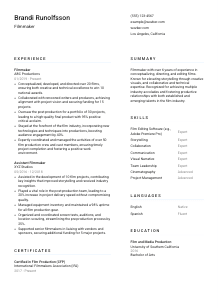
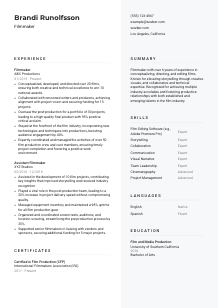
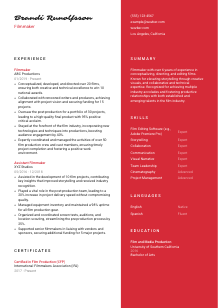
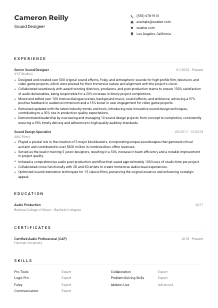
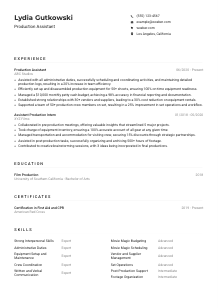
Scripting films, but your CV feels like a blooper reel? Check out this Filmmaker CV example, created with Wozber free CV builder. It shows how to seamlessly splice your cinematic flair with job criteria, positioning your career for a standing ovation behind the scenes!
Filmmaking CVs are read through the lens of execution. Hiring teams want to see whether you can carry a project from concept to final cut, direct a crew with authority, and protect the quality of the story through production and post-production. If your CV stays vague about what you directed, edited, shot, or delivered, it becomes hard to separate you from adjacent candidates such as editors, camera operators, or production coordinators.
A tailored CV makes your filmmaking scope legible fast, especially when an ATS is sorting for terms tied to directing, cinematography, post-production, and team leadership. Wozber's free CV builder helps organise that language into an ATS-friendly CV format, so the first read makes it clear where you have led creative decisions, managed production flow, and delivered finished work at a professional level.
This section should read like a clean production slate. For a Filmmaker, that means clear identification, reliable contact information, and any practical detail that removes friction early, especially when a posting includes a location requirement or expects a portfolio link.
Use your full name in a larger, readable format at the top of the page. In creative hiring, your name often sits next to portfolio links, festival credits, or referrals, so make it easy to scan and remember.
Place "Filmmaker" directly under your name if that is the role you are pursuing. If your background leans more heavily toward directing or cinematography, you can still align with the posting by using the title that best matches the opening, as long as the rest of the CV supports it.
Your phone number and email should look professional and current. Producers and hiring managers move quickly when scheduling calls, interviews, or reel reviews, so this section needs to be error-free.
If the job requires a specific base, show that clearly. Here, listing Los Angeles, California directly addresses a stated requirement and avoids questions about relocation or availability for shoots, meetings, and production schedules.
For filmmakers, a website, reel, or well-maintained professional profile often matters as much as the CV itself. Link to work that shows your visual style, directing choices, pacing, editing judgment, or cinematography range, and make sure the content is current and easy to navigate.
Your personal details should remove practical doubts from the start. When your title, location, and portfolio access are clear, the reader can move straight to your films, production scope, and creative track record.




Experience is where a filmmaking CV earns credibility. Hiring teams look for proof that you have handled real production pressure, shaped stories visually, worked across departments, and delivered finished projects that met creative and technical expectations.
Before writing bullets, identify the work the employer actually needs done. In this case, the posting emphasizes directing, editing, cinematography, collaboration, post-production oversight, and crew coordination. Those points should guide which projects, employers, and accomplishments you foreground.
Start with your most recent position and include the company, your title, and dates. Keep the structure simple so the reader can follow your progression from supporting production work into broader creative or leadership responsibility.
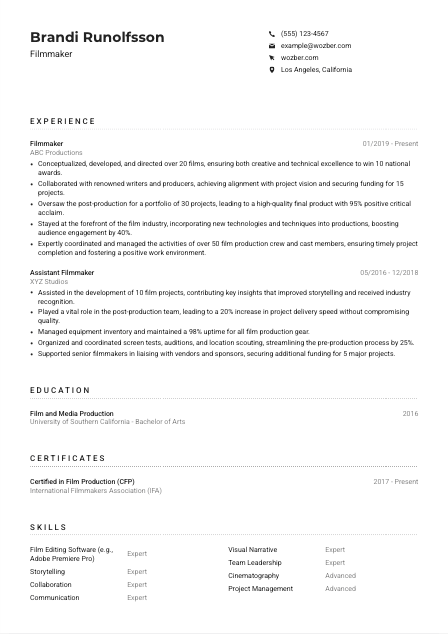
Generic lines such as "worked on multiple productions" do not tell enough. Show what you actually led or contributed to. The sample CV does this well with points like directing over 20 films, collaborating with writers and producers, and overseeing post-production across a 30-project portfolio. That kind of phrasing makes your scope tangible.
Metrics work best when they reflect production results. Depending on your background, that could mean number of films completed, festival selections, awards, delivery speed, funding secured, audience engagement, crew size, critical response, or turnaround improvements in post. "Boosted audience engagement by 40%" and "secured funding for 15 projects" are strong examples because they connect creative work to business and reception outcomes.
Every bullet should support your case for handling film production professionally. Keep the emphasis on directing, visual storytelling, editing workflows, equipment management, collaboration with producers or writers, and leadership on set or in post. If an older role is only loosely related, compress it so your strongest production work gets the space.
By the end of this section, the reader should understand the scale of projects you have handled, the creative and technical decisions you owned, and the results your work produced. That is what turns experience into a credible filmmaker profile.
Education matters here because the role explicitly asks for a bachelor's degree in Film, Media Production, or a related field. For filmmakers, this section usually works best when it confirms formal training without pushing practical credits and production outcomes into the background.
If the posting asks for a film-related bachelor's degree, make sure that qualification is easy to spot. A degree in Film, Media Production, Cinematic Arts, or a closely related discipline should be listed clearly and without abbreviations that hide the match.
Include your degree, field of study, school, and graduation year. Clean formatting helps the reviewer confirm the credential quickly and move back to your film work, where most of the decision will be made.
When your academic background closely matches the posting, use the full wording. "Bachelor of Arts in Film and Media Production" speaks directly to a requirement like the one in this example and removes ambiguity about your training.
Early-career filmmakers can benefit from naming thesis films, directing workshops, cinematography labs, or editing-intensive coursework. If you already have 5+ years of production experience, keep those details brief unless they connect to something notable such as a festival screening or a specialised technical focus.
Awards, competitive film programs, student festival selections, and standout capstone projects can add value when they say something concrete about your storytelling or craft development. Keep these selective and relevant rather than listing every campus activity.
Your education should quickly establish that you meet the formal requirement and have a legitimate training base in film or media production. Once that is clear, your professional work can do the heavy lifting.
Certifications are rarely the deciding factor for a filmmaker, but they can strengthen your profile when they reflect current production methods, technical specialization, or continued development in the craft. Use this section to support your experience, not to compete with it.
If the job posting does not require a license or certificate, choose credentials that still add role-specific value. A film production certification, advanced editing training, colour grading course, camera certification, or workshop in emerging production tech can all help if they reflect work you actually do.
You do not need a long list. A concise set of certifications tied to directing, editing, cinematography, post-production, or production management will read more credibly than a broad collection of loosely related courses. The sample's "Certified in Film Production" works because it supports the role directly.
List the year earned, and if the credential remains active, show that too. This is especially useful for software training, equipment certifications, or programs tied to evolving production standards and digital workflows.
The posting specifically mentions staying current with new techniques and technologies. Certifications can support that point when they reflect newer cameras, editing platforms, virtual production methods, drone operation, or updated post-production workflows. Only include them if they are relevant to the type of filmmaking work you want next.
Treat certifications as supporting proof that your craft stays current. They work best when they strengthen the picture already established by your films, credits, and production accomplishments.
For a filmmaker, the skills section should connect creative judgment to production execution. Hiring teams want to see the tools and capabilities behind your work, from story development and directing decisions to editing systems, crew leadership, and visual storytelling.
Start with the requirements section and mark the skills that appear explicitly or implicitly. Here, that includes storytelling, directing, editing, cinematography, collaboration, communication, and familiarity with industry-standard software and equipment. Those are the terms to prioritise if they match your background.
A filmmaker rarely gets hired on software alone. Pair tools and craft areas such as editing platforms, camera operation, and cinematography with story development, visual narrative, collaboration, and team leadership. The sample CV handles this well by combining film editing software, storytelling, visual narrative, and project management in one section.
Do not overload this section with every creative or media skill you have touched. Choose the abilities that support the target role and are backed up elsewhere in the CV. If you claim advanced cinematography or expert editing software knowledge, your experience bullets or portfolio should make that believable.
Your skills list should tell the reader that you can shape a story, run production work with discipline, and use the tools required to finish strong visual work. Relevance matters more than volume.
Language skills matter in filmmaking when they affect communication on set, collaboration with talent, or the kinds of projects you can support. This posting makes English fluency mandatory, so your CV should state that plainly.
If the employer names a language requirement, include it exactly and rate it honestly. For this role, English fluency is not optional, so it should appear in the section without vague wording.
List English first when it is the stated requirement or the primary working language for directing, script collaboration, production meetings, and post-production reviews. That ordering helps the recruiter confirm the requirement quickly.
Additional languages can strengthen your profile if they support work with diverse casts, interview-based documentaries, international productions, branded content, or bilingual crews. Spanish, for example, can be useful in many production environments, but it should be presented as an added capability rather than a substitute for core filmmaking credentials.
Choose standard terms such as "Native," "Fluent," "Advanced," or "Conversational." Avoid inflated claims. On a film set, language ability affects real-time coordination, direction, and stakeholder communication, so precision matters.
If multilingual ability helps you conduct interviews, work with communities, adapt scripts, or build trust with contributors, that can be worth signaling. Keep it grounded in actual production use rather than treating languages as decoration.
Your language section should answer one practical question right away: can you communicate at the level the production requires. Anything beyond that is a bonus when it clearly supports the kind of film work you do.
The summary should give a concise read on the kind of filmmaker you are, how long you have worked professionally, and where your strongest value sits. In a few lines, it should connect creative voice with production credibility.
Start with a direct line that names you as a filmmaker and states your experience level. For this posting, mentioning more than 5 years of professional work is useful because it matches a stated threshold and helps establish seniority immediately.
Choose two or three strengths that reflect the role, such as directing, editing, cinematography, post-production oversight, or visual storytelling. Keep them specific enough that the reader can picture how you operate across a production lifecycle.
This is a good place for high-level results such as award recognition, critical response, project volume, funding wins, or audience growth. The sample summary works because it points to industry accolades and collaborative success without turning into a long experience section.
Avoid dramatic language or vague claims about passion and creativity. A filmmaker summary reads better when it sounds like someone who has actually delivered productions, worked with crews, and finished projects to a professional standard. Aim for clarity, not flourish.
After these lines, the reader should know your level, your filmmaking strengths, and the kind of production value you bring. That gives the rest of the CV a clear frame.
A filmmaker CV works when it shows more than artistic interest. It needs to make your production judgment, storytelling range, post-production command, and team leadership easy to trace from section to section.
Use Wozber's free CV builder to shape that material into an ATS-compliant CV, and refine the language with its ATS CV scanner so directing, editing, cinematography, and collaboration terms match the job description naturally. The final result should make it easy to judge whether you can step into the production and deliver finished work at the level the role demands.