



Use Wozber and land your dream job
Create CV
No registration required
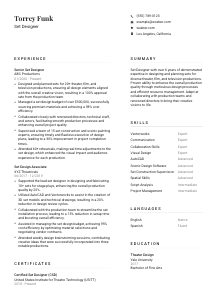
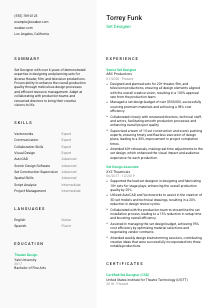
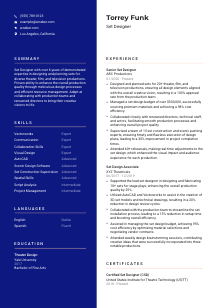
Building worlds, but your CV feels like a stage with one prop? Step into this Set Designer CV example, created with Wozber free CV builder. Learn how to present your artistic vision and construction skills in line with job specs, putting your design career front and centre!
Set design work is judged in the room long before an audience sees the stage or screen. Hiring teams want to know whether you can turn a script and a director's concept into buildable scenery, workable sightlines, and a set that survives rehearsals, budget pressure, and technical change. Your CV needs to show that kind of practical design judgment, not just visual taste.
A tailored CV helps separate conceptual designers from candidates who can also draft, coordinate, and adapt during production. Using Wozber's free CV builder to shape an ATS-friendly CV format makes it easier to align your wording with the posting, surface tools such as AutoCAD or Vectorworks, and make your production experience readable at a glance. That matters when a team is scanning for someone who can move from design boards to install notes without losing the creative brief.
In production hiring, the top of the CV should answer a few practical questions immediately: who you are, what role you do, and how the team can reach you. For set designers, this section also helps remove friction around location, portfolio access, and basic fit before anyone gets into your drafting work or production credits.
Your name should sit at the top in a size that is easy to spot, much like a clear title block on a drawing set. Keep it simple and professional so the focus stays on your production work, credits, and design scope.
Place "Set Designer" directly under your name if that is the job you want. Matching the title used in the posting helps the CV line up with both ATS filters and human review, especially when employers are sorting between adjacent creative roles such as production designer, scenic artist, or art director.
List a reliable phone number and a professional email address that you check regularly during active hiring periods. If a production team wants to schedule an interview, discuss availability, or request portfolio samples, they should not have to work to find you.
Some set design jobs are tied to a production hub, rehearsal schedule, or build shop. In this example, Los Angeles, California is explicitly requested, so listing the city and state near the top immediately answers a logistical requirement. Treat that as tailoring to the posting, not a rule for every set designer CV.
Set design is a visual discipline, so a portfolio link can carry as much weight as a job title. Include a clean URL to a site or profile that shows renderings, drafting samples, finished sets, model photos, or before-and-after production images. Make sure the work matches the kind of theater, film, or television projects you want next.
This section should remove basic questions fast. When your name, target role, contact details, location, and portfolio are easy to find, the reader can move straight to your design work and production experience.




For set designers, experience is where concept becomes proof. Employers look for more than artistic involvement. They want to see script interpretation, collaboration with directors and technical crews, control of budget and materials, and the ability to adjust designs once rehearsals and construction expose real constraints.
Read the job description the way you would read a script breakdown. Pull out the practical demands, such as scenic planning, drafting software, collaboration with directors, budget oversight, rehearsal revisions, or supervision of build teams. Then choose bullets from your past work that speak directly to those needs. In the sample CV, experience with AutoCAD, Vectorworks, budget management, and rehearsal adjustments maps closely to the employer's priorities.
List roles in reverse chronological order so the employer sees your current level of responsibility first. For set design, recency matters because workflows, software, and production scale change quickly. If your latest work includes theater, film, or television sets similar to the target role, make that progression easy to follow.
Each role should show what you designed, who you worked with, and what happened because of your work. Use verbs that reflect actual set design practice, such as designed, drafted, sourced, coordinated, supervised, revised, and installed. Strong bullets do more than say you were involved. They show how your designs supported the director's vision, improved build execution, or kept the production on schedule.
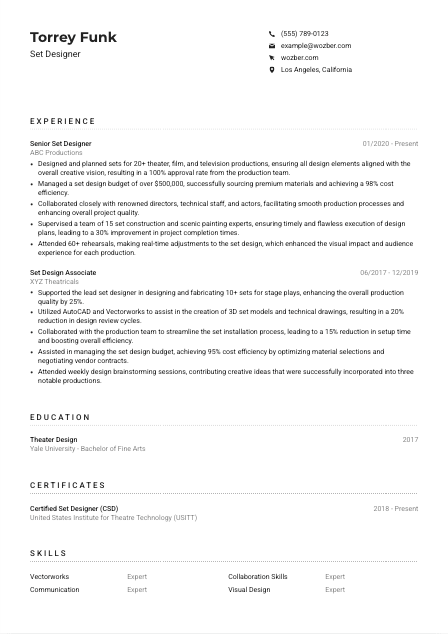
Quantified results make your scope easier to judge. Relevant measures for set design include number of productions, budget size, team size, rehearsal support, installation speed, cost efficiency, or review-cycle reductions. The sample CV does this well by showing 20+ productions, a $500,000 budget, a team of 15, and a 30% improvement in completion times. Metrics like these give your creative work operational context.
Space is limited, so focus on work that strengthens your case for scenic design, production collaboration, or technical execution. If an older role does not show transferable design judgment, drafting skill, or production coordination, shorten it or remove it. Keep the section centered on the kind of sets, teams, and responsibilities the employer is hiring for.
Your experience section should make it clear that you can move from concept through construction and rehearsal changes with control over design, communication, and resources. That is the combination most teams are trying to confirm.
Formal training matters in set design because it often shapes how you approach space, scale, drafting, materials, and visual storytelling. Even for experienced candidates, education helps confirm that your creative instincts are backed by technical grounding and discipline-specific study.
If the posting asks for a bachelor's degree in Theater Design, Set Design, or a related field, make sure your degree is easy to find and clearly labeled. A Bachelor of Fine Arts in Theater Design, like the one in the sample CV, directly supports the requirement and should not be buried below less relevant details.
List degree, field of study, school, and graduation year in a consistent order. Hiring teams are usually scanning this section quickly, so clarity matters more than decoration. Keep the layout simple so the qualification can be confirmed in seconds.
When your field of study directly connects to scenic work, name it precisely. Theater Design, scenic design, stage design, production design, or a related discipline gives the employer more useful information than a broad arts label. That specificity helps frame your training around production environments rather than general creative education.
If you are early in your career, selected coursework can add value, especially classes in drafting, model making, CAD, lighting for scenery, script analysis, or stage technology. The same goes for thesis productions or capstone builds that show practical design process. Skip course lists if you already have enough professional production work to carry the CV.
Academic honors, scholarships, design showcases, or competitive production selections can help if they point to design excellence or recognized craft. Include them when they add context to your training, especially if they relate to scenic work, collaboration, or technical theater.
This section works best when it confirms your training in space, storytelling, and production practice. For set design, that foundation matters most when it clearly supports the work shown in your experience.
Certificates are not always required in set design, but they can strengthen your CV when they point to recognized training, technical capability, or continued involvement in the field. They are most useful when they reinforce your production credibility rather than simply add another line.
Start with the job description. If a certificate is specifically requested, match the wording exactly. In this case, none is required, so any certification you include should clearly support scenic design, technical theater, drafting tools, safety practices, or production supervision rather than filling space.
Prioritise credentials that strengthen your case as a working set designer. A field-relevant certification such as Certified Set Designer can help because it points to recognized professional standards. Software training or specialised technical credentials may also be valuable if the target role leans heavily on drafting, rigging awareness, or construction coordination.
Dates help the reader understand whether a certification is current, recently earned, or part of long-term professional development. That context matters most for software training, safety-related credentials, or other certificates tied to current production practices.
Set design changes with new software workflows, fabrication methods, and cross-team production processes. If you complete new training in CAD tools, scenic technologies, or related technical areas, add it when it strengthens the kind of jobs you are pursuing. An outdated certificates section can make your toolkit look static.
The best certificates section reinforces your technical range or professional development in ways that matter to production hiring. If a credential does not help explain how you design, coordinate, or deliver sets, leave it out.
A set designer's skills section should read like a practical production toolkit, not a pile of generic strengths. Employers are looking for software fluency, spatial thinking, collaboration across departments, and the technical judgment needed to move from concept boards to construction-ready plans.
Start with the language in the job description, then compare it with the tools and abilities you actually use. For this role, that includes design software such as AutoCAD and Vectorworks, along with visual and spatial skills, collaboration, communication, and supervision of construction-related teams. Mirror the employer's wording where it honestly matches your background.
Lead with the skills most central to the job you want. For a set designer, software proficiency, scenic planning, drafting, collaboration with directors and technical staff, budget awareness, and construction supervision usually deserve priority over broader traits. The sample CV sensibly puts Vectorworks, AutoCAD, visual design, and set construction supervision near the top of the profile.
A grouped or clearly ordered skills list works better than a random collection. You might separate design software, production skills, and collaboration strengths, or simply order them by relevance. Keep the section tight and specific so the employer can quickly see both your technical toolkit and how you function inside a production team.
The right skills list should tell the reader how you work, what tools you use, and where you can contribute on a live production. Keep it focused on abilities that matter in scenic planning, drafting, build coordination, and creative collaboration.
Set design is highly collaborative work, and miscommunication can ripple into delays, rebuilds, or design compromises. Language skills matter most when they help you explain design intent, interpret notes, coordinate with crews, and work smoothly with directors, performers, and technical staff.
If the posting states that English communication is required, list English clearly with an honest proficiency level. For many theater, film, and television environments, strong spoken and written English supports script discussion, design presentations, rehearsal notes, vendor coordination, and technical documentation.
Lead with the language most important for the job, then add others that may help in collaborative or multicultural production settings. If you work on projects with international casts, touring productions, or bilingual creative teams, additional language ability can be a real advantage.
Additional languages are worth listing when they improve collaboration, research, or communication on set or in rehearsal. In the sample CV, Spanish adds useful range, especially in a market where crews and collaborators may work across languages. That is a plus, though not a substitute for the required English fluency.
Use clear levels such as Native, Fluent, Advanced, Intermediate, or Basic, and choose the one you can support in a professional setting. If you can discuss scripts and design choices in a language, say so confidently. If you only handle casual conversation, do not overstate it.
Languages can strengthen a CV, but they should not crowd out more important scenic qualifications. Include them as a useful support to your production profile, especially when communication across teams or cultures is part of the work.
For set design, language ability matters when it helps the work move cleanly from concept meetings to rehearsal notes and build coordination. List what you can genuinely use on the job.
The summary is often where a hiring manager decides whether the rest of the CV deserves close attention. For set designers, those lines should quickly connect your years of experience with the kinds of productions, tools, and creative collaboration you handle well.
Anchor the summary in your professional identity. That may mean theater-focused scenic design, cross-medium work in theater, film, and television, or strength in concept-to-install execution. Give the reader an immediate sense of your design lane and production environment.
Include your years of experience and the range of work you cover. A line such as having 6+ years across theater, film, and television tells the employer more than a vague claim about creativity. It helps them place you quickly against the seniority and production variety they need.
Use the summary to highlight the abilities that matter most for the target job, such as script-driven scenic design, CAD fluency, budget control, rehearsal adjustments, or leadership of construction and scenic teams. The sample summary points in the right direction by combining production range, resource management, and collaboration with directors.
Aim for a short paragraph that sounds grounded in real productions, not broad self-promotion. If every sentence could apply to any creative professional, tighten it. A hiring team should finish the summary with a clear picture of what you design, how you work, and what level of responsibility you can handle.
A precise summary gives your CV momentum by framing your production experience before the reader reaches the details. With Wozber's free CV builder, you can shape that section into an ATS-compliant CV that presents your set design background with the right terminology and focus.
A set designer CV should show more than creative potential. It should show that you can interpret a script, work with directors and technical teams, manage materials and budgets, and adapt the design once rehearsals and build realities change.
Use Wozber's ATS CV scanner and ATS-friendly CV templates to align your experience, skills, and summary with the language of each posting. The final result should make one thing easy to judge: you can design sets that work both artistically and practically in production.




