




Use Wozber and land your dream job
Create CV
No registration required
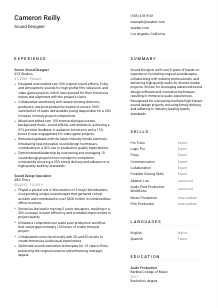
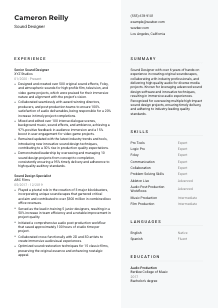
Creating sonic landscapes, but your CV sounds like static? Harmonize your credentials with this Sound Designer CV example, created with Wozber free CV builder. Learn how to amplify your audio artistry to match job specifications, ensuring your career hits all the right notes!
Sound design work gets judged in the final mix. Hiring teams want to see whether you can build believable sonic worlds, shape Foley and atmospheres with intention, and support the director's vision without slowing down post-production. Your CV should make that range visible quickly, from creative sound choices to the practical discipline of editing, mixing, and delivering on schedule.
When the CV is tailored well, it becomes much easier to separate a candidate who has touched audio from one who has owned full sound design work across projects. Using Wozber's free CV builder helps you align your wording with the posting, keep an ATS-compliant CV structure, and surface the tools, workflows, and media credits that show you can carry a project from asset creation to final mix.
Personal details may look simple, but for a Sound Designer they set up key basics right away: who you are, how to reach you, and whether you meet practical requirements that affect hiring. Keep this section clean and production-ready.
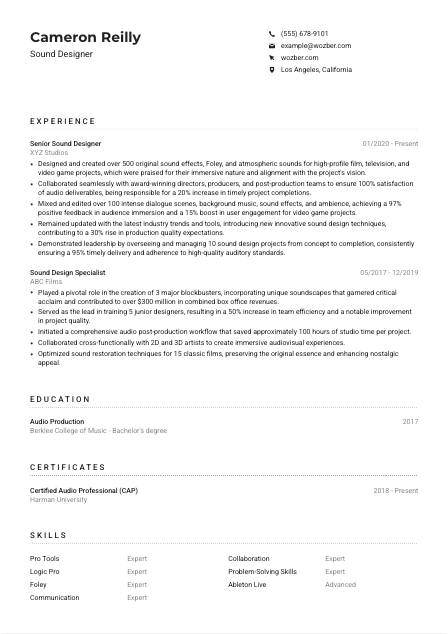
Use your full name as the header, then place "Sound Designer" directly beneath it. That immediate role match helps recruiters and production teams place you correctly, especially when they are reviewing candidates across audio editing, mixing, composition, and broader post-production functions.
List a current phone number and a professional email address that you check regularly. In production environments, callback timing matters. If a studio wants to schedule an interview, discuss availability, or request a portfolio link, they need a direct line that feels reliable.
If a job requires you to be based in a specific market, show that clearly. Here, listing "Los Angeles, California" works because the opening asks for a candidate located there. For other applications, only add location details that help remove friction around on-site sessions, studio collaboration, or time zone overlap.
A website, reel, or portfolio link is especially valuable in sound design. Employers often want to hear examples of your sound effects, dialogue cleanup, Foley work, ambient design, or final mix contributions. If you include a link, make sure the work is easy to navigate and labeled by project type or medium.
Do not add age, marital status, headshots, or other personal details unless a local market specifically expects them. For most sound design roles, the priority is your technical range, media experience, and collaboration record, not personal background that has nothing to do with the mix stage or project delivery.
This section should remove logistical questions, not create them. Clear contact details, the right title, and any job-specific location requirement let the reader move straight into your audio work.




This is where hiring teams look for proof that you can handle the real work: creating original assets, collaborating through revisions, and delivering polished audio under production deadlines. Focus less on broad creative claims and more on what you designed, mixed, improved, and finished.
Before editing your experience bullets, mark the terms the employer repeats. In this case, the posting centers on sound effects, Foley, atmospheres, audio post-production workflows, mixing, editing, and collaboration with directors and producers. Build your bullets around the overlap between those requirements and the work you have actually done.
List jobs in reverse chronological order and include your title, employer, and dates. For Sound Designers, title progression matters. "Senior Sound Designer" or "Sound Design Specialist" immediately tells the reader whether you led sessions, owned deliverables, or supported a larger post team.
Each bullet should show a concrete piece of audio work and the result. Good examples include creating original sound libraries, editing dialogue for key scenes, mixing final assets for release, or improving turnaround time in post. The sample CV does this well by tying work to outcomes such as 500+ original effects created, 100 scenes mixed, and stronger on-time delivery.
Use metrics that fit the field: number of projects completed, scenes mixed, assets created, hours saved in post, audience response, on-time delivery rate, or efficiency gains for the team. Metrics are especially persuasive when they show scope and workflow impact, such as reducing studio time per project or managing multiple sound design projects from concept through final approval.
If a bullet does not help prove your sound design range, trim it or rewrite it. A hiring manager for film, TV, or game audio wants to see asset creation, mix quality, tool fluency, collaboration in post, and delivery discipline. Leave out experience that cannot be tied back to those areas, or frame it in terms of relevant audio outcomes.
Your experience section should leave no doubt that you can build, edit, mix, and deliver audio for real productions. The strongest version reads like a record of finished work, not a list of generic responsibilities.
Education matters here because it backs up your grounding in audio theory, production practice, and post workflows. It will not outweigh your portfolio or credits, but when a posting asks for a degree, this section should answer that requirement cleanly.
If the employer requests a bachelor's degree in Audio Production, Sound Design, or a related field, place that information clearly. The sample CV matches the requirement well with a Bachelor's degree in Audio Production, which removes one screening question immediately.
Include degree, field of study, school, and graduation year. That is usually enough. In most sound design applications, hiring teams do not need a long academic narrative. They want to confirm relevant training and move on to your production work and software fluency.
When your degree directly relates to the role, state it exactly. "Audio Production" or "Sound Design" carries more value here than a vague label. If your degree is adjacent, such as music technology or media production, keep the wording accurate and let the rest of the CV show the practical sound design depth.
You can include standout coursework, studio concentrations, honors, or major projects if they connect to post-production, game audio, recording, mixing, or sound synthesis. This is most useful early in your career or when your academic work produced portfolio material worth discussing.
If you already have several years in professional sound design, keep education concise. Senior candidates are usually judged more on shipped work, collaboration history, and mix results than on classroom detail. The degree still matters, but it should not crowd out stronger production evidence.
For Sound Designers, education is supporting context. Keep it clear, relevant, and easy to verify so the focus stays on your actual audio work.
Certifications are not always required in sound design, but the right one can reinforce your technical seriousness and commitment to staying current with tools and workflows. Include them when they add real value to the role you are targeting.
If you hold certifications related to audio production, software, post workflows, or studio systems, include them. A credential like Certified Audio Professional can support your positioning, especially when paired with hands-on work in editing, mixing, restoration, or production environments.
A short list of well-matched certifications is more useful than a long list of unrelated training. For a Sound Designer, credentials tied to DAWs, recording, post-production, game audio middleware, or acoustic workflows usually matter more than broad creative certificates with no production application.
Add the year earned and, if relevant, the active validity period. Audio tools and workflows change quickly. Dates help show whether your learning is current, especially when the role emphasizes industry-standard software and evolving post-production practices.
If your current CV has no certifications, that is not a deal-breaker. Still, ongoing learning can help, particularly in areas such as immersive audio, restoration, game implementation, advanced mixing, or updated DAW workflows. Choose training that connects to the work you want more of.
A certificate section works best when it reinforces your technical depth and current practice. Keep only the credentials that make your audio background more credible for the production setting.
Sound design hiring is highly specific. Teams want to know which tools you use, what parts of the audio pipeline you can handle, and how well you work with creative and post-production partners. Your skills list should sound like it belongs to an actual production environment.
Start with the posting. Here, the must-have list includes Pro Tools, Ableton Live or Logic Pro, audio post-production workflows, sound effects creation, Foley, mixing, editing, collaboration, communication, and problem-solving. Build your skills section from the items you can genuinely back up in your experience.
A Sound Designer is rarely hired on software names alone. Combine DAWs and production tools with craft skills such as dialogue editing, ambience creation, sound effects design, Foley, music integration, or final mix support. Then include the collaboration skills that matter when working with directors, producers, editors, and other post specialists.
Do not turn this section into a master inventory of everything you have ever touched. Choose the skills that match the target role and are reinforced elsewhere in the CV. In the example, Pro Tools, Logic Pro, Foley, collaboration, and audio post-production workflows support the experience section rather than repeating it vaguely.
A hiring manager should be able to scan this list and picture you in the workflow. Prioritise the tools, audio craft, and collaboration strengths that fit the projects you want to join.
Language ability matters in sound design when the role involves detailed feedback, session communication, revision notes, and collaboration across production teams. Keep this section brief, but accurate.
If the job asks for strong or superior English, list English first and state your level clearly. In a role that involves creative interpretation, technical notes, and back-and-forth with directors or producers, language precision affects the work itself, not just the interview.
Additional languages can help in multilingual productions, international teams, localization-heavy game work, or projects involving global clients and talent. They are not always central, but they can broaden the kinds of productions you can support.
Use straightforward labels such as Native, Fluent, Advanced, or Conversational. Avoid overstating your level. If you may need to discuss cue revisions, dialogue nuance, or client feedback in that language, accuracy matters.
For some Sound Designers, extra language capacity is a minor bonus. For others, especially in international media pipelines or cross-border production houses, it can make collaboration smoother and reduce friction in review cycles and delivery notes.
Language skills can become more relevant over time, particularly if your work expands into new markets or multilingual content. Keep the section current, just as you would with new software proficiency or production credits.
For this field, languages matter when they improve communication around creative choices, revisions, and delivery. List them clearly and at the level you can actually use on the job.
The summary needs to establish your level, your medium, and the kind of audio work you can own. For Sound Designers, that usually means combining years of experience with a few concrete strengths in creation, post-production, and collaboration.
Start by naming yourself as a Sound Designer and anchoring the summary with your years of experience. That gives immediate context. In the example, "over 6 years of hands-on experience" works because it quickly places the candidate above the minimum 3-year requirement.
Include the parts of the craft you handle best, such as original sound effects, Foley, ambience, dialogue editing, music integration, or final mix work. This tells the reader whether you operate as a niche contributor or someone who can support a project across the broader post-production chain.
Name the software or workflow strengths that directly match the posting, but keep it selective. Pro Tools, Ableton Live, Logic Pro, and audio post-production fluency are useful here because they are requested in the role and reinforced by the rest of the CV.
Aim for a short paragraph that reads like a hiring-ready snapshot, not a biography. A strong summary mentions scope, medium, and impact in a few lines, such as delivering immersive audio, supporting creative vision, and maintaining high standards across multiple productions.
By the time someone finishes these lines, they should already know your level, your audio strengths, and the environments you have worked in. That context makes the rest of the CV easier to trust.
Your Sound Designer CV should now show the work behind the headphones: the assets you created, the mixes you shaped, the teams you collaborated with, and the projects you delivered on time. Keep every section aligned with the kind of production work you want next.
With Wozber's free CV builder, ATS-friendly CV template, and ATS CV scanner, you can tighten wording around the job description, improve ATS optimisation, and present your background in an ATS-friendly CV format that keeps the focus on your actual sound design range. The result should make it easy to hear that you are ready for the role.