



Use Wozber and land your dream job
Create CV
No registration required
Rolling the camera, but your CV isn't quite in frame? Check out this Film Producer CV example, built with Wozber free CV builder. Learn how to script your producing prowess to match job demands, and watch your career story unfold as a hit at the box office!
Film producers are trusted with the part of a project where creative ambition meets schedule, financing, contracts, hiring, and release strategy. That means a CV for this field needs to show more than title prestige. It should make clear that you can move a film from development through post-production while protecting budget, aligning stakeholders, and keeping delivery on track.
Hiring teams often sort producer candidates by scope first. They want to see whether you have handled funding, distribution conversations, crew build-out, and production timelines at a level close to their project. Using Wozber's free CV builder to tailor your language and strengthen ATS optimisation helps surface that scope quickly, so your CV reads like someone who can actually run a production, not just contribute to one.
The contact section is simple, but it still carries practical signals. For a Film Producer, it should immediately confirm who you are, the role you do, and whether you're positioned to work where the production company needs you. Keep it clean, professional, and easy to scan.
Use your full name in the most prominent text on the page. In an industry built on relationships and repeat collaborations, your name is part of your professional identity, so present it clearly and consistently across your CV, LinkedIn, website, and credits.
Place "Film Producer" directly under your name if that matches your current or target role. This helps frame your experience before the reader reaches your work history and aligns your CV with the language used in the posting.
List a reliable phone number and a professional email address. If you maintain a portfolio site, IMDb page, or LinkedIn profile with production credits, include it only if it is current and supports the same career story shown in your CV.
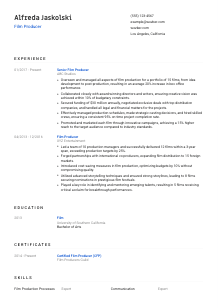
When a posting includes a location requirement, make that easy to see. In the example, Los Angeles, California belongs in this section because the employer specifically asks for candidates based there. For other Film Producer roles, only include location details that matter to availability, union market, or production logistics.
A producer's online profile should reinforce the practical side of the work. If you link to a profile, make sure it reflects relevant productions, festival runs, financing or distribution wins, leadership roles, and collaborators. A sparse or outdated profile can weaken the professional picture instead of strengthening it.
This section does not need flair. It needs accuracy, professionalism, and any logistical detail that affects whether you can step into the production environment immediately.




This is the section that carries the most weight for Film Producer hiring. Credits alone are not enough. Your bullets need to show the scale of productions, the business decisions you owned, the people you coordinated, and the outcomes you delivered across development, filming, post-production, and release.
Pull out the operating demands behind the wording. In this role, those include end-to-end production oversight, collaboration with directors and writers, budgeting, financial planning, deal negotiation, hiring, scheduling, and marketing or distribution support. Those are the themes your experience bullets should answer.
Start with your most recent producing work and make each entry easy to scan with job title, company, and dates. For producer CVs, title progression matters. A move from Film Producer to Senior Film Producer, for example, helps show increased authority over budgets, greenlight decisions, partnerships, and production teams.
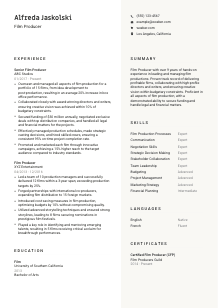
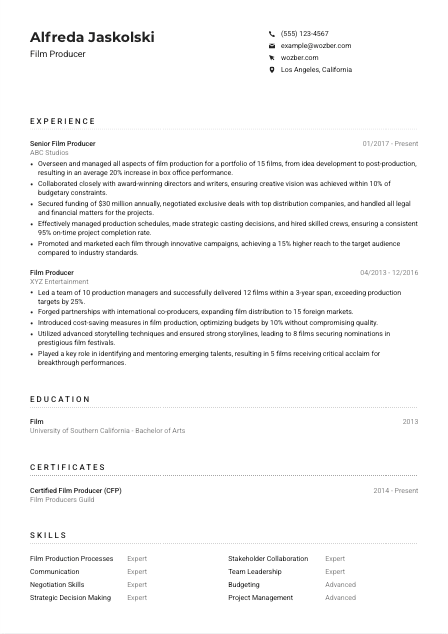
Each bullet should show what you led and what changed because of your work. Strong producer bullets often cover financing secured, productions delivered, schedules met, markets reached, awards or festival recognition, and revenue or audience impact. The example does this well by tying oversight of 15 films to a 20% increase in box office performance and linking funding work to $30 million secured annually.
Numbers matter in this field because they show control over scale and risk. Include figures tied to budgets, funding raised, number of films produced, on-time delivery rates, crew size, foreign markets entered, box office lift, campaign reach, or cost reductions. Those metrics tell a hiring manager whether you have handled productions at the level they need.
Focus on work that proves producer judgment. Administrative tasks, unrelated creative projects, or general entertainment experience should only stay if they connect to financing, stakeholder management, production operations, or distribution results. Every bullet should help answer a core question: can you take a film from concept to audience while managing the business realities around it?
The best experience sections for Film Producers read like a record of projects delivered, deals closed, and productions steered through pressure. When your bullets show operational control and measurable outcomes, the hiring team can picture you running their next project.
Education is rarely the deciding factor for an experienced Film Producer, but it still matters when the posting asks for a specific academic foundation. Keep this section concise and relevant, with enough detail to confirm that you meet the requirement and understand the business or creative side of production.
Start by checking what the employer asked for. Here, a bachelor's degree in Film, Business, or a related field is requested, so your degree should be listed in a way that makes that match obvious.
Present your degree, field of study, school, and graduation year in a simple structure. Hiring teams should be able to confirm your academic background in seconds without hunting through extra text.
If your degree is especially relevant, let that work in your favor. The example candidate's Bachelor of Arts in Film from the University of Southern California directly supports a producing path and aligns neatly with the requirement. If your degree is in Business or Communications, that can also be valuable when your experience shows budgeting, financing, and project leadership.
Relevant coursework, producing labs, student film leadership, or honors can help if you are early in your career or if they connect directly to production planning, financing, development, or distribution. If you already have 5+ years in industry roles, keep these details selective.
Awards, fellowships, or notable academic distinctions are worth listing when they carry weight in film or media circles. They should add context to your trajectory, not distract from your production experience.
This section should confirm the academic baseline and support your professional story. For most producer CVs, the deeper proof still comes from productions managed, budgets handled, and outcomes delivered.
Certifications are usually a supporting section for Film Producers, not the main event. Still, the right credential can reinforce professional development, industry commitment, or specialised knowledge in production management, financing, or legal and business practices.
Some producer roles care far more about credits and deal experience than certifications. If the posting does not ask for one, treat this section as optional support rather than a core qualification.
Choose credentials that connect to production leadership, budgeting, entertainment business, or film operations. In the example, "Certified Film Producer (CFP)" works because it directly supports the candidate's positioning in the field.
Dates help when a certification is current, recently earned, or still active. That can be especially useful in areas where business practices, compliance expectations, or production workflows keep changing.
If you have recent training in distribution strategy, production finance, entertainment law, or digital marketing for releases, include it when it strengthens your relevance. Ongoing education matters most when it connects to how films are financed, delivered, and promoted today.
A certification will not replace real producing credits, but it can add polish when it clearly relates to the work. Keep the focus on credentials that strengthen your authority in production and business decision-making.
A Film Producer's skills section should read like the operating toolkit behind a successful production. Include the mix of commercial judgment, production control, stakeholder management, and communication that the job requires. Generic soft-skill lists are not enough on their own.
Use the posting to identify the capabilities that matter most. For this role, that includes film production processes, budgeting, financial planning, project management, negotiation, communication, and collaboration with directors, writers, distributors, and crew leads. Those should appear in language that matches your actual experience.
Keep the list tight and relevant. Producing roles are judged heavily on planning, financing, hiring, schedule management, and negotiation, so those skills should appear before broader traits that could apply to almost any job.
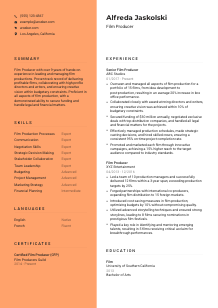
Group skills in a way that reflects the work. You might separate production operations from business and communication skills, or simply order them by relevance. The example handles this well by mixing core production capabilities like Film Production Processes and Budgeting with leadership strengths such as Stakeholder Collaboration and Team Leadership.
Your skills should reinforce the experience section, not repeat vague claims. When this section reflects the real mechanics of producing, it adds another fast layer of credibility.
Language ability can matter in film more than candidates sometimes expect. Producing work often crosses borders through co-productions, festival circuits, international sales, and global crews. Even when the role is domestic, clear language requirements should be handled directly.
If the posting specifies language fluency, include it clearly. This role requires conversational English, so English should appear with an honest proficiency label such as Native or Fluent.
Additional languages can strengthen your profile when they help with international partners, foreign markets, or multicultural crews. In the example, French adds relevant context because it can support collaboration beyond English-language productions.
Do not overstate fluency. Producers are often pulled into negotiations, stakeholder calls, press activity, and on-set problem solving, so language claims should match what you can handle in real working situations.
Simple descriptors such as Native, Fluent, Advanced, or Conversational are enough. The goal is to help the employer understand how you can communicate, not to turn this section into a language assessment.
If you target international features, documentary co-productions, or projects with overseas financing and distribution, multilingual ability can become a meaningful differentiator. If it is not relevant to the role, keep the section brief.
For Film Producers, languages matter when they improve communication across markets, partners, or crews. Present them clearly, and only at the level you can use professionally.
The summary is where you frame your level before the reader gets into the details. For a Film Producer, that means quickly stating your years in the industry, the type or scale of productions you have led, and the business responsibilities you handle well. Keep it short, specific, and aligned with the role you want.
Start with a direct description of your level, such as Film Producer with 9+ years of experience across development, production, and post. This immediately sets expectations for scope and seniority.
Follow with two or three strengths that match the posting. For this employer, that would include end-to-end production oversight, budget control, funding and distribution negotiations, and close collaboration with directors and writers. The example summary does this effectively by combining production leadership with funding and legal-financial responsibility.
Aim for a few lines, not a paragraph that repeats your whole CV. Include one or two concrete outcomes if they are strong, such as profitable films, on-time delivery, or improved audience reach, and leave the detailed metrics for the experience section.
A producer summary should tell the reader, quickly and credibly, what level of project you can manage and where your judgment is strongest. When it is tailored well, the rest of the CV lands faster.
A Film Producer CV should leave little doubt about the scale of productions you have managed, the budgets and deals you have handled, and the teams you have coordinated from development through release.
Before applying, review your wording against the posting, tighten weak bullets, and make sure the most relevant credits surface first. Wozber's free CV builder and ATS CV scanner can help you align terminology, strengthen ATS-friendly CV format choices, and present your experience in a way that makes your producing scope easy to judge.
When the CV is tailored well, hiring teams can quickly see whether you are ready to take ownership of the next production.




