



Use Wozber and land your dream job
Create CV
No registration required
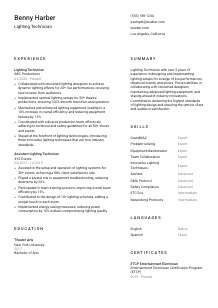
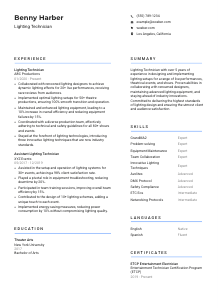
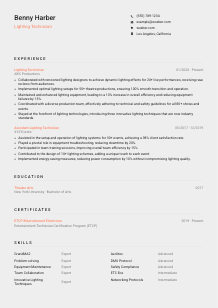
Shedding light on dark stages, but your CV feels dim? Illuminate your credentials with this Lighting Technician CV example, created with Wozber free CV builder. Learn how to highlight your technical brilliance to match job demands, forging a career as brilliant as the spotlights you control!
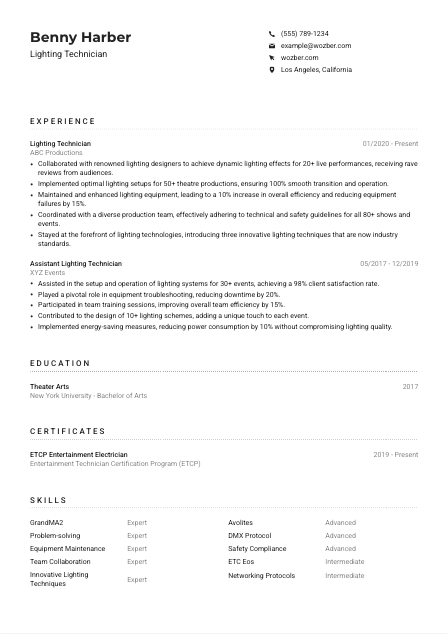
Lighting work gets judged in real time. When cues miss, fixtures fail, or a console patch goes sideways, the whole production feels it. A Lighting Technician CV needs to make that operational reliability visible fast, showing that you can support rehearsals, live shows, and event changeovers without losing control of the rig.
The first screening pass often separates candidates who know live production workflows from those with only general technical experience. Using Wozber's free CV builder helps you shape an ATS-compliant CV around the language hiring teams expect to see, from console experience and DMX knowledge to troubleshooting and show support, so your background reads clearly for the pace and pressure of production work.
Production teams move quickly, and your contact details need to answer basic logistics without getting in the way. For a Lighting Technician, this section should confirm who you are, what role you do, and whether you match practical requirements such as location or relocation readiness.
Use your full name in a clean, prominent format so stage managers, production coordinators, or hiring leads can find it immediately. There is no need for design flourishes here. Clear presentation works better than theatrical styling, especially in an ATS-friendly CV format.
Place "Lighting Technician" directly under your name if that is the role you are applying for. Matching the posting title helps both ATS parsing and human review. If your recent title was "Assistant Lighting Technician" but your experience supports the next step up, the rest of the CV should make that progression obvious through console work, setups, and troubleshooting scope.
List a reliable phone number and a professional email address. In live events and theatre hiring, callbacks can move fast when a crew need opens up before a run, tour, or weekend event. One typo in your phone number is enough to lose that chance.
If the posting names a work location, include your city and state when you already meet that requirement. Here, "Los Angeles, California" works because the employer asked for candidates who are local or willing to relocate. If relocation applies, say so plainly rather than leaving the employer to guess.
If you have a website, LinkedIn profile, or portfolio with production photos, cue sheets, design credits, or equipment lists, include it. For Lighting Technicians, a link is most useful when it shows the scale and type of productions you have supported, not when it sends employers to an unfinished page.
Keep this section simple and functional. It should confirm your identity, role, and availability quickly so the hiring team can move on to what matters most in production hiring, your technical experience and show support record.




This section carries the most weight for Lighting Technician hiring. Teams want to see what kinds of productions you have supported, which systems you have operated, how you handled setup and troubleshooting, and whether you can keep a show running under pressure.
Start by identifying the work the employer cares about most. In this role, that includes collaborating with designers and directors, implementing lighting setups, maintaining fixtures and systems, troubleshooting issues, and following technical and safety guidelines. Your bullets should reflect that same production language when it matches your actual work.
Begin with your most recent role and include employer, job title, and dates. Then make the setting clear through your bullets. A theatre run, live event environment, touring setup, or rehearsal-heavy production schedule tells the reader far more than a generic task list.
Each bullet should show what you did and what changed because of it. The sample CV does this well by moving beyond "set up lights" to results such as supporting 50+ theatre productions with smooth transitions and reducing equipment failures. That kind of phrasing shows both hands-on execution and production reliability.
Quantify the scale of your work where possible. Good metrics for this field include number of shows, events, fixtures, venues, cue-heavy productions, downtime reduction, equipment reliability, energy savings, or efficiency gains during setup and strike. "Reduced downtime by 20%" or "supported 80+ shows and events" says more than vague claims about impact.
Cut experience that does not support your case for this role, or rewrite it so the relevant parts stand out. If you have broader production experience, focus on the lighting side of it: console operation, patching, DMX distribution, fixture maintenance, crew coordination, rehearsals, or safety compliance. The goal is to make your path toward Lighting Technician work easy to follow.
When this section is working, a hiring manager can picture you on the crew. They should see the productions you handled, the systems you touched, and the results you delivered when timing, safety, and technical consistency mattered.
Hands-on production work often outweighs formal education in lighting roles, but your education still adds useful context. It can show technical grounding, theatre exposure, or early specialization in performance production, design, or electrical systems.
If the job posting does not require a specific degree, list the most relevant education you have without forcing it. A degree in Theater Arts, Production Technology, Stagecraft, or a related field strengthens your CV because it connects directly to performance environments and backstage workflows.
List the school, degree, field of study, and graduation year or date range. This section does not need extra decoration. Hiring teams mainly want to confirm your background and then return to your production experience and technical skills.
If your education closely matches the role, let that alignment work for you. In the example CV, a Bachelor of Arts in Theater Arts supports the candidate's move into theatre productions and live performance work. That kind of degree is not mandatory everywhere, but it does reinforce context.
Relevant coursework, workshops, or lab training can be worth mentioning if they strengthen your case in areas such as lighting systems, control consoles, networking basics, or electrical safety. This is especially useful earlier in your career or when recent training supports a new production environment.
Student productions, technical theatre clubs, or stage crew leadership can help if they involved real console operation, rigging support, or design implementation. Keep these details brief and include them only when they add meaningful lighting experience rather than general campus involvement.
Use this section to show your foundation in theatre, production, or technical training. Then let your experience section carry the deeper proof that you can execute under live show conditions.
Certifications carry real weight in technical production because they point to safety awareness, electrical knowledge, and commitment to current industry standards. If a posting asks for them directly, this section moves from helpful to important.
When an employer names specific credentials, list those first if you hold them. Here, ETCP Entertainment Electrician and Lighting Certified Specialist are directly relevant because the posting either requires them or asks candidates to be willing to obtain them.
Focus on credentials tied to lighting systems, entertainment electrics, control equipment, safety, or power distribution. A shorter list of relevant certifications works better than a long list of loosely related training items.
Show the earned date and, if relevant, the renewal period or current status. For technical certifications, date visibility helps employers see whether your knowledge is active and current, especially in safety-sensitive environments with changing standards and equipment.
Lighting technology changes quickly, from console ecosystems to networking practices and fixture capabilities. Updating this section tells employers you are staying current with the tools and standards that affect rehearsals, programming sessions, and live operation.
A well-chosen certifications section tells production teams that you take safety, systems knowledge, and professional development seriously. That matters when you are handling live power, complex rigs, and show-critical equipment.
For Lighting Technicians, the skills section should show the tools and technical judgment behind your work. It needs to balance console proficiency, system knowledge, troubleshooting ability, and the collaboration skills that keep rehearsals and live cues running smoothly.
Read the job description closely and separate hard skills from execution skills. In this case, consoles such as GrandMA2, Avolites, and ETC Eos belong alongside DMX, networking protocols, troubleshooting, multitasking, and safety awareness. That mix reflects how the role is actually performed.
Choose skills that support live event and theatre work first. Console software, patching knowledge, fixture maintenance, cue execution, and problem-solving deserve priority over broad generic abilities. The example CV works because it combines desk-specific expertise with operating skills such as equipment maintenance and safety compliance.
Present your strongest and most relevant skills first, and use honest proficiency levels if your format includes them. Grouping or ordering matters. A hiring lead should be able to scan the section and quickly spot the consoles, protocols, and troubleshooting depth needed for the production.
After reading this section, an employer should know which desks you can use, which systems you understand, and whether you have the troubleshooting range to support a live show without constant supervision.
Language skills matter in production more than many candidates realize. Clear communication affects cueing, safety calls, rehearsals, crew coordination, and fast problem-solving during load-in or live operation.
If the employer asks for a specific language, include it clearly. Here, strong English matters because production communication depends on precise instructions, timing, and safety coordination across designers, directors, operators, and crew.
List English prominently when it is named in the job description. A clear rating such as Native, Fluent, or Professional helps the employer understand how comfortably you can work in rehearsals, technical run-throughs, and show calls.
Additional languages can be valuable in event production, touring environments, and multicultural crews. They are not a substitute for technical skills, but they can strengthen your ability to coordinate with a wider team on busy production days.
Keep your levels honest and easy to interpret. Labels like Native, Fluent, Intermediate, and Basic work well because they set practical expectations for workplace communication.
If the role involves touring, diverse event crews, or client-facing work, another language may carry more value. If not, keep this section short and factual. Relevance matters more than listing every language you have ever studied.
This section is most useful when it tells the employer how effectively you can communicate during rehearsals, technical setups, and live show conditions. Keep it accurate and practical.
Your summary should give a fast, credible read on the kind of Lighting Technician you are. In a few lines, it should cover your production experience, your technical strengths, and the environments where you deliver dependable results.
Start with a direct professional identity and a realistic experience range, such as "Lighting Technician with 5+ years of experience." That immediately sets your level and helps employers place you within the crew structure they are hiring for.
Follow with two or three specifics tied to the posting, such as live performance setups, console proficiency, equipment maintenance, or troubleshooting under pressure. The sample summary works because it mentions both implementation and collaboration, which are central to the job.
Avoid broad claims about passion or excellence unless the rest of the sentence proves them. A short summary with details like theatre productions, event support, advanced lighting equipment, or production reliability reads much stronger than generic enthusiasm.
Close on the outcome your work supports, such as smooth show operation, dependable technical execution, or high-quality lighting delivery. That gives the reader a clear reason to continue into your experience section.
A useful summary makes your level, technical range, and production value clear in seconds. When it is tailored well, the rest of the CV feels like proof of that opening statement.
Your Lighting Technician CV should show more than interest in live production. It should show console familiarity, setup and troubleshooting experience, safety awareness, and a record of keeping shows running smoothly under pressure.
Use Wozber's free CV builder and ATS CV scanner to align your wording with the posting, strengthen ATS optimisation, and present your work in an ATS-friendly CV format. The finished CV should make it easy to judge one thing quickly: whether you can step into the rig, support the team, and deliver reliable lighting execution from rehearsal through show call.