



Use Wozber and land your dream job
Create CV
No registration required
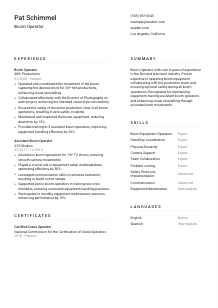
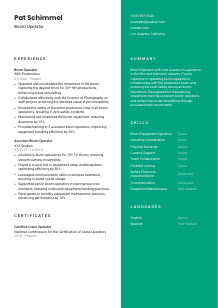
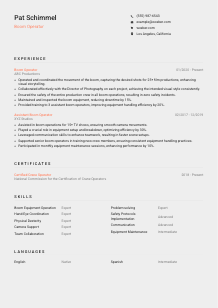
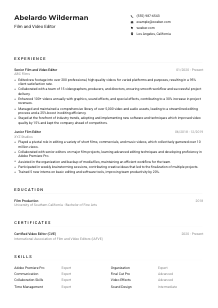
Captivating sound for the silver screen, but your CV falls flat? Elevate your credentials with this Boom Operator CV example, made with Wozber free CV builder. Learn how to position your audio acumen so it resonates with job criteria, making your career as impactful as that scene-stealing explosion!

Boom operators work where precision, timing, and safety meet. On a live set, there is little room for guesswork when moving heavy camera support equipment around cast, crew, and lighting setups. Your CV needs to show that you can execute clean movements, follow safety protocols, and work closely with the Director of Photography and camera team without slowing production down.
A tailored CV makes that operational judgment much easier to make. When your experience and skills reflect the same language the production uses for boom movement, equipment maintenance, crew coordination, and safety compliance, both hiring teams and ATS screening can connect your background to the role faster. Wozber's free CV builder helps organise that alignment into an ATS-compliant CV that clearly shows whether you can step onto set and handle the work.
Production hiring often starts with practical checks before anyone studies your credits in detail. Your personal details should confirm who you are, what role you do, and whether you are available for the production setup the employer needs.
Use your full name as the most visible text at the top of the page. Keep it clean and professional so the hiring manager can identify you quickly when scanning a stack of crew CVs or reviewing candidates between production meetings.
Place "Boom Operator" directly under your name if that is the position you are targeting. This immediately frames your background around camera support, safe boom movement, and on-set coordination instead of leaving the reader to guess whether you are coming from a broader grip, rigging, or crane background.
List a current phone number and a professional email address that you check regularly. Set hiring can move quickly, especially when productions need to confirm availability, call times, or licensing details, so accuracy matters here more than style.
If a posting specifies a local requirement, include your city and state. In the example job description, Los Angeles, California is stated directly, so listing Los Angeles, California in the header removes a common logistical question right away.
A personal website, portfolio page, or well-maintained LinkedIn profile can help if it supports your set experience, credits, or certifications. Keep it relevant. A hiring manager should find production work, equipment familiarity, or industry background there, not unrelated personal content.
This section should answer the quick practical questions first: your identity, target role, how to reach you, and whether your location matches the production's needs. Make those details easy to confirm so the rest of the CV can focus on your on-set work.




For a Boom Operator, experience carries most of the hiring weight. Production teams want to see where you have operated, what kind of coordination you handled on set, and whether you can move equipment safely while supporting the shot the DP wants.
Read the posting closely and mark the responsibilities that define success in the role. Here, the key themes are operating the boom for desired shots, collaborating with the DP and Camera Operator, maintaining equipment, training assistants, and following safety procedures. Those same themes should appear in your bullet points when they match your real experience.
List positions in reverse chronological order and make the job title, employer, and dates easy to scan. If you progressed from Assistant Boom Operator to Boom Operator, as the sample CV does, that progression tells a useful story about growing technical responsibility and trust on set.
Each bullet should show what you operated, who you worked with, and what changed because of your work. Strong examples for this profession mention camera movement support, visual consistency, scene execution, crew safety, equipment uptime, or assistant training. The sample CV does this well with bullets about collaborating with the Director of Photography, maintaining zero safety incidents, and improving handling efficiency for assistant operators.
Metrics make your experience more concrete when they are native to the work. Good Boom Operator measures include number of productions supported, downtime reduced through maintenance, setup efficiency, training outcomes, or safety records. "Captured desired shots for 25+ film productions" and "reduced downtime by 15%" work because they show scope and reliability, not because they add numbers for the sake of it.
Keep the section focused on boom operation, equipment handling, on-set communication, and safety-conscious execution. If you have broader production experience, include it only when it strengthens the case that you can support camera operations smoothly and work within the pace of film, television, or live production.
By the end of this section, the reader should understand the scale of sets you have worked on, how reliably you support the camera team, and how you handle safety and equipment care under production pressure. That is what makes your experience persuasive for this role.
Education is rarely the deciding factor for a Boom Operator, but it can still add useful context. It shows training, technical foundations, and early exposure to production environments, especially when your formal experience is still building.
List your degree, school, and graduation year or attendance dates. Keep the format simple. This section should support your CV without competing with your set experience and certifications.
If you studied film, broadcasting, media production, or a related technical field, make that easy to spot. Coursework in camera operations, production safety, rigging basics, or live event workflows can be relevant when it explains how you built practical knowledge.
If you do not yet have many years of production work, include workshops, boot camps, or hands-on training that relate to boom equipment, crane operation, set safety, or crew coordination. These details can help show technical preparation before your credit list gets longer.
Honors, student productions, or film club leadership can be useful when they point to real production involvement. Leave them out if they do not add anything about technical ability, teamwork on set, or commitment to the field.
If you already have several years of paid work in film or television, this section can stay brief. For a more experienced candidate, hiring managers will care far more about on-set performance, safety record, and equipment handling than about extensive academic detail.
Education should provide context, not take over the page. Include enough to show your training and relevant background, then let your production experience and certifications carry the main argument.
Certifications matter more in this field when they connect directly to equipment operation and compliance. If a role asks for a crane or boom-related credential, this section can move from helpful to essential very quickly.
When a posting asks for a valid Crane Operator Certification or a state-issued license, include it clearly with the issuing body and active dates. In the sample CV, "Certified Crane Operator" is exactly the kind of credential that addresses the requirement directly.
List certifications that support boom handling, crane operation, rigging awareness, set safety, or equipment compliance. A short, relevant list is stronger than a long list of unrelated training because it tells the employer you meet the operational standard for the role.
Production employers need to know whether a credential is active or current enough to rely on. Add the year earned and, when applicable, the renewal or expiration range so there is no ambiguity about your certification status.
As you take on larger sets, more complex equipment, or mentoring responsibilities, your certifications should reflect that progression. Updated credentials show that you stay aligned with industry requirements and current safety practices.
For a Boom Operator, the right certificate can answer a practical hiring question immediately. Use this section to show that your qualifications are current, relevant, and ready for the equipment and safety demands of the production.
A Boom Operator skills section should read like a quick technical and operational snapshot. The best lists balance equipment control, safety awareness, physical execution, and on-set communication instead of leaning too heavily on generic soft skills.
Pull the required abilities from the job description before adding anything else. For this role, that includes boom or crane operation, safety protocol implementation, hand-eye coordination, physical dexterity, and communication with the production team, directors, and actors.
This profession sits at the intersection of machinery, movement, and teamwork. A useful skills list might include boom equipment operation, camera support, equipment maintenance, safety procedures, team collaboration, and communication. The sample CV reflects that balance well by combining operation and maintenance skills with coordination and problem-solving.
Put the most role-critical abilities first. For a Boom Operator, equipment operation and safety should usually appear before broader traits. That ordering helps the reader see your technical suitability for the set before they reach secondary strengths.
Your skills section should give a quick read on whether you can operate the equipment, move accurately under pressure, and work smoothly with the camera team. Keep it focused enough that those priorities stand out immediately.
Language skills matter on set when they improve coordination, safety, and communication under time pressure. This section is usually short, but it becomes more valuable when a posting names a language requirement or when productions involve multilingual crews or talent.
Always review the posting first. Here, excellent English skills are specifically requested, so English should appear clearly in your language section if it is one of your working languages.
Lead with the language most relevant to the role. In this case, listing English prominently supports the communication side of the job, especially because Boom Operators need to coordinate with the DP, Camera Operator, directors, and performers during active setups.
Additional languages can be valuable when they help with cast interaction, crew coordination, or work on productions with mixed-language teams. In the sample CV, Spanish at an intermediate level adds useful range without overstating fluency.
Use clear levels such as Native, Fluent, Intermediate, or Basic. Accurate language ratings matter in production settings where misunderstood instructions can affect timing, safety, or shot execution.
Do not list languages just to fill space. Include the ones you can actually use in production conversations, equipment coordination, or on-set problem solving. Practical communication matters much more than a long list.
For this role, languages support clear calls, safe movement, and smoother teamwork. Lead with the language the employer asked for, then add others only when they contribute to real production communication.
Your summary should give a fast, credible picture of the kind of Boom Operator you are. In a few lines, it should establish your experience level, your operating strengths, and the kind of set contribution you make most reliably.
Before writing, pull out the role's main themes and use them to shape your opening. For this job, the summary should touch on years of experience, boom operation in film or television, collaboration with the camera team, safety discipline, and equipment care if those are all part of your background.
Start with a direct statement such as your title and years in the field. "Boom Operator with over 4 years of experience in film and television production" works because it establishes level and industry context immediately.
Focus on strengths that matter in production, such as accurate boom movement, collaboration with the Director of Photography, maintaining equipment performance, or training assistant operators. The sample summary is effective because it combines operating expertise, team coordination, safety, and mentoring without drifting into generic claims.
Aim for a short paragraph that can be read in seconds. Avoid vague personality language. Use the space for concrete capabilities and scope so the hiring manager can quickly decide whether your background matches the set's technical and operational needs.
A good summary tells the reader, quickly and plainly, that you have relevant production experience, understand the equipment, and can support the shot safely. If those points are clear, the rest of the CV has a strong lead-in.
A Boom Operator CV works when it shows dependable equipment control, safe on-set execution, and close coordination with the camera team in language that matches the production's needs. That means specific experience bullets, current certifications, and a summary that reflects the real pace and responsibility of the work.
Use Wozber's free CV builder to shape that experience into an ATS-friendly CV format, then refine it with the ATS CV scanner so the wording lines up with the posting's technical and operational requirements. The finished CV should make one thing easy to judge: you can step onto set, handle the boom safely, and support the shot.