



Use Wozber and land your dream job
Create CV
No registration required
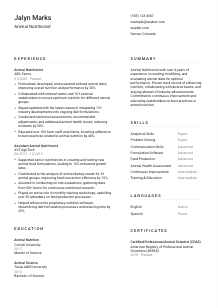
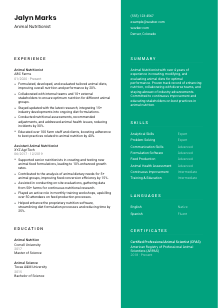
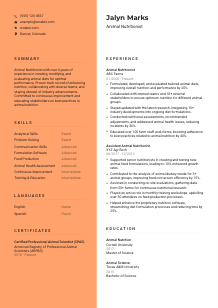
Balancing kibble and credentials, but your CV feels ruff? Check out this Animal Nutritionist CV example, created with Wozber free CV builder. Learn how to blend your dietary expertise with job needs, making your career as nourishing as the meals you formulate!
Animal nutrition work sits at the intersection of science, production performance, and animal health. Hiring teams want a CV that shows you can formulate diets, interpret nutritional data, understand feed production realities, and explain recommendations clearly to farm staff, clients, and cross-functional partners.
A targeted CV changes how quickly those strengths come through, especially when an ATS is scanning for diet formulation, feed process knowledge, research awareness, and stakeholder training. Wozber's free CV builder helps you shape an ATS-compliant CV around the language employers use, so your background reads clearly as applied nutrition expertise rather than general animal science experience.
This section should establish you as a real, reachable candidate for the opening without making the reader hunt for basics. For an Animal Nutritionist, that means clear professional identity, reliable contact details, and, when the posting requires it, location that removes uncertainty about availability.
Use your full name prominently and keep the formatting clean. Animal nutrition roles often involve collaboration with operations teams, veterinarians, feed suppliers, and clients, so your header should read like a professional document tied to technical credibility, not a creative profile.
If you are applying for an Animal Nutritionist position, place that title directly under your name. Matching the posted title helps frame your background around diet formulation, nutritional assessment, and feed-related decision-making from the first line.
List a phone number and professional email address that are current and typo-free. A missed digit or outdated email can cost you an interview, especially when employers are moving quickly between candidates with similar education in animal science or nutrition.
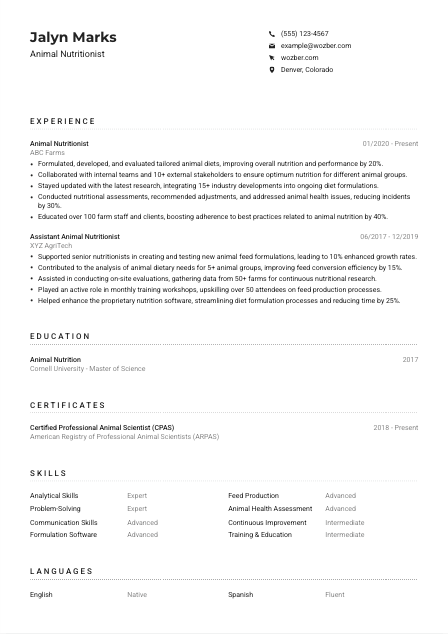
Some openings make geography part of the screening process. Here, Denver, Colorado is specifically requested, so showing Denver in the sample CV immediately answers a practical hiring question. If you are relocating, state that clearly instead of leaving the employer to guess.
Include LinkedIn or a professional website only if it supports your application with useful detail such as research work, publications, speaking activity, or industry projects. For a nutrition specialist, that link should reinforce your technical background and communication strengths, not distract from them.
Keep this section simple, accurate, and aligned with the posting. Once your identity, title, and availability are clear, the reader can move straight to your formulation work, production knowledge, and nutritional results.




Experience carries the most weight when it shows how you turn nutritional knowledge into better diets, healthier animals, and stronger production outcomes. Employers are looking for applied work here, not just exposure to animal science topics.
Pull the main duties from the job description and reflect them in your bullet points using your own real experience. For this role, that includes formulating tailored diets, conducting nutritional assessments, collaborating with stakeholders, and training others on diet management. The sample CV handles this well by echoing those priorities through concrete responsibilities instead of generic support language.
List positions in reverse chronological order with employer, title, and dates easy to scan. For animal nutrition hiring, your most recent role should quickly answer what species or animal groups you supported, how hands-on you were with ration formulation, and whether you worked close to production, research, consulting, or client education.
Use numbers where they reflect real performance. Strong measures in this field include feed conversion efficiency, growth rates, health incident reduction, adherence to nutrition protocols, formulation turnaround time, or stakeholder reach. The example bullets do this effectively with outcomes like a 20% improvement in nutrition and performance and a 30% reduction in health issues.
Prioritise work that shows judgment in diet design, feed evaluation, software use, or production problem-solving. If a bullet does not connect to animal performance, health, formulation accuracy, feed processes, research application, or client education, it is probably taking space away from stronger evidence.
Employers want to see how your responsibilities have expanded over time. Moving from assisting with feed formulation and on-site evaluations to leading diet development, stakeholder collaboration, and training is a strong progression. The transition from Assistant Animal Nutritionist to Animal Nutritionist in the example gives that growth a practical shape.
Your experience section should show that you can analyse needs, formulate diets, translate research into practice, and improve outcomes in the field. When those points are specific and measurable, your background reads as working nutrition expertise instead of general agricultural experience.
Animal Nutritionist roles are usually grounded in formal study, and employers often screen for the degree before they read much further. Present your education so the technical foundation is obvious at a glance.
List degrees that directly support nutrition work, especially Animal Nutrition, Animal Science, or closely related fields. This posting asks for a bachelor's degree and prefers advanced study, so the example's Master of Science in Animal Nutrition and Bachelor of Science in Animal Science align well with that expectation.
Use a straightforward structure with degree, field, school, and graduation year. Hiring teams reviewing technical candidates often move quickly through this section to confirm academic preparation before focusing on formulation experience, software use, and production knowledge.
When your field of study directly matches the role, do not bury it. Spell out the degree and specialization clearly. A precise field such as Animal Nutrition carries more weight here than a broad science label because it points to ration balancing, nutrient requirements, and applied feed knowledge.
If you are earlier in your career, relevant coursework, thesis work, or research projects can help fill in practical context. Topics such as feed formulation, nutrient metabolism, livestock production systems, or feed manufacturing are worth mentioning when they support the target role.
Academic honors, research assistantships, judging teams, or extension-related projects can help if they connect to nutrition practice or animal production. Keep these details selective and useful, especially if you already have several years of hands-on diet formulation experience.
This section should confirm that your training supports the technical demands of the role. Once the degree match is clear, your CV can shift attention to the applied results you achieved with that knowledge.
Certifications matter in animal nutrition because they signal recognized professional standards and continued engagement with the field. When a posting names a credential, treat it as a high-priority detail rather than an extra.
Place certifications tied directly to animal nutrition, animal science, or professional practice near the top of the section. This posting specifically mentions ARPAS certification, so listing CPAS from the American Registry of Professional Animal Scientists is a strong match.
If you hold multiple credentials, favor the ones that reinforce formulation work, production advising, research-based practice, or technical credibility with clients and farm teams. Leave out certificates that do not help explain your value for nutrition planning or feed-related decision-making.
Show when the credential was earned and whether it is current. The sample CV lists CPAS as active from 2018 to present, which helps the reader quickly understand that the credential is not outdated.
A current certification also suggests that you stay engaged with new research, standards, and industry changes. That matters in a field where formulation choices shift with ingredient availability, production goals, regulatory expectations, and emerging health findings.
Relevant credentials can strengthen trust in your recommendations, especially when the job involves advising others on diets, health issues, and feed practices. Keep the section focused on certifications that support that level of responsibility.
A hiring manager should be able to scan your skills section and immediately understand how you operate as an Animal Nutritionist. That means balancing technical capability with the communication skills needed to explain recommendations in the field.
Start with the skills clearly named or strongly implied in the posting. Here that includes analytical ability, problem-solving, communication, nutrition software, and feed production understanding. Mirroring those terms helps both human readers and ATS screening connect your background to the role.
Lead with skills that affect day-to-day performance, such as ration formulation, nutritional assessment, feed production processes, software proficiency, and client or staff education. Broad strengths are useful, but they should not push core nutrition capabilities lower on the list.
Group or order skills in a way that makes technical depth easy to read. The sample CV mixes hard and soft skills effectively, but you can sharpen yours further by prioritising categories like formulation tools, production knowledge, animal health assessment, and stakeholder communication.
This section should reinforce how you solve nutrition problems in practice. When the right technical and communication skills appear in the right order, the rest of the CV becomes easier to trust.
Language matters in animal nutrition because the work often moves between technical analysis and practical instruction. Your CV should show whether you can communicate clearly in the languages needed for reports, consultations, and on-site training.
If the posting specifies language ability, list it clearly. This role requires effective reading and writing in English, so English should appear prominently with an honest proficiency level.
Additional languages can be valuable when you work with multilingual farm staff, clients, suppliers, or field teams. In the example, Spanish adds useful context because it can support training, implementation, and relationship-building in many agricultural settings.
Use clear labels such as Native, Fluent, Advanced, or Conversational, and keep them accurate. Overstating language ability can create problems quickly in training sessions, client meetings, or written communication about nutrition protocols.
Only give this section more space if languages materially support the job. For some animal nutrition roles, multilingual ability helps with farm education and stakeholder communication. For others, English proficiency is the main point to confirm.
If you use a second language regularly in field visits, documentation, or training, keep the rating current. Language skills are most useful on a CV when they reflect how you can actually operate in professional settings.
Keep this section factual and relevant to the work. The right language details can strengthen your case when the role involves training, collaboration, and clear communication across different audiences.
The summary should quickly tell the reader what kind of Animal Nutritionist you are, how much experience you bring, and where your impact shows up. Focus on applied nutrition work, not broad statements about passion or interest.
Start with your title, years of experience, and main area of contribution. For this profession, that usually means diet formulation, nutritional evaluation, feed process knowledge, and support for animal performance or health outcomes.
Choose two or three strengths that reflect the target role, such as improving nutrition programs, collaborating across teams, using formulation tools, or training clients and staff. The example summary works because it stays close to the posting's priorities instead of listing generic strengths.
Aim for a short paragraph that can be scanned in seconds. Replace vague claims with specific signals such as years of experience, diet optimisation work, production support, or measurable improvements tied to health or performance.
Close with a line that connects your background to the kind of contribution the employer needs, whether that is better feed strategies, clearer recommendations for stakeholders, or continuous improvement informed by current research.
A good summary helps the reader place your experience before they reach the detail below. For an Animal Nutritionist, that means a concise introduction to your formulation background, analytical strengths, and ability to turn nutrition knowledge into better outcomes.
When each section points back to the real work of the job, your CV becomes much easier to evaluate. It should show degree alignment, hands-on diet formulation, feed production understanding, measurable animal or production outcomes, and the communication range to advise both technical and non-technical audiences.
Wozber's free CV builder helps you organise that experience into an ATS-friendly CV format, and its ATS CV scanner can help you match the posting's terminology more precisely across sections. The finished CV should make one thing clear fast: you can turn nutrition knowledge into practical results in the field.




