



Use Wozber and land your dream job
Create CV
No registration required
Decoding signals, but your CV seems mute? Check out this Animal Behaviorist CV example, showing how to articulate your understanding of creatures with a human touch. See how easily Wozber free CV builder helps you bridge the communication gap between critters and careers, making sure your professional story is as captivating as a wagging tail or a curious meow!
Animal behaviour work is reviewed through outcomes people can trust: sound observation, ethical intervention design, clear communication with owners and care teams, and a working grasp of ethology and learning theory. A CV for this field needs to show how you turn behavioral assessment into treatment plans, research findings, staff education, or safer daily handling for animals with complex needs.
When the wording mirrors the target role, hiring teams can quickly separate candidates with broad animal care experience from those who have actually handled behaviour consultations, data analysis, and cross-functional casework. Wozber's free CV builder helps you shape that experience into an ATS-compliant CV that reflects the job language naturally, so your application makes your behavioral expertise, intervention work, and professional collaboration easy to recognize.
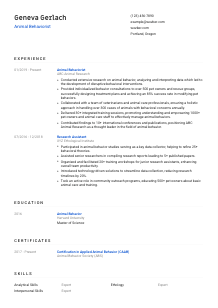
This section is brief, but it still affects how smoothly your application moves forward. For an Animal Behaviorist, it should immediately present a professional identity, reliable contact details, and any location information that matters for onsite consultations, shelter work, or coordination with local veterinary teams.
Use your full name as the most visible text on the page. Keep the styling simple and polished. In a field built on credibility, calm judgment, and clear reporting, your header should feel as orderly as the case notes and treatment documentation you would produce on the job.
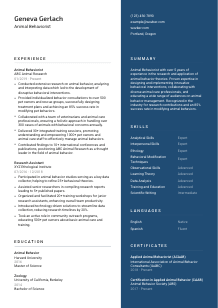
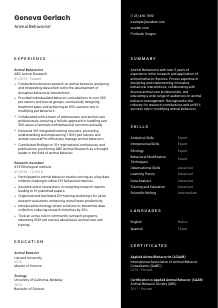
Place "Animal Behaviorist" directly under your name when that reflects your actual background. This creates immediate alignment with behaviour research, consultations, intervention planning, and owner education. If your recent experience is closer to research support or training, use the title that best matches your real scope while still staying close to the posting.
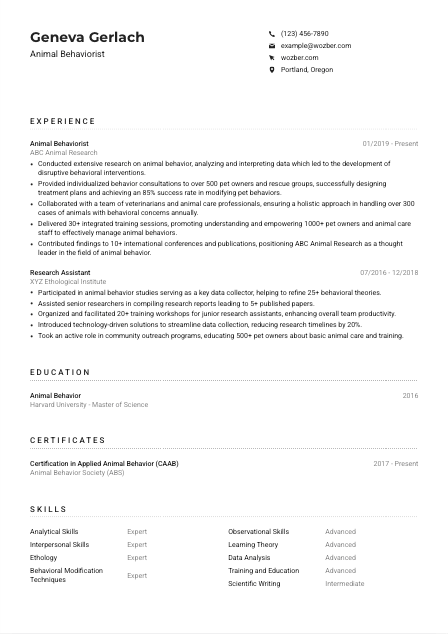
If the employer needs someone based in a specific area, include your city and state. In the example, listing Portland, Oregon immediately addresses the posted location requirement and avoids unnecessary concern about relocation. Treat location this way when geography affects client consultations, facility access, or local collaboration.
Include LinkedIn, a professional website, or a publication profile if it strengthens your candidacy. For this profession, useful links might show conference presentations, research publications, training philosophy, or behaviour resources you have created for owners or shelter staff. Skip anything that does not support your behaviour science or applied practice background.
Your personal details should answer the basics without distraction: who you are, how to reach you, and whether you meet any location requirement tied to the role. That clears the way for hiring teams to focus on your case experience, research work, and behavioral expertise.




Animal Behaviorist hiring usually turns on applied work, not title alone. This section needs to show the settings you worked in, the behaviour issues you handled, the people you collaborated with, and the outcomes your interventions or research produced.
Before writing bullets, identify the recurring duties in the role. Here, the priorities are behaviour research, data analysis, individualized consultations, treatment planning, collaboration with veterinarians and care staff, training delivery, and professional contributions through publications or conferences. Build your experience around those themes instead of listing generic animal care tasks.
Lead with your most recent role and work backward. For each position, include employer, title, and dates, then make the scope of work clear through your bullets. In this field, hiring teams want to see whether you worked in research institutes, clinics, shelters, rescue settings, or private consultation practice because context shapes the kind of behaviour cases you have handled.
Focus on what you assessed, designed, delivered, or improved. Good bullets show direct behaviour work such as conducting observational research, creating individualized intervention plans, or educating owners on reinforcement strategies and management techniques. The example works because it names real responsibilities, including consultations for 500+ pet owners and rescue groups and collaboration on 300 cases annually.
Numbers make your experience more credible when they reflect the job naturally. Use counts of consultations, case volume, workshop attendance, publication output, behaviour modification success rates, or reduced research timelines. The sample's 85% behaviour modification success rate, 30+ training sessions, and 10+ conference or publication contributions are strong because they connect directly to intervention effectiveness, education, and professional impact.
If a bullet does not support your candidacy for animal behaviour work, trim it or reframe it. General animal handling, routine care, or unrelated admin tasks should only stay if they support case management, data collection, welfare outcomes, or interdisciplinary coordination. Keep the section centered on behaviour assessment, learning theory in practice, research rigor, and client or team education.
By the end of this section, a reader should understand the kinds of animals, cases, research activities, and collaborative environments you have worked in, along with the results you produced. Wozber can help organise those bullets in an ATS-friendly CV template so the most relevant behavioral work is easy to scan and compare.
Formal study matters in this profession because behaviour recommendations need to rest on science, not intuition. Your education section should make your grounding in animal behaviour, zoology, biology, or related study areas easy to confirm.
List the degrees most relevant to behaviour science first. If you have a graduate degree in Animal Behaviour or a closely related discipline, make sure it is prominent. In the example, the Master of Science in Animal Behaviour immediately strengthens alignment with a role that asks for subject depth in ethology, learning theory, and intervention methods.
Use a simple structure: degree, field, school, and graduation year. That is usually enough. Hiring teams reviewing clinical, research, or shelter-based behaviour roles want to confirm your academic background quickly so they can move on to your casework, consultation experience, and applied results.
When the posting asks for a bachelor's degree in Animal Behaviour, Biology, Zoology, or a related field, your education section should make that match obvious. The sample's Bachelor of Science in Zoology covers the stated baseline requirement, while the master's degree adds specialization. Use your exact field names rather than broad paraphrases.
Early-career candidates can strengthen this section with specific coursework, thesis work, lab projects, or research topics tied to behaviour observation, conditioning, welfare assessment, or animal cognition. Once you have several years of applied experience, those details become optional unless they are especially relevant to the target role.
Honors, society memberships, or research awards can help when they point to serious engagement with animal science or behaviour research. Include them if they reinforce your scientific training or publication potential. Leave them out if they crowd out more important experience and credential information.
Your education should confirm that you have the scientific foundation to assess behaviour, interpret findings, and recommend interventions responsibly. Wozber's ATS-friendly CV format helps present those credentials in a way that stays easy to read in both applicant tracking systems and human review.
Behaviour credentials can carry real weight here because they show advanced training beyond a general animal science background. Use this section to highlight certifications that strengthen your authority in applied behaviour assessment, treatment planning, and professional standards.
If the posting mentions a preferred certificate, include it exactly as named. For this role, CAAB and ACAAB are the clearest examples because they directly support applied animal behaviour practice. Matching the credential language also improves ATS alignment without forcing extra wording.
Prioritise certificates tied to behavioral consultation, assessment, modification methods, welfare, or related advanced practice. This section should reinforce that your expertise extends beyond general animal care into evidence-based behaviour work. A shorter, more relevant list is stronger than a long inventory of loosely related training.
Dates help when they show recency, active status, or sustained professional involvement. In the sample, "2017 - Present" and "2018 - Present" suggest ongoing relevance rather than one-time coursework. If your certification expires, renews, or remains active through continuing education, present that clearly.
Animal behaviour practice evolves through new research, welfare standards, and refinements in training and modification methods. If you have recent coursework, workshops, or advanced certificates that strengthen your current approach, include the ones most relevant to the work you want next. This is especially useful if your formal degree is older or broader than the role's focus.
A focused certificate section tells employers that your behaviour knowledge is active, specialised, and professionally recognized. Wozber's ATS optimisation tools can help you present these credentials with the exact terminology a posting uses, which is especially useful when preferred certifications influence screening.
Animal Behaviorist skills should reflect both scientific method and real-world casework. This section works best when it combines behaviour-specific knowledge, analytical ability, and the communication skills needed to work with owners, shelters, and veterinary partners.
Start with the capabilities the employer already named. In this posting, that includes ethology, learning theory, behavioral modification techniques, analytical skills, observational skills, interpersonal skills, and advanced English. If those match your background, include them using the same language the employer uses.
Place the most role-relevant skills first. For animal behaviour work, that usually means behaviour assessment, data analysis, intervention planning, client consultation, animal observation, training or education, and cross-disciplinary collaboration. In the example, skills like Ethology, Behavioral Modification Techniques, Data Analysis, and Training and Education support the stated responsibilities much more clearly than generic descriptors would.
Group or order your skills so a hiring manager can scan them quickly. You might separate technical knowledge from interpersonal strengths, or simply list the most important capabilities first. Avoid overloading the section with vague traits. Specific skills tied to behaviour science and consultation practice are what carry weight here.
A useful skills section should read like the toolkit behind your consultations, research, and intervention plans. Wozber's ATS-friendly CV format helps keep those terms organised and visible, which matters when employers search for exact behaviour-related language during screening.
Language ability matters in this field because much of the work depends on clear explanations, owner compliance, staff instruction, and accurate written communication. If a role involves consultations, training sessions, or publications, language proficiency becomes part of your professional effectiveness.
Start with the posting itself. Here, advanced English is explicitly required, which means it should appear clearly on your CV. If a role includes written reports, owner education, or conference contributions, language ability is more than a bonus.
List English prominently when it is mandatory and be accurate about your level. The example uses "Native" for English, which fully addresses the requirement. Use the label that best reflects your real speaking and writing ability, especially if the work includes consultations, case notes, or scientific communication.
Additional languages can be valuable if you work with diverse pet owner communities, multilingual shelter staff, or international research networks. Spanish, for instance, may strengthen community-facing consultation work in some regions. Include extra languages when they are relevant and real, not as filler.
Terms like native, fluent, advanced, intermediate, and basic help set expectations. Be careful not to overstate your level. In owner consultations and staff training, unclear communication can affect compliance with behaviour plans, so accuracy matters here.
If the job leans heavily toward publications, conference speaking, or public education, language skills deserve more emphasis. If it is more research-internal or locally focused, the section can stay short. Either way, keep it aligned with how communication is actually used in the position.
For Animal Behaviorists, languages are most valuable when they strengthen consultations, training delivery, and professional communication. Wozber's free CV builder helps present that information cleanly in an ATS-compliant format, so required language qualifications are easy to identify.
The summary should give a compact read on your behaviour background before anyone gets to the bullet points. For this profession, that means stating your years of experience, your main area of practice or research, and the kinds of results or collaborations that define your work.
Read the posting closely and note what kind of Animal Behaviorist they need. Here, the balance includes research, applied consultations, collaboration with veterinarians and animal care professionals, education, and field contribution through publications or conferences. Your summary should reflect that mix, not just a broad love of animals.
Lead with a concise line that states your title and level of experience. The sample does this well with "Animal Behaviorist with over 5 years of experience in the research and application of animal behaviour theories." A line like this gives immediate context and works especially well when your background spans both research and applied casework.
Use the next sentence to name your strongest themes, such as behaviour intervention design, consultation success, interdisciplinary collaboration, or public education. In the example, mentioning innovative behavioral interventions and collaboration with diverse animal care professionals reinforces the responsibilities in the posting. If you have a strong metric, such as a consultation volume or behaviour modification success rate, this is a good place to use it once.
Aim for a short paragraph that can be read quickly without losing detail. Avoid generic statements about passion, dedication, or being results-driven unless they are attached to concrete work such as treatment planning, owner coaching, shelter support, or published research. The summary should sound like a precise introduction to your practice, not a mission statement.
A well-written summary should make your specialization, scope, and strongest contributions clear within a few lines. Wozber's free CV builder and ATS CV scanner can help you align that opening paragraph with the posting's terminology, so the rest of your CV starts from a clear, relevant professional profile.
An Animal Behaviorist CV should make three things easy to understand right away: your scientific grounding, your applied behaviour experience, and the results you have delivered through consultations, interventions, research, or education. When those pieces are clearly connected, employers can see how you would contribute in clinical, shelter, rescue, research, or community-facing settings.
Use the job description to guide what you emphasize, then support it with concrete examples from your own work, whether that is case volume, treatment success, conference contributions, or collaboration with veterinarians and care teams. Wozber gives you a practical way to build, tailor, and refine that content with ATS-friendly CV templates and ATS optimisation tools, so your next application presents your behaviour work with the clarity this field expects.




