



Use Wozber and land your dream job
Create CV
No registration required
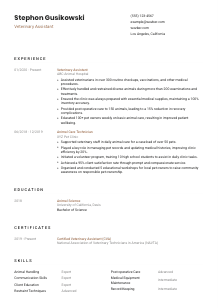
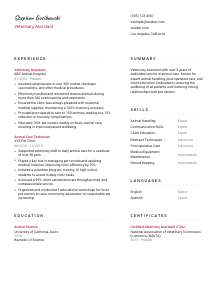
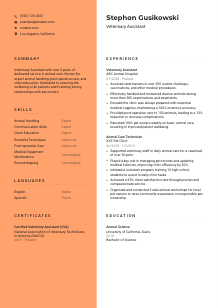
Giving pets a helping paw, but your CV doesn't fetch attention? Wag your tail over this Veterinary Assistant CV example, created with Wozber free CV builder. Learn how to match your furry friend care skills with job needs, guiding your career to a purr-fectly rewarding path!
Veterinary assistants work where patient care, safe animal restraint, clinic flow, and client communication meet. Hiring teams look quickly for proof that you can support exams, prepare treatment areas, handle animals calmly during procedures, and follow directions with the consistency a busy veterinary setting requires. Your CV should make that hands-on readiness visible from the start.
A tailored CV changes how fast your experience connects to the job. When your wording reflects the clinic's needs, such as routine checkups, post-operative care, medication support, and pet owner education, Wozber's free CV builder helps turn that experience into an ATS-compliant CV that is easier to match against the posting. That matters when a practice is sorting applicants who all care about animals, but not all of them show clinical support experience with the same clarity.
In veterinary hiring, the top of the CV needs to answer a few practical questions immediately. Can the clinic contact you easily, are you presenting yourself for the right role, and do you meet any location requirement listed in the posting. Keep this section clean, accurate, and easy to scan.
Use your full name in a clear, readable format so it stands out immediately. In a fast-moving clinic environment, no one needs design flourishes here. What matters is a professional header that introduces you plainly and makes the rest of the CV easy to follow.
Place "Veterinary Assistant" directly under your name if that is the role you are pursuing. This helps frame the rest of your experience around animal care support, restraint, client education, and treatment assistance instead of leaving the reader to guess whether you are aiming for reception, kennel, or technician-track work.
Include a working phone number and a professional email address, then check them carefully. Clinics often move quickly when scheduling interviews, especially for support roles tied to patient flow, so small errors here can cost you a real opportunity.
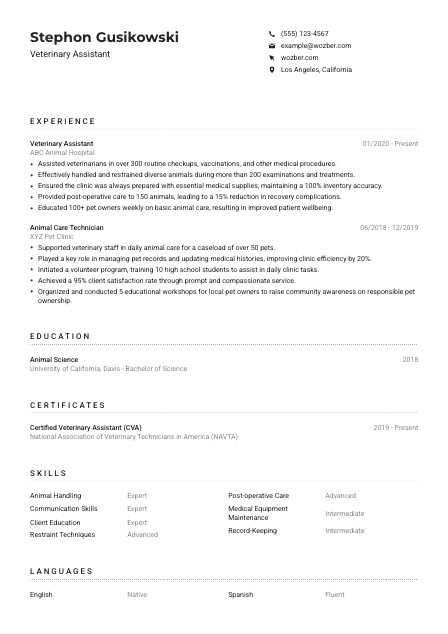
If the employer asks for candidates in a specific area, show your city and state. In the example posting, listing Los Angeles, California directly supports the stated requirement. For other openings, use location to remove doubt about commute, relocation, or local availability.
A LinkedIn profile or professional website is worth adding if it reinforces your veterinary background, volunteer animal work, certifications, or related education. Keep it current and consistent with your CV so the clinic sees the same job titles, dates, and credentials across both.
This section does not need personality or extra detail. It needs accuracy, role alignment, and any logistical information the clinic must confirm right away. Wozber's free CV builder helps you keep that opening clean and ATS-friendly.




For a Veterinary Assistant, experience is where hiring managers look for proof that you can step into a treatment room and help. Daily care tasks, safe restraint, procedure support, medication follow-through, record handling, and client interaction all belong here, especially when you can show volume, consistency, or clinic impact.
Read the job description closely and note the duties that shape day-to-day work. For this role, that includes assisting during checkups and vaccinations, restraining animals, maintaining supplies and instruments, supporting post-operative care, and educating pet owners. Those phrases should guide which bullets you prioritise and how you word them.
Start with your most recent animal care position and include job title, employer, and dates. This structure makes it easier for a hiring manager to track your progression from general animal care into stronger clinical support work. It also keeps the section readable for ATS parsing.
Choose accomplishments that show direct value in a clinic setting. Strong bullets mention the kind of animals or caseload you handled, the procedures you supported, the records or supplies you managed, or the pet owners you educated. The sample CV does this well by highlighting routine checkups, restraint during treatments, post-operative care, and client education rather than vague statements about loving animals.
Numbers help a clinic picture your workload and reliability. Counts such as 300 routine checkups assisted, 150 animals supported post-operatively, or 100+ pet owners educated weekly tell a clearer story than general claims. In veterinary support roles, useful metrics often include patient volume, procedure count, inventory accuracy, recovery outcomes, and client satisfaction.
Keep the section centered on animal care, clinical assistance, client communication, sanitation, record-keeping, and related duties. If you include a less-direct role, rewrite it to emphasize transferable work such as handling animals safely, maintaining treatment spaces, or documenting care. Every bullet should strengthen your case for working effectively alongside veterinarians and support staff.
The most persuasive experience sections show how you operated in a real veterinary setting. Use job-relevant language, patient-care tasks, and measurable workload so a hiring manager can picture you assisting on day one. Wozber's ATS-friendly CV template helps keep those details organised and easy to scan.
Education matters differently across veterinary assistant roles depending on the clinic, state, and level of hands-on responsibility. Even when the posting emphasizes experience first, your education section should still confirm your baseline qualifications and any academic background that supports animal care work.
Check the minimum education listed and make sure your CV clearly meets it. Here, a high school diploma or equivalent is required. If you also have relevant college study, such as animal science, veterinary technology coursework, or biology, include it because it adds useful context for your clinical knowledge.
List the school, degree or diploma, field of study if applicable, and graduation year. A simple format is best. This section is usually reviewed quickly, so clarity matters more than detail unless a program directly strengthens your fit for the role.
If you completed education connected to animal health, place it where it will be seen immediately. In the example, a Bachelor of Science in Animal Science adds weight because it supports the daily realities of handling animals, understanding care routines, and working in a clinical environment. That does not make a bachelor's degree universal for every veterinary assistant opening, but relevant study should be visible when you have it.
If your training included subjects like animal anatomy, nutrition, husbandry, pharmacology basics, or veterinary office procedures, they can strengthen this section, especially for earlier-career candidates. Keep the additions selective and tied to the kind of work the clinic actually needs.
Clubs, projects, or volunteer work can be useful when they connect directly to animal care or veterinary support. Examples include animal shelter work, livestock handling, pre-vet organizations, or lab animal care. Keep these brief and include them only if they reinforce your readiness for patient handling, clinic support, or client-facing animal care work.
This section should show that you meet the baseline requirement and, where relevant, that your studies support the hands-on work of a veterinary assistant. Wozber's ATS-friendly CV format helps present that information clearly without crowding the page.
Certifications carry real weight in veterinary support roles because they point to formal training, current knowledge, and commitment to clinic standards. When a posting names a specific credential, make it easy to find and easy to verify.
Put the most relevant certification first, especially if it is specifically requested. For this opening, a NAVTA-backed credential such as Certified Veterinary Assistant belongs near the top of the section because it directly addresses the employer's stated requirement.
Include certifications that strengthen your ability to work in animal care settings, assist with procedures, support patient recovery, or follow safety protocols. A short list of well-matched credentials is more effective than unrelated courses that do not improve your case for veterinary assistant work.
Add the year earned and note whether the certification is current when that matters. This helps the clinic understand whether your training is recent and whether the credential is still active, especially in roles where handling procedures and care expectations may be updated over time.
If you have completed refresher training or added certifications in areas like animal restraint, fear-free handling, CPR for pets, or clinic safety, include the most relevant ones. Ongoing training tells employers you stay current with practical patient care and workflow expectations in veterinary settings.
A well-placed certification section can remove uncertainty early, especially when the employer names a required credential. Wozber's ATS optimisation tools help keep those qualifications prominent and easy to match against the posting.
The skills section should read like the toolkit you bring into a veterinary clinic. Hiring teams are looking for practical abilities they can use right away, from safe restraint and treatment support to accurate communication with pet owners and staff.
Veterinary assistant roles usually blend physical animal-care tasks with client-facing communication. In this description, animal handling, restraint, basic medical procedures, and strong communication all matter. Mirror that balance in your skills list so the CV reflects how the job actually works.
List the abilities most relevant to exam-room support and patient care. Skills such as animal handling, restraint techniques, post-operative care, medication support, inventory upkeep, record-keeping, and client education are all stronger here than broad terms like "hardworking" or "team player." The example CV shows this well by combining technical support skills with communication-focused ones.
Choose a concise group of skills instead of trying to name everything you have ever done. Group the most important abilities first, especially those tied to the posting. A shorter, better-targeted list gives the hiring team a faster read on whether you can support veterinarians, handle animals safely, and communicate clearly with owners.
A useful skills section maps directly to the work on the floor. Keep the emphasis on veterinary support tasks, communication, and patient handling so the employer can quickly connect your strengths to the needs of the practice. Wozber's free CV builder helps keep that section ATS-optimised and easy to review.
Language skills matter in veterinary clinics because instructions, medication guidance, discharge notes, and routine client conversations all depend on clear communication. If a posting calls out language ability, treat it as a requirement to address directly rather than a minor extra.
If the posting specifies English fluency, include English and state your level plainly. In this case, strong verbal and written English is required, so leaving it off would create an avoidable gap even if you assume it is obvious.
Additional languages can be valuable in clinics that serve diverse communities. If you can speak with pet owners about diet instructions, medications, follow-up care, or appointment details in another language, include it. The sample CV lists Spanish, which would be especially useful in many client-facing settings, though it is an advantage rather than a universal requirement.
Use honest labels such as Native, Fluent, Intermediate, or Basic. Overstating language ability can create problems quickly in a veterinary setting where misunderstandings about care instructions or medication timing can affect patient outcomes.
Not every veterinary assistant job will prioritise multiple languages, but many practices value staff who can make anxious owners feel understood and informed. If your language skills improve intake conversations, discharge teaching, or day-to-day front-and-back office coordination, they deserve a place on the CV.
When you speak more than one language, the benefit is practical. It can improve client trust, reduce confusion around home-care instructions, and help the clinic communicate more smoothly across appointments and follow-ups. That is the kind of value worth making visible.
List languages when they strengthen communication with pet owners and staff, especially when the posting names English proficiency. Wozber's ATS-friendly CV template helps present those details cleanly so the clinic can recognize added communication range at a glance.
The summary should quickly establish what kind of veterinary assistant you are. In a few lines, it should connect your experience level, clinic strengths, and patient-care focus so the employer sees the role-specific value before reading the rest of the CV.
Build your summary around the real demands of veterinary support work. That usually means hands-on assistance during exams and procedures, safe animal handling, post-operative care, medication support, and communication with pet owners. Keep the focus on capabilities that matter in a treatment setting.
Your first sentence should identify you as a Veterinary Assistant and mention your years of experience or the depth of your animal care background. Then add two or three strengths that define your value, such as restraint, client education, record accuracy, or recovery support.
Use language that reflects the employer's priorities, then support it with specifics from your background. The example summary works because it names more than 3 years of experience and highlights animal handling, post-operative care, and client education, all of which connect directly to the role described.
Aim for a short paragraph that sounds like an experienced professional, not a slogan. Skip generic passion statements unless they are backed by work context. A clear summary should make the hiring manager expect solid experience with clinic support, patient handling, and owner communication before they even reach the first job entry.
When this section is written well, it sets the tone for everything that follows and immediately places you in the right lane of veterinary support work. Wozber's free CV builder and ATS CV scanner can help refine the wording so your strongest qualifications surface early and align with the role.
A tailored Veterinary Assistant CV should leave little guesswork about your value in a clinic. It should show that you can support veterinarians during routine care, handle animals safely, maintain supplies and records, help with recovery care, and communicate clearly with pet owners.
Use Wozber to organise those qualifications in an ATS-friendly CV format, strengthen role-specific wording with AI-assisted tailoring, and check alignment with the posting through the ATS CV scanner. The final result should make your hands-on readiness for veterinary assistant work easy to judge.




