



Use Wozber and land your dream job
Create CV
No registration required
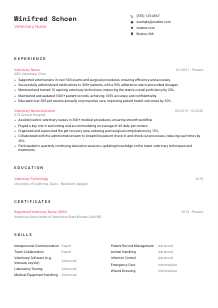
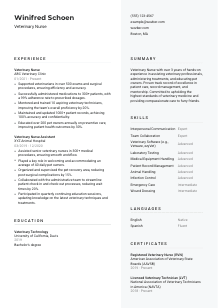
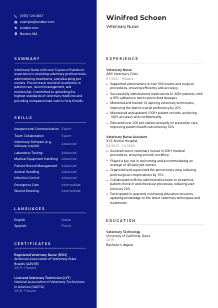
Caring for critters, but your CV feels like a caged bird? Check out this Veterinary Nurse CV example, created with Wozber free CV builder. It shows how to gently align your animal care expertise with job needs, ensuring your career journey is as healthy as the pets you nurture!
Veterinary nursing work sits at the point where clinical support, animal handling, and client communication all meet. Hiring teams want a CV that makes your day-to-day contribution easy to picture, from assisting in exams and surgery to administering medications accurately, maintaining clean records, and guiding pet owners through preventive or post-operative care.
A tailored CV changes how quickly those responsibilities come through, especially when an employer is sorting applications through an ATS before anyone reviews clinical experience in detail. Wozber's free CV builder helps you align your wording with the posting, keep the CV in an ATS-friendly CV format, and surface the parts of your background that show you can support veterinarians, document care properly, and communicate well with owners.
In veterinary settings, small administrative details matter because they reflect the same accuracy expected in patient charts, medication logs, and client communication. Your contact section should be clean, current, and matched to the role you want.
Use your full name as the most prominent text on the page so the CV is easy to identify in a stack of applications or an ATS export. Keep the formatting simple and professional, the same way a well-kept medical record avoids anything distracting.
Place "Veterinary Nurse" directly under your name when that is the role you are pursuing. Using the posted title helps the employer connect your background to the opening right away, and it supports ATS matching without forcing extra wording.
List a phone number you answer reliably and an email address that looks appropriate in a clinical workplace. Double-check every character. A missed digit or typo can cost you an interview just as surely as an inaccurate patient note can create problems in practice.
If an employer specifies a location requirement, include your city and state. In the example, listing Boston, MA directly supports the employer's request and removes uncertainty about local availability. For other roles, mirror the posting rather than adding unnecessary address detail.
If you include LinkedIn or a professional profile, make sure it supports your CV with aligned job titles, dates, certifications, and veterinary experience. It should extend your presentation, not introduce conflicting details about clinic work, training, or credentials.
This section is short, but it sets the tone for everything that follows. Accurate contact details, the right job title, and any required location cue show the same care employers expect when you handle records, medications, and owner communication.




Veterinary employers read experience for proof that you can work confidently in a live clinical environment. They look for the kind of hands-on support you provided, the pace or volume you handled, and the results you improved for patients, veterinarians, and pet owners.
Start by identifying the core work in the job description, then map your history to those functions. For a Veterinary Nurse, that usually means exam support, surgical assistance, lab work, medication administration, record maintenance, owner education, and teamwork inside the clinic. When a posting also mentions mentoring, include training responsibilities if you have them.
List roles in reverse chronological order with your title, employer name, and dates. Clinics and hospitals want to see where you built your hands-on experience and how recently you worked in active patient care. Clear sequencing also helps separate full Veterinary Nurse experience from assistant or trainee roles.
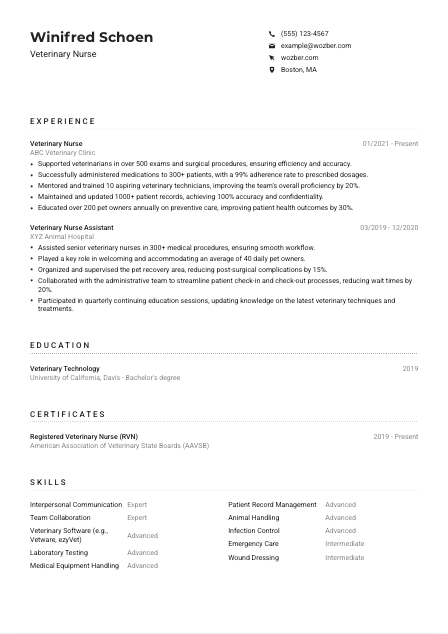
Do not stop at "assisted with procedures" or "updated records." Show scope and context. The example does this well by stating support in more than 500 exams and surgical procedures and by tying record management to 100 percent accuracy and confidentiality. That tells a hiring manager how you worked, not just what room you stood in.
Quantify workload and outcomes where the numbers are real and useful. Good metrics in this field include procedure volume, patients treated, medication accuracy, client education reach, recovery outcomes, reduced wait times, or training impact on team efficiency. The sample's 300+ medication administrations and 200+ owners educated annually are strong models because they reflect actual clinic performance.
Every bullet should strengthen your case for veterinary nursing. Prioritise animal care, treatment support, medical documentation, equipment use, infection control, recovery monitoring, and client-facing education. If a past accomplishment does not connect to clinic operations or patient care, remove it in favor of something that does.
Your experience section should leave no doubt that you can support veterinarians, manage patient care tasks accurately, and handle the pace of a working practice. Keep the focus on clinical contribution, measurable volume, and outcomes that matter in animal care.
Your education section confirms the formal training behind your clinical work. In veterinary nursing, that training matters because employers need to know you learned the science, procedures, and care standards that support safe patient handling and treatment.
If the posting asks for an Associate or Bachelor's degree in Veterinary Technology or a related field, list that credential clearly and use the exact degree name you earned. In the example, a Bachelor's degree in Veterinary Technology aligns directly with the requirement and should be easy to spot.
Include school name, degree, field of study, and graduation year or date. That is usually enough. This section should read cleanly so the employer can confirm your educational background without digging through extra wording.
If your degree is not titled exactly "Veterinary Technology," use the formal program name and let the rest of your CV support the connection through clinical experience, certifications, and skills. Accuracy matters more than trying to rename a qualification to match a posting.
Extra detail helps most when you are early in your career or when your program work directly relates to the opening. Relevant additions might include anesthesia monitoring, animal physiology, lab diagnostics, radiology, pharmacology, or clinical rotations in small animal practice.
Honors, research, student leadership, or veterinary club involvement can add value when they connect to patient care, technical training, or professional development. Keep these additions selective so the section stays focused on preparation for clinical practice.
This section should quickly show that you meet the role's academic requirement and have a solid technical foundation for veterinary care. Keep it direct and aligned with the level of training the employer requested.
Licensure and certification carry real weight in veterinary hiring because they speak to legal eligibility, clinical standards, and professional accountability. If the role names a required credential, make it one of the easiest details to find on the page.
When a posting asks for credentials such as RVN or LVT, list them prominently and use the exact wording the employer used where it accurately applies to you. That makes your qualification clear for both human review and ATS screening.
Prioritise certifications that support veterinary practice, patient handling, anesthesia, emergency care, laboratory work, or continuing clinical education. In the provided example, RVN and LVT are the core credentials because they directly answer the employer's stated requirement.
Add the year earned, renewal window, or "Present" status when it helps show that the credential is current. In regulated clinical work, current standing matters more than decorative detail.
Veterinary medicine changes with new protocols, medications, equipment, and care standards. If you complete continuing education or role-relevant recertification, include it when it strengthens your case for current clinical practice.
A hiring manager should be able to confirm your licensure and role-relevant certification in seconds. Make that part easy, and your CV can move quickly to the quality of your clinic experience.
A Veterinary Nurse skills section works best when it reflects the real mix of clinical, technical, and interpersonal work the job requires. Employers are looking for someone who can support treatment, handle equipment, document care accurately, and communicate clearly with both the veterinary team and pet owners.
Read the posting for explicit and implied competencies. In this case, veterinary software, medical equipment, communication, written English, exams, surgery support, laboratory testing, and patient record accuracy all point to skill areas worth reflecting in your CV.
Do not list only soft skills or only clinical tasks. A strong Veterinary Nurse profile usually combines items such as animal handling, medication administration, lab testing, infection control, anesthesia or recovery support, record management, client education, and team collaboration. The example's mix of veterinary software, laboratory testing, medical equipment handling, and interpersonal communication is a solid model.
Order the section around the target job, not around your personal preference. If the employer stresses software proficiency and communication, those should appear early. If another clinic emphasizes emergency triage or surgical monitoring, adjust the list to match. Reordering skills is one of the fastest ways to improve ATS optimisation and human readability at the same time.
A useful skills list should mirror the work waiting on the clinic floor. When the right mix of technical ability, record discipline, and client communication appears early, the rest of your CV lands more clearly.
Language ability matters in veterinary practice because care instructions, medication guidance, consent discussions, and follow-up conversations all depend on clear communication. Even when English is the only stated requirement, additional language skills can widen the range of clients you can support.
If the job description specifies written or spoken English ability, include English and your proficiency level plainly. That matters in a role where chart notes, discharge instructions, and owner education all need to be accurate and easy to understand.
List additional languages after English if you can use them in real conversations with clients or colleagues. In clinics serving diverse communities, a second language can help with intake, preventive care guidance, medication explanations, and post-operative instructions.
Choose levels that reflect what you can actually do in practice, such as Native, Fluent, Advanced, or Intermediate. Overstating language ability can create problems quickly when a conversation turns to treatment plans or urgent care instructions.
Multilingual ability carries more weight when it supports the actual patient and client flow of the practice. If you have used another language during appointments, follow-up calls, or front-desk coordination, that value is worth showing.
Language skills help most when they add practical communication range. For example, the sample's English and Spanish combination would be valuable in many client-facing clinics, but only include languages you can use with confidence in a veterinary care context.
For veterinary nursing, language ability matters when it helps owners understand care and helps the team work smoothly. Keep the section accurate and tied to communication you can genuinely handle in practice.
The summary should quickly place you in veterinary practice, not in generic healthcare language. In a few lines, show your level of experience, the kind of clinical support you provide, and one or two strengths that match the target opening.
Start with your professional identity and years of experience, then move straight into the type of work you handle. For a Veterinary Nurse, that may include assisting with exams and surgery, administering treatments, maintaining records, educating owners, or supporting daily clinic flow.
Your first sentence should immediately tell the reader who you are. The example does this effectively by identifying the candidate as a Veterinary Nurse with more than 3 years of hands-on experience, which gives context before listing strengths.
Choose highlights that reflect this employer's needs rather than trying to summarise your full career. Good options include medication accuracy, procedure support volume, patient record quality, owner education, mentoring junior staff, or proficiency with veterinary software and equipment.
Aim for a summary that feels specific without becoming a paragraph of repeated claims. Three to five lines is usually enough to frame your background and point the reader toward the strongest evidence in your experience section.
When this section is tailored well, it gives an immediate sense of your clinic experience, care standards, and day-to-day value. That sets up the rest of the CV to confirm the picture with details and results.
A Veterinary Nurse CV works when it shows more than compassion for animals. It should clearly present your clinical support experience, medication and record accuracy, client education work, relevant credentials, and the pace or scope of care you have handled in practice.
Use Wozber's free CV builder to shape that experience into an ATS-compliant CV, strengthen wording with role-specific terminology, and check alignment with an ATS CV scanner before you apply. The final document should make it easy for a clinic or hospital to see that you can step into patient care, support veterinarians effectively, and communicate with owners with confidence.




