



Use Wozber and land your dream job
Create CV
No registration required
Juggling finances, but your CV isn't adding up? Count on this Treasurer CV example, created with Wozber free CV builder. Learn how to balance your fiscal know-how with job requisites, directing your career to its most profitable path!
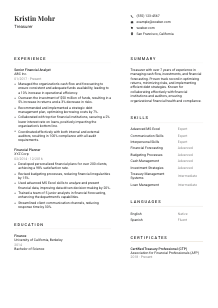
Treasurer hiring usually turns on one question fast: can this person protect liquidity while making disciplined decisions about investments, debt, and financial risk? A CV for this function needs to show control over cash positioning, forecasting accuracy, banking relationships, and audit-ready treasury operations, not just broad finance experience.
When that track record is tailored to the target role, the CV becomes much easier to read through an ATS and much easier for finance leaders to trust. Wozber's free CV builder helps you align your wording with treasury-specific requirements, keep an ATS-friendly CV format, and surface the work that matters most, such as funds availability, borrowing strategy, and coordination with auditors.
For a Treasurer, the top of the CV should read like a clean professional record. Keep it precise and businesslike so hiring teams can immediately confirm who you are, what level you work at, and whether you meet any practical requirements tied to the opening.
Use your full name in a larger, easy-to-read format. Treasury roles deal in precision and credibility, so even the header should feel orderly and professional rather than decorative.
Place your professional title under your name and match it to the role when appropriate. If you are applying for a Treasurer position, using "Treasurer" or a close equivalent helps frame the rest of the CV through the right lens, especially when your background includes adjacent titles such as Senior Financial Analyst or Finance Manager.
List a reliable phone number and a professional email address. Treasury hiring often involves several interview rounds with finance leaders, executives, and sometimes banking or audit stakeholders, so your contact details should look straightforward and credible.
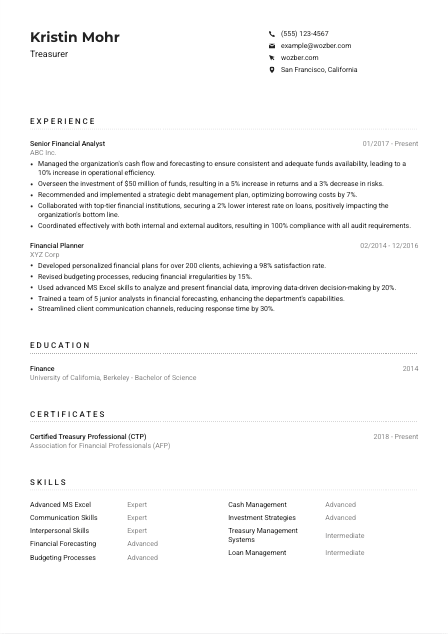
If the job specifies a location, address it clearly in the header. In the example, listing "San Francisco, California" immediately confirms alignment with a stated requirement. For other Treasurer roles, only include location details that help remove a practical hiring question.
A LinkedIn profile or professional website can support your application if it reinforces your finance background, credentials, and career progression. Make sure it matches the CV on titles, dates, and major treasury accomplishments such as cash management, debt planning, or investment oversight.
Your header should answer the basic logistical questions quickly and professionally. Once that is clear, the reader can focus on your treasury judgment and financial management record.




This is the section where Treasurer candidates separate themselves from general finance profiles. Hiring teams want to see how you managed liquidity, influenced capital decisions, worked with lenders or financial institutions, and kept treasury operations aligned with compliance and reporting expectations.
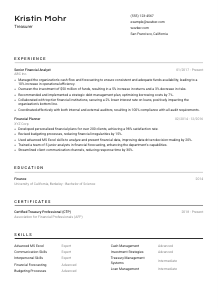
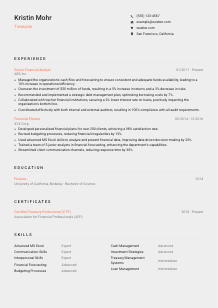
Prioritise positions and bullet points that show cash flow forecasting, funds availability, investment decisions, debt strategy, banking relationships, and audit coordination. If your title was not Treasurer, show how your responsibilities already covered treasury functions. The sample does this well by translating a Senior Financial Analyst role into treasury-relevant work such as cash flow management and strategic debt planning.
List your most recent roles first and make the progression easy to follow. For finance leadership hiring, recent experience usually carries the most weight because it shows current exposure to forecasting tools, treasury controls, and cross-functional financial decision-making.
Every Treasurer CV benefits from bullet points that show what changed because of your work. Instead of saying you handled investments or cash forecasting, show the scale and result. The example gives a strong model with accomplishments such as overseeing $50 million in funds, improving returns by 5%, and reducing borrowing costs by 7%.
Numbers make your impact easier to judge when they reflect how treasury performance is actually measured. Use figures tied to liquidity, return, risk reduction, interest rates, compliance, forecasting, operating efficiency, or capital costs. These metrics carry more weight here than generic statements about being responsible or detail oriented.
Keep the section centered on financial stewardship, forecasting, capital management, and stakeholder coordination. If an earlier role included unrelated achievements, trim them unless they strengthen the story. Even in broader finance positions, select bullets that point toward Treasurer-level responsibilities, such as budgeting process improvements, Excel-based financial analysis, or analyst leadership.
Your experience section should show a pattern of sound treasury decisions, quantified business outcomes, and comfort working across banks, auditors, and internal finance leaders. That is what makes the jump from finance professional to credible Treasurer.
Treasurer roles are usually grounded in formal finance or accounting training, even when the hiring decision leans heavily on experience. Your education section should confirm that foundation quickly and in a format that leaves no doubt about your academic background.
If the role asks for a bachelor's degree in Finance, Accounting, or a related field, make that easy to find. A Bachelor of Science in Finance, like the one shown in the example, directly answers the requirement without any extra interpretation.
List the degree, field of study, institution, and graduation year in a consistent structure. Finance hiring tends to favor CVs that present information cleanly, and a straightforward education entry helps maintain that disciplined tone.
Spell out the degree and concentration rather than using vague abbreviations alone. "Bachelor of Science in Finance" tells the reader more than a shortened form and aligns better with how requirements are written in many job descriptions.
Most experienced Treasurer candidates do not need a long list of classes. Include coursework only if it strengthens a specific angle, such as investments, corporate finance, risk management, or financial modeling, and only when that knowledge is not already clear from your experience.
Honors, scholarships, or standout academic results can add value early in your career. For senior treasury candidates, these details are secondary to your record in cash management, forecasting, and capital strategy, so include them only if they add real context.
Education should confirm that you have the financial foundation expected in treasury leadership. Present it cleanly, match the posted requirement, and let your experience carry the heavier argument.
Certifications are not always required for Treasurer roles, but the right one can reinforce your technical depth and commitment to treasury practice. They are especially useful when they connect directly to liquidity management, capital planning, controls, or financial analysis.
Start with credentials that strengthen your case for treasury work. The clearest example here is the Certified Treasury Professional credential, which immediately supports expertise in cash management, payments, risk, and treasury operations.
Put treasury, finance, and accounting certifications ahead of broader learning certificates. If you hold credentials tied to forecasting, risk management, or capital markets, list those before general professional development items.
If a certification requires renewal or continuing education, show the relevant dates. In treasury, current knowledge matters because regulations, banking conditions, and financing environments change, and date ranges help show that your credential remains active.
Use this section to reflect current engagement with the field, not to fill space. A small number of relevant credentials says more than a long list of unrelated courses, especially for a role that depends on sound financial judgment and current market awareness.
A well-chosen certification can strengthen your treasury profile quickly, especially when it supports the exact work the role involves. Keep this section focused, current, and relevant to financial stewardship.
Treasurer roles sit at the intersection of technical finance work and high-trust collaboration. Your skills section should reflect both sides: the tools and analytical capabilities needed to manage cash and capital, and the communication strength required to work with executives, banks, auditors, and internal teams.
Start with the capabilities the employer names directly, then add closely related skills you genuinely use. In this case, financial forecasting, budgeting processes, treasury management systems, advanced MS Excel, communication, and interpersonal skills all deserve attention because they connect directly to the stated work.
Do not list treasury terms just because they appear in the posting. Include skills you can support elsewhere on the CV through accomplishments, projects, or certifications. The example is effective because skills like cash management, investment strategies, and Excel analysis are reflected in the experience section as well.
Favor a focused list over a long catalogue. For Treasurer hiring, the highest-value skills usually involve cash forecasting, liquidity management, investment oversight, debt management, treasury systems, financial modeling, Excel, and stakeholder communication. Put the most relevant items first so the section reads like a clear priority list rather than a keyword dump.
The best Treasurer skills lists feel consistent with the candidate's actual work. If the section names the capabilities the role needs and your experience proves them, the fit becomes much easier to recognize in both ATS screening and human review.
Language requirements matter when the position names one explicitly or when the organisation works across regions, lenders, or investor groups. In most Treasurer CVs, this section should stay brief and factual, with English listed clearly when it is a condition of employment.
If the posting states that English proficiency is required, include it clearly and use an honest proficiency label. In the example, listing English as Native answers that requirement immediately.
Put the required or primary working language first, followed by any additional languages in descending proficiency. This keeps the section easy to scan and emphasizes the communication capability most relevant to the role.
Extra languages are not a core requirement for every Treasurer role, but they can help in organizations with international banking relationships, cross-border cash operations, or multilingual stakeholders. Spanish in the example adds breadth without distracting from the finance core of the CV.
Stick with familiar descriptors such as Native, Fluent, Advanced, or Intermediate. Treasury work often involves precise communication around funding terms, controls, and reporting, so clarity matters more than inflated claims.
If the position involves global treasury operations or frequent interaction with international partners, language capability deserves more visibility. Otherwise, keep it concise and let your financial judgment remain the main story.
Languages can strengthen a Treasurer CV when they answer a requirement or support the business context. Present them clearly, but keep the emphasis on the financial and strategic work that defines the role.
A Treasurer summary should quickly position you at the right level of financial responsibility. It needs to show the kind of capital, liquidity, forecasting, and institutional coordination you handle, while staying concise enough to work as the opening frame for the rest of the CV.
Start with your title or target function and the number of years you have in treasury, finance, or accounting. A line like the example's "Treasurer with over 7 years of experience in managing cash flow, investments, and financial forecasting" works because it establishes scope immediately.
Follow with the treasury responsibilities that define your background, such as liquidity planning, investment oversight, debt strategy, budgeting, or banking relationships. Keep it grounded in your record, especially if you are moving into a Treasurer title from another finance role.
A summary becomes much stronger when it includes proof of business impact. Pull in one or two metrics that reflect treasury performance, such as increased returns, reduced financing costs, improved operational efficiency, or strong audit compliance. The sample metrics around investment returns and lower loan rates are the right kind of detail.
Aim for a brief paragraph that a CFO, controller, or finance director can read in seconds. Skip generic traits and use the space for treasury outcomes, financial scope, and the collaboration points that matter, such as working with financial institutions or external auditors.
Your summary should tell the reader, quickly and convincingly, what level of treasury responsibility you can handle. If it captures your scope, business impact, and command of core treasury functions, the rest of the CV has a strong opening to build on.
A well-tailored Treasurer CV makes liquidity management, investment judgment, debt strategy, and audit coordination easy to spot from the first scan. With Wozber's ATS-friendly CV template, ATS optimisation features, and free CV builder, you can organise that experience into an ATS-compliant CV that mirrors the role's language without losing clarity or credibility.
The final check is simple: your CV should make it easy to see that you can safeguard cash, support financing decisions, and manage treasury operations with confidence.




