



Use Wozber and land your dream job
Create CV
No registration required
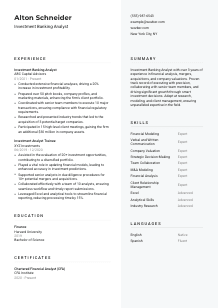
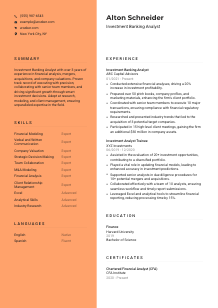
Juggling numbers, but your CV isn't adding up? Check out this Investment Banking Analyst CV example, created with Wozber free CV builder. Learn how to bring your financial expertise in line with job specs, ensuring your career portfolio yields the highest returns!
Investment banking analyst CVs are read against a demanding standard. Teams want early proof that you can handle the core analyst load accurately and fast, whether that means building valuation models, updating merger scenarios, pressure-testing assumptions during due diligence, or turning raw analysis into client-ready materials without slowing a live process.
A tailored CV changes how quickly that proof appears. When your bullets mirror the language of transactions, modeling, pitch books, industry research, and cross-functional deal support, the reader can place you in the analyst seat much faster, and Wozber's free CV builder helps structure that experience into an ATS-compliant CV that surfaces the right banking keywords and makes your transaction readiness easier to judge.
Investment banking is formal, client-facing, and detail-heavy, so the top of the CV should reflect that standard immediately. Keep this section clean, credible, and aligned with any practical screening requirements named in the posting.
Your name should be the most visible text on the page, set in a professional style that fits the tone of finance recruiting. Banks expect polish and consistency, so avoid decorative formatting and use the same spelling here, on LinkedIn, and in your application records.
Place "Investment Banking Analyst" under your name when that is the role you are pursuing. This helps both recruiters and ATS software connect your CV to analyst openings focused on valuation work, pitch materials, transaction execution, and financial modeling.
Include a reliable phone number and a professional email address, ideally a simple variation of your name. In banking, small presentation errors can raise questions about judgment, so check for typos, outdated links, and anything informal before you send the CV.
If a role specifies a city, show that clearly in your personal details. Here, New York City, NY is a stated requirement, so listing New York City on the CV removes unnecessary doubt about availability and location fit. For other roles, tailor location only when the employer calls it out.
A current LinkedIn profile is useful for analyst hiring because it gives context on internships, deal exposure, coursework, and certifications. Make sure the titles, dates, and credentials match your CV exactly, especially if you want recruiters to see continuity across finance experience and exam progress.
This section should tell a banking team that your application is organised, current, and easy to process. When the basics are accurate, the reader can move straight to your modeling, transaction, and client support experience.




For investment banking analysts, experience is where hiring teams look for real operating proof. They want to see the work behind live deals and client materials, not broad claims about being analytical or strategic.
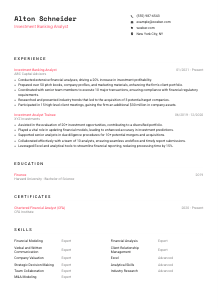
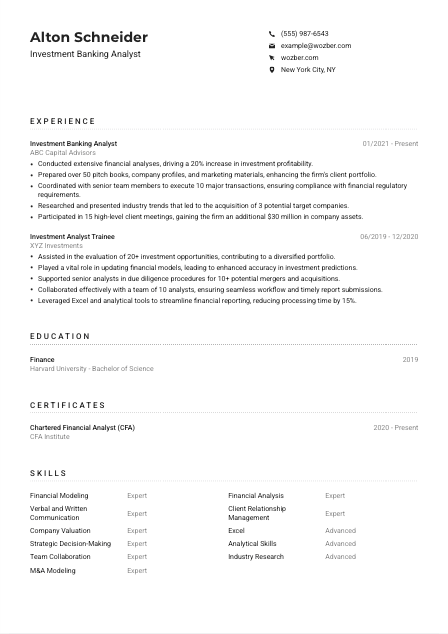
Read the posting line by line and identify the operating tasks underneath the wording. If the job calls for company valuation, M&A modeling, due diligence, industry research, and presentation materials, your bullets should show where you did those things and what came from them. The sample bullet about driving a 20% increase in investment profitability works because it ties analysis to a business result, not just effort.
List your roles in reverse chronological order with title, employer, and dates. That structure lets the reader quickly see whether your background progresses from trainee or internship work into full analyst responsibilities, which matters in a field where 1-2 years of relevant experience often separates support exposure from execution-ready contribution.
Focus each bullet on a concrete deliverable or transaction task. Useful analyst bullets mention valuation models, comparable company analysis, merger models, due diligence support, pitch books, company profiles, management presentations, buyer lists, or industry screens. In the example, preparing more than 50 pitch books is strong because it names a core banking output and gives scale.
Numbers carry weight in analyst hiring because they show throughput and scope. Include metrics such as number of transactions supported, pitch books prepared, companies analysed, assets raised, reporting time reduced, or profitability improved. The sample CV does this well with figures like 10 major transactions, 15 client meetings, and $30 million in additional assets.
Prioritise experience that reflects investment banking, transaction services, corporate finance, valuation, equity research, or closely related financial analysis. If you include adjacent roles, rewrite them through relevant analyst work such as model maintenance, diligence support, market research, or reporting improvements so the CV stays anchored in deal execution.
A strong experience section should leave little doubt about the work you can step into on day one. Show the models you built, the materials you prepared, the transactions you supported, and the results attached to that work.
Education matters in investment banking because it establishes the analytical foundation behind modeling, valuation, and market work. For early-career analysts especially, this section helps confirm that your training matches the finance intensity of the role.
When the posting asks for a bachelor's degree in Finance, Economics, or a related field, use the full degree and field name exactly as awarded. A clear entry such as "Bachelor of Science in Finance" aligns neatly with both ATS filtering and a recruiter's quick academic scan.
List school, degree, field of study, and graduation year in a straightforward format. Banking CVs are often reviewed quickly alongside transcripts, test scores, and internship history, so this section should be instantly readable without extra wording.
If your degree directly supports valuation, accounting interpretation, or market analysis, make that visible through the field name. The sample CV's finance degree works well because it naturally supports the technical expectations behind Excel modeling, company valuation, and transaction analysis.
If you are still close to graduation, include coursework or achievements that strengthen your analyst profile. Classes in corporate finance, financial statement analysis, valuation, econometrics, accounting, or capital markets can help, as can honors, student investment funds, or finance case competitions.
If you are pursuing additional credentials or training, you can briefly reflect that academic momentum here, especially early in your career. This works well when it supports analyst fundamentals such as valuation, ethics, risk, and financial reporting, though full credential details should remain in the certificates section.
Your education entry should quickly confirm that you have the finance or economics background to handle modeling, valuation, and research demands. For newer candidates, it can also strengthen the story between coursework and transaction-related experience.
Certifications are not mandatory in every investment banking analyst search, but relevant credentials can add weight, especially when they reinforce technical discipline, financial judgment, or long-term commitment to the field.
If the employer mentions certifications such as CFA or FRM, list those first when you hold them or are actively pursuing them. That kind of alignment helps your CV connect with stated preferences without forcing unrelated credentials into a finance role.
Choose certifications that support valuation, investment analysis, risk, accounting fluency, or broader capital markets knowledge. A short, focused list reads better than a long catalogue, especially in banking where relevance matters more than volume.
Dates give context, especially for multi-level credentials. If you are in progress, say so clearly. The sample CV handles this well by showing CFA and FRM with ongoing dates, which tells the reader the candidate is actively building technical depth rather than listing completed study vaguely.
Banking teams value candidates who keep sharpening technical skills, but the wording should stay factual. Mention recognized certifications, formal coursework, or targeted training that supports modeling, risk analysis, or regulatory understanding, and avoid inflating minor workshops into major qualifications.
Well-chosen certifications can strengthen an analyst CV by showing sustained commitment to finance knowledge. Keep them relevant, clearly dated, and tied to the kind of analytical work the role actually requires.
The skills section should read like the toolkit of someone who can contribute to banking work immediately. That means leading with technical ability and supporting it with the communication skills needed for client materials and cross-team execution.
Start with the abilities the employer names directly, then match them to your real experience. In this case, that includes Excel, financial modeling, quantitative analysis, written communication, verbal communication, and collaboration. This keeps the section aligned with both ATS matching and practical analyst screening.
Investment banking analysts are hired for modeling accuracy and output quality, but they also work on presentation materials, internal coordination, and client-facing meetings. A strong list might combine financial modeling, company valuation, M&A modeling, and industry research with communication, teamwork, and client relationship support.
Put the highest-priority analyst skills first so the reader sees your technical profile immediately. In the sample CV, skills like Financial Modeling, Company Valuation, M&A Modeling, Financial Analysis, and Excel belong near the top because they map directly to day-to-day analyst work.
This section should quickly show that you can build the analysis, support the materials, and collaborate through execution. Keep the list focused on the tools and capabilities that matter in transaction work.
Language skills matter in investment banking when they affect client communication, cross-border work, or internal coordination. Even when the role is primarily domestic, clear written and verbal English is non-negotiable because analyst work flows into presentations, memos, and live transaction materials.
If the posting specifies English proficiency, reflect that clearly in the section. Here, strong verbal and written English is required, so listing English at the appropriate level removes uncertainty about your ability to handle presentations, emails, diligence requests, and client-facing materials.
If you speak another language fluently and it could matter for investor relations, cross-border transactions, or sector coverage, include it. Extra language ability is most useful when it supports real business interaction, not when it is added just to fill space.
Additional languages can still be worth listing if they reflect useful communication range or international exposure. The key is accuracy. Overstating fluency creates risk in a field where candidates may be asked to interact with clients, counterparties, or research sources directly.
Stick to standard levels such as Native, Fluent, Professional, Conversational, or Basic. Recruiters should be able to understand immediately whether you can draft, present, and discuss financial topics in that language without guessing what your label means.
For groups with international clients, sector coverage across regions, or frequent market research beyond the U.S., language skills can add practical value. The sample CV lists Spanish as Fluent, which is useful because it broadens communication range without distracting from the core analyst profile.
Keep this section factual and relevant. It should confirm that you can communicate clearly in English and, if applicable, support broader client or market coverage with additional language ability.
The summary should give a banking team a fast read on your level, technical focus, and transaction relevance. In a few lines, it needs to connect your finance background to the kind of analyst work the role actually involves.
Before writing, identify the functions the role leans on most. For an investment banking analyst, that usually means valuation, modeling, due diligence, market research, presentation support, and coordination with senior bankers and adjacent teams. Your summary should reflect that operating mix rather than generic ambition.
Lead with a direct statement of who you are professionally. The sample summary starts well with "Investment Banking Analyst with over 3 years of experience in financial analysis, mergers, acquisitions, and company valuations," which immediately places the candidate in the right part of the market.
Follow your opening with strengths that match the target role closely, such as financial modeling, pitch book preparation, due diligence support, industry research, or client presentation exposure. Mention collaboration where it matters, especially if you have worked with senior bankers, legal teams, or compliance partners during transactions.
Aim for a summary that can be read in seconds and trusted on first pass. Skip inflated adjectives and broad leadership claims. Use compact language that reflects the kind of outcomes analysts produce, whether that is stronger analysis, smoother execution, high-volume materials, or support on completed transactions.
A strong summary should tell the reader, quickly and credibly, what level of analyst you are and what kind of transaction support you can provide. If the rest of the CV delivers on that promise, you have a much stronger application.
An investment banking analyst CV works when it makes your technical foundation, transaction exposure, and output quality easy to read at a glance. Valuation work, modeling depth, pitch materials, diligence support, and quantified results should carry most of that story.
Use Wozber's free CV builder to shape that experience into an ATS-friendly CV format, strengthen ATS optimisation with role-specific language, and check alignment with an ATS CV scanner. The finished CV should make one thing clear fast: you can support real banking work with precision and pace.