



Use Wozber and land your dream job
Create CV
No registration required
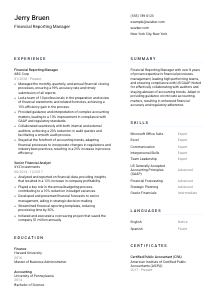
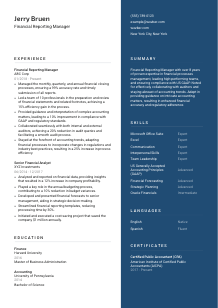
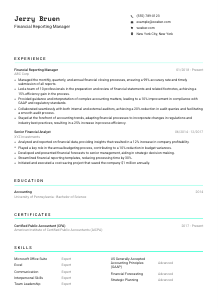
Balancing ledgers, but your CV isn't adding up? Check out this Financial Reporting Manager CV example, created with Wozber free CV builder. It shows how to line up your reporting acumen with job expectations, ensuring your career story is as precise as your balance sheets!
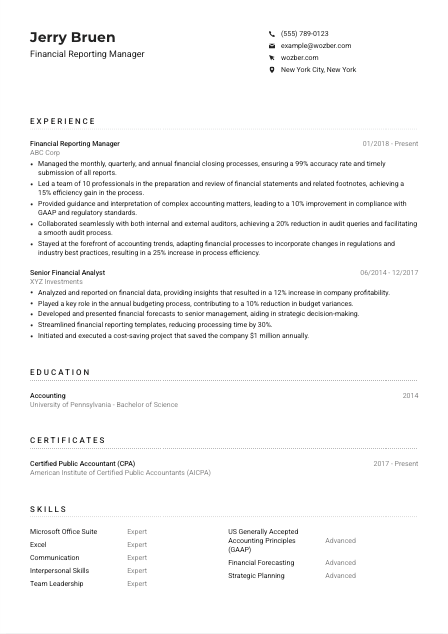
Financial Reporting Managers are trusted with close accuracy, GAAP judgment, audit coordination, and the final quality of statements that leaders, auditors, and regulators rely on. CVs for this kind of role need to make that control point visible quickly, especially your command of reporting cycles, technical accounting interpretation, and the business results tied to cleaner, faster reporting.
When that experience is tailored well, reviewers can immediately see whether you have handled the reporting cadence, statement preparation, and cross-functional coordination their finance team needs. Wozber's free CV builder helps shape that story into an ATS-compliant CV by aligning your wording with the posting while keeping your reporting scope, accounting depth, and leadership track record easy to spot.
Finance hiring starts with practical filters. If your contact details, title, or location create friction, your reporting expertise may never get a close look. Keep this section clean, professional, and aligned with the basics the employer needs to confirm first.
Use your full name in a larger, clear font so it stands apart from the rest of the page. For a Financial Reporting Manager, that presentation should feel as orderly as the reporting packages you produce: direct, polished, and easy to read.
Place "Financial Reporting Manager" directly beneath your name when that is the role you are pursuing. This immediately anchors your CV to financial close leadership, statement preparation, and GAAP-focused reporting instead of leaving you positioned as a broader finance candidate.
Include a current phone number and a professional email address that would not look out of place in an audit request or board reporting chain. Keep it simple and businesslike so the focus stays on your accounting experience.
If the employer requires New York City presence or relocation, mention that in this section when it applies to you. Doing so removes an early question and helps the hiring team move straight to your reporting background rather than pausing on logistics.
A LinkedIn profile or professional website can support your application when it reflects the same titles, dates, and accounting credentials shown on your CV. For finance leaders, consistency matters. If your online profile mentions SEC reporting, ERP systems, or audit collaboration, make sure those details line up here too.
Your personal details should answer the easy questions fast: who you are, how to reach you, what role you are targeting, and whether any location issue exists. That lets the review stay focused on your reporting judgment and close-management experience.




This is where a Financial Reporting Manager CV earns credibility. Hiring teams look for proof that you have run close processes, produced accurate financial statements, handled technical accounting questions, and worked smoothly with auditors under deadline pressure.
Read the job description and mark the responsibilities that define the role's day-to-day demands. Here, that includes monthly, quarterly, and annual close management, financial statement and footnote review, GAAP interpretation, and audit support. Your experience bullets should answer those points directly instead of staying at the level of general finance work.
List positions in reverse chronological order and include job title, employer, and dates without extra clutter. For finance leadership roles, the title progression matters. Moving from Senior Financial Analyst into Financial Reporting Manager, as in the example, helps show increased ownership over reporting, review, and team direction.
Choose bullets that mirror the employer's reporting needs. Strong examples include managing close calendars, reviewing financial statements and footnotes, resolving complex accounting issues, and partnering with internal and external auditors. The sample CV does this well by tying each core duty to a result, such as a 99% reporting accuracy rate and fewer audit queries.
Numbers carry real weight in financial reporting because they show control and scale. Use metrics that fit the work: close timeliness, accuracy rates, process efficiency, audit issue reduction, team size, or cost savings from reporting improvements. A bullet like "led a team of 10" or "reduced audit queries by 20%" gives hiring managers a clearer picture than a generic claim about leadership.
Keep the section focused on financial reporting, accounting compliance, systems use, and management responsibility. If a bullet does not support your ability to oversee close, interpret GAAP, review disclosures, or improve reporting processes, trim it or rewrite it. Relevance matters more than volume, especially for a role with a defined technical scope.
Your experience section should make it easy to picture you running the reporting calendar, reviewing statements, guiding the team through accounting issues, and keeping audit conversations under control. If those points are clear, your CV is doing the right work.
Education is a baseline screen for many financial reporting roles, especially when the work involves GAAP interpretation, disclosure review, and collaboration with auditors. Present your degrees clearly so the employer can confirm the accounting or finance foundation without searching for it.
Start by making sure your degree meets the posting's education requirement. For this role, a bachelor's degree in Accounting, Finance, or a related field is the expected baseline. If you have that background, place it where it is easy to find and name the field exactly.
List each degree with school, degree name, field of study, and graduation year. Reverse chronological order usually works best, especially if you also hold a master's degree that supports your progression into reporting leadership.
Advanced education can strengthen your position for roles involving technical accounting review and leadership. In the example, the bachelor's degree in Accounting checks the core requirement, while the MBA in Finance adds broader business and financial perspective. That combination is useful, though not every Financial Reporting Manager posting requires a graduate degree.
Most experienced candidates do not need to list classes unless the coursework supports a specific gap or specialization, such as advanced accounting, financial statement analysis, or corporate reporting. Use it selectively, not as filler.
Honors, scholarships, or finance-related leadership activities can help if you are earlier in your career or if they reinforce your accounting profile. For candidates with 7+ years in reporting, degrees and certifications usually matter more than campus details.
Your education section should quickly confirm that you have the technical foundation for financial reporting work. Once that baseline is clear, the rest of the CV can focus on close ownership, GAAP expertise, and leadership results.
Credentials carry real weight in financial reporting because they reinforce technical accounting knowledge and professional standards. If you hold a recognized certification, use it to strengthen your standing for roles tied to GAAP compliance, audit interaction, and complex reporting decisions.
Look closely at the certification language in the job description. Here, a CPA is preferred, so candidates who have it should feature it prominently. When an employer is hiring for financial statement oversight and accounting interpretation, that designation can materially improve your positioning.
Focus on credentials that strengthen your profile for reporting leadership, technical accounting, or financial control work. A CPA belongs here immediately. Less relevant certificates should stay off the page unless they connect clearly to the target role.
Add the certification name, issuing body, and date or active period so the employer can confirm its status. The example does this effectively with the CPA and its active date range, which helps show current professional standing.
Financial reporting changes with new guidance, disclosure expectations, and regulatory developments. Keeping certifications active or adding targeted continuing education reflects the kind of currency employers want in managers who oversee reporting quality.
Use certifications to underscore that your accounting judgment is backed by recognized professional standards. For many Financial Reporting Manager roles, a current CPA is one of the clearest signals of technical credibility.
Financial Reporting Managers need a mix of technical accounting capability, reporting systems fluency, and people leadership. Your skills section should reflect how the work actually gets done: through GAAP knowledge, spreadsheet control, system-based reporting, review discipline, and communication across finance and audit partners.
Start with the skills the posting emphasizes, then include them in language that matches your real background. For this role, that means US GAAP, financial reporting systems, advanced Excel, communication, interpersonal effectiveness, and team leadership. These are not filler keywords. They point to the actual tools and working style behind monthly and quarterly reporting cycles.
List both hard and soft skills, but keep them relevant to reporting work. Technical strengths might include GAAP, financial statement preparation, footnote review, Excel modeling, ERP or reporting systems, and audit coordination. Leadership strengths should connect to the role as well, such as cross-functional communication, team supervision, and stakeholder management.
Avoid a long inventory of general finance skills. Prioritise what supports financial close execution and reporting accuracy. The sample CV handles this well by highlighting GAAP, Excel, leadership, and Oracle Financials instead of drifting into unrelated competencies. Choose skills that support the job you want, not every finance task you have ever done.
A well-built skills section should read like the operating toolkit of someone who can manage close deadlines, review financial statements, work through accounting questions, and lead a reporting team with confidence.
Language requirements are usually straightforward in finance roles, but they still matter. Reporting managers write explanations, coordinate with auditors, and communicate accounting issues across teams, so language proficiency should be listed clearly and honestly.
If the posting states that English is mandatory, list English clearly with an accurate proficiency level. For a Financial Reporting Manager, that supports written reporting, disclosure review, auditor communication, and cross-functional discussions with leadership.
Use plain labels such as Native, Fluent, Professional, or Intermediate. In a role where wording in statements, footnotes, and audit responses matters, clarity around language ability is more useful than vague descriptions.
Additional languages can be worth including, especially in multinational businesses or teams with global reporting lines. In the example, Spanish adds breadth, but English remains the essential language because it is the one explicitly required for the position.
Do not overstate your level. If you can manage meetings, reporting discussions, or written business communication in another language, say so accurately. If not, use a lower level. Precision matters in finance, and that expectation carries into your CV.
Additional language ability can strengthen your profile, but it should not distract from your accounting and reporting qualifications. Keep the emphasis where it belongs: on the communication level required to manage close, audits, and financial reporting work effectively.
This section should confirm that you can handle the communication demands of the job, especially in English. Any additional languages are a bonus when they support collaboration across broader finance operations.
Your summary should read like the top line of a finance leader's profile: concise, specific, and grounded in reporting responsibility. In a few lines, show your level, technical focus, and the kind of results you have delivered in close management, financial statements, and compliance-oriented work.
Before writing, pull out the responsibilities that define the job. For a Financial Reporting Manager, that usually means leading close processes, preparing and reviewing statements and footnotes, applying GAAP, supporting audits, and improving reporting discipline. Your summary should cover the parts of that scope you have genuinely owned.
Start with your current profession and years of relevant experience. A line such as "Financial Reporting Manager with 8+ years in financial reporting and close management" works because it immediately places you in the right lane for the role.
Use the next lines to highlight the strengths most relevant to reporting leadership. Good choices include GAAP expertise, financial statement review, team leadership, audit coordination, and process improvement. The example summary is effective because it links accounting guidance and auditor collaboration to stronger accuracy and compliance, rather than listing traits in the abstract.
Aim for a short paragraph, usually 3 to 5 lines. Skip broad claims about being results-driven or detail-oriented unless you connect them to reporting work, such as faster close cycles, improved compliance, or better audit outcomes. Every sentence should help explain why you can step into the reporting seat quickly.
By the time someone finishes your summary, they should already understand your reporting scope, your accounting depth, and your level of leadership. That gives the rest of the CV a clear frame and makes your candidacy easier to place.
A Financial Reporting Manager CV should leave little ambiguity about your command of close processes, financial statement preparation, GAAP compliance, audit coordination, and team leadership. Each section should help a reviewer connect your background to the reporting work they need handled accurately and on schedule.
Wozber's free CV builder can help you organise that experience into an ATS-friendly CV template, sharpen role-specific wording with AI support, and improve ATS optimisation before you apply. The final result should make one thing easy to judge: you can step into the reporting cycle, lead the work, and keep the numbers dependable.