



Use Wozber and land your dream job
Create CV
No registration required
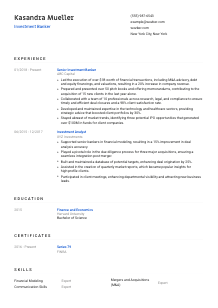
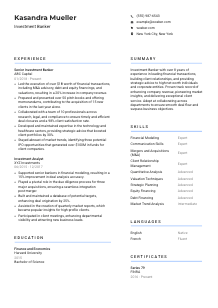
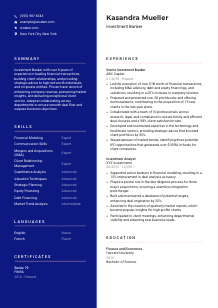
Crunching numbers, but your CV isn't adding up? Check out this Investment Banker CV example, created with Wozber free CV builder. Learn how to strategically position your financial finesse to match job prerequisites, and get ready to make lucrative career deals in no time!
Investment banking CVs get attention when they show transaction depth, analytical range, and the ability to operate under pressure with clients, internal teams, and demanding timelines. Hiring teams want to see more than finance credentials. They look for proof that you can move a deal forward, build defensible models, produce client-ready materials, and contribute sound judgment when the stakes are high.
A tailored CV changes how quickly those strengths come through, especially when firms screen for M&A, financings, valuation work, and client exposure through ATS filters before a banker ever reads the file. Wozber's free CV builder helps you align your wording with the mandate, keep the structure clean for ATS optimisation, and make it easier to see whether your background points to live deal execution rather than adjacent corporate finance work.
For investment banking, the header should establish professional credibility fast. Keep it clean, accurate, and aligned with the practical filters that can affect whether your CV moves into a deeper review.
Use your full name in a larger, easy-to-read font so the document feels polished from the first line. In a field where materials like pitch books and offering memorandums are expected to be precise, even your header should reflect control and professionalism.
Place "Investment Banker" directly under your name when that matches the role you are pursuing. This helps position your background immediately, especially if your recent title was Analyst, Associate, or Senior Investment Banker and you want the reader to connect your experience to transaction execution and advisory work without guessing.
List a reliable phone number and a professional email address, ideally a simple format such as first and last name. Banking teams move quickly when scheduling interviews, modeling tests, or follow-up conversations, so there should be no friction in reaching you.
If the job requires a specific market, show that clearly in your header. Here, listing "New York City, New York" addresses a stated requirement and signals that you are already positioned for a market where client meetings, deal teams, and execution cycles often move in person and on short notice.
If you include LinkedIn or a professional website, make sure it supports your CV with consistent titles, dates, and sector focus. For investment banking candidates, that profile should reinforce transaction experience, industry coverage, internships, licenses, or capital markets exposure rather than read like a generic social page.
These details are simple, but they still shape the first read. A precise header tells the firm that the rest of the CV is likely to show the same level of care you would bring to client materials and deal execution.




This section carries the most weight for investment banking hiring. Firms want to see where you worked, what kinds of transactions you touched, how much responsibility you held, and whether your work translated into closed deals, stronger client relationships, or measurable business results.
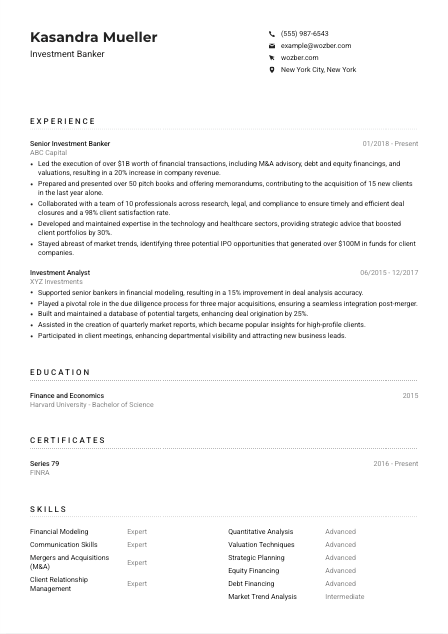
Start by identifying the experience the job is truly screening for. In this case, the posting emphasizes M&A advisory, debt and equity financings, valuations, client materials, and cross-functional coordination. Your bullets should mirror that language where it reflects real work. A line like "Led the execution of over $1B worth of financial transactions" works because it directly addresses transaction leadership and gives immediate scale.
List positions in reverse chronological order, with firm name, title, and dates clearly shown. For bankers, recent deal exposure matters more than older general finance work, so your current or latest role should carry the most detail, especially if it includes live execution, valuation modeling, diligence, or client presentations.
Focus each bullet on work that matters in investment banking: building models, supporting or leading a process, preparing pitch books, coordinating diligence, advising clients, or driving origination. Then attach the business result. The sample CV does this well with bullets tied to revenue growth, client acquisition, deal closures, and portfolio gains rather than vague claims about being responsible for transactions.
Scale matters in banking, so quantify transaction value, number of deals, revenue impact, client wins, model accuracy improvements, or funds raised whenever you can support it. Metrics such as "$1B in transactions," "50 pitch books," or "three IPO opportunities generating over $100M" tell a hiring team far more than broad statements about strong performance.
Remove or shrink experience that does not support the banking story you need to tell. If you have work from corporate finance, private equity, valuation advisory, or transaction services, frame it around modeling, due diligence, client communication, and deal support. Leave out details that do not help the reader place you in an execution-heavy banking seat.
A banking title alone is never enough. Your bullets should make clear what you executed, how complex the work was, and what results followed for clients, the firm, or the deal pipeline.
Education matters in investment banking because it anchors your technical foundation. Keep the section concise, but make sure it clearly supports the analytical training expected for valuation, modeling, and corporate finance work.
When a role asks for a bachelor's degree in Finance, Economics, or a related field, list that information clearly and early in the section. A degree such as "Bachelor of Science in Finance and Economics" aligns directly with the analytical background many banking teams expect.
Present your degree, field of study, university, and graduation date in a simple order that is easy to scan. Investment banking CVs tend to be dense with deals, metrics, and transaction detail, so the education section should stay efficient and precise.
If your academic background maps cleanly to the position, make that connection visible. The example degree in Finance and Economics works well because it supports core banking tasks such as valuation analysis, financial statement interpretation, and market assessment.
Include relevant coursework only if it strengthens your case, especially if you are earlier in your career or your degree title is broader. Classes in corporate finance, valuation, financial accounting, econometrics, or capital markets can help clarify technical preparation without taking over the section.
Academic distinctions, finance societies, case competitions, or high-performance coursework can be useful if they reinforce analytical rigor or interest in markets. Keep them if they add signal. Skip them if your professional transaction record already carries the section.
Your education section should confirm the financial foundation behind your deal work. Once that is clear, let experience and results carry the heavier load.
Certifications matter most when they connect directly to regulated activity, market credibility, or the preferred qualifications in the posting. In investment banking, the right licenses can remove hesitation and show that you are prepared for the practical demands of the role.
If the posting references licenses or certifications, move those to the top of this section. Here, Series 79 and Series 63 are preferred, so listing them clearly helps your CV line up with a concrete hiring preference rather than leaving that match buried elsewhere.
Do not overload this section with every course completion or minor certificate. For banking roles, FINRA licenses, valuation credentials, or capital markets training usually matter more than general business learning. The sample CV keeps the emphasis where it belongs by highlighting Series 79 and Series 63.
Include the year earned and current standing when relevant. That makes it easy for the reader to confirm your qualifications, especially for licenses that affect immediate readiness for client-facing or regulated transaction work.
Markets, regulation, and deal structures change. If you are pursuing additional training in valuation, modeling, sector specialization, or compliance-related areas, include only the items that sharpen your candidacy for the kind of banking seat you want next.
Well-chosen certifications do not replace transaction experience, but they can strengthen credibility and answer practical screening questions quickly. That is especially useful when the posting names preferred licenses outright.
The skills section should read like a snapshot of how you operate in banking, not a generic finance keyword list. Choose skills that map to execution, analysis, client work, and the technical tools or judgment areas that show up repeatedly in real transactions.
Look past the surface wording and identify the working skills underneath it. A request for financial modeling, valuation techniques, quantitative analysis, and client relationship building points to a banker who can handle both technical output and external communication. Those are the capabilities your list should foreground.
Lead with the skills most tied to the seat you are targeting. For this role, that means areas such as financial modeling, M&A, valuation, debt and equity financing, quantitative analysis, and client relationship management. If you truly have them, these should appear before broader skills like strategic planning or general communication.
Keep the list readable and ordered by relevance or proficiency so a reviewer can spot your core banking strengths in seconds. The example CV works because it groups technical and client-facing strengths that support the responsibilities of leading transactions, preparing materials, and advising clients.
Every skill should connect back to work you can defend in your experience section. When the language matches the role and the bullets prove it, the section does its job.
Language ability matters in investment banking when it affects client interaction, written materials, or cross-border work. Keep this section factual and relevant, especially if the posting names a required language.
If the role requires strong English communication, list English clearly with an honest proficiency level. In banking, this is not only about conversation. It also covers client calls, board materials, pitch books, committee memos, and the accuracy of written financial commentary.
Order the list so the most relevant language appears at the top. For this role, English belongs first because it is explicitly required and central to daily transaction work, presentations, and relationship management.
Additional languages can help if you work with international clients, cross-border buyers, or multilingual management teams. A language like French may strengthen the profile, but it should be presented as an added capability rather than a substitute for core banking qualifications.
Choose ratings such as Native, Fluent, Professional, or Conversational only if you can support them in real business settings. Precision matters here just as much as it does in valuation assumptions or deal documents.
When a language has direct relevance to your target work, let that relevance be clear through the rest of your CV. For example, if you support cross-border transactions or international client coverage, the language section becomes more meaningful because it connects to actual advisory scope.
List languages that genuinely expand your ability to communicate with clients, management teams, or counterparties. For this role, clear English proficiency is the baseline that should be easy to spot.
The summary should quickly establish the level and type of banking work you do. A hiring team should be able to tell within a few lines whether you bring transaction execution, sector knowledge, analytical strength, and client exposure that match the role.
Start with the priorities in the job description, then choose the parts of your background that answer them best. For this role, that likely includes years of banking or corporate finance experience, transaction types handled, modeling and valuation strength, and client-facing work.
Your first line should establish who you are professionally in concrete terms. A phrasing like "Investment Banker with over 8 years of experience" works because it gives level immediately, then sets up the kinds of mandates you have led or supported.
Use the next lines to name the work that defines your candidacy, such as M&A advisory, debt and equity financings, valuations, industry coverage, or strategic advice to corporate clients. The example summary is strongest where it points to leading financial transactions, building client relationships, and collaborating across departments to keep deal flow moving.
Aim for a short paragraph that stays specific. Avoid generic claims about being results-driven or passionate about finance unless they are backed by concrete outcomes. The summary should read like a concise banker profile, not a personal statement.
A good summary tells the reader what kind of banker you are before they reach the first bullet. Once that frame is clear, the rest of the CV can prove your transaction record in detail.
Your CV should now show the combination firms actually look for in investment banking: transaction experience, technical finance skills, credible client exposure, and results with scale behind them. That makes it easier to tell whether you can contribute in M&A, financings, valuation work, or broader advisory mandates.
Use Wozber's free CV builder to shape that story in an ATS-friendly CV format, refine wording with role-specific language, and check alignment with an ATS CV scanner before you apply. The final version should make one thing immediately clear: you have the background to step into live deal work and add value fast.




