




Use Wozber and land your dream job
Create CV
No registration required
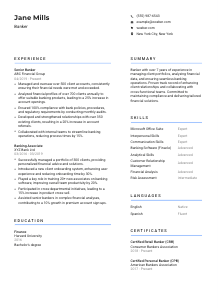
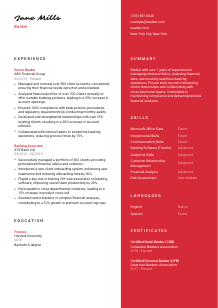
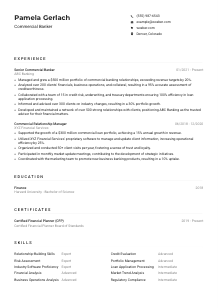
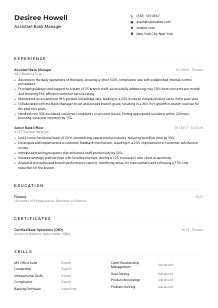
Balancing ledgers, but your CV doesn't add up? Check out this Banker CV example, built with Wozber free CV builder. It shows how to align your fiscal finesse with job demands effortlessly, and deposit your banking career into a growth account!

Banking CVs work best when they show how you handle client trust under daily operational pressure. Hiring teams want to see more than general finance experience. They look for clear proof that you can manage accounts, recommend appropriate products from financial analysis, protect compliance standards, and work smoothly with branch or back-office teams when client issues need fast resolution.
The difference tailoring makes is immediate. When your CV uses the same banking language the employer uses, account management, product recommendations, regulatory compliance, client relationship growth, it becomes much easier to read your background through an ATS and quickly separate retail or personal banking experience from broader finance work. Wozber's free CV builder helps shape that language into an ATS-compliant CV so your strengths come through clearly for a banking role.
In banking, credibility starts before a hiring manager reaches your experience bullets. Your contact details should look clean, professional, and aligned with any practical requirements in the posting, especially when the employer is hiring for a specific market or branch footprint.
Use your full name as the most prominent text at the top of the page. In a client-facing profession where trust and recognition matter, this should look straightforward and polished, not stylized or crowded by extra wording.
Place "Banker" directly under your name if that is the role you are targeting. This helps frame the rest of the CV immediately, especially when recruiters are reviewing applicants across related profiles such as banking associate, relationship banker, or personal banker.
Include one reliable phone number and a professional email address. If the employer requires local presence, reflect that clearly. In the example, listing "New York City, New York" directly supports a stated location requirement, which is useful when local client coverage or in-branch availability matters.
A LinkedIn profile or professional site can help round out your banking background, especially if it supports your CV with career progression, certifications, or client-service accomplishments. Make sure the information matches your CV titles and dates exactly.
Do not include age, marital status, photo, or other personal information that has no bearing on banking performance. Keep the section focused on professional identification and contact access, which is what the hiring team needs to move you forward.
This section should confirm that you are reachable, professionally presented, and aligned with any practical hiring filters. In banking, that kind of precision already says something about how you work.




This is where a banking CV earns attention. Employers need to see how you managed client relationships, handled financial analysis, supported revenue goals, and maintained compliance in real operating environments, not just that you worked in finance.
Pull the main work themes from the description before you rewrite your bullets. For a banker role, that usually includes account management, product recommendations, regulatory discipline, client retention or acquisition, and coordination with internal departments. Your experience should answer those priorities directly instead of describing general duties.
List positions in reverse chronological order and make sure the top roles are clearly tied to banking operations or client portfolio work. In the example, "Senior Banker" and "Banking Associate" immediately tell the reader that the candidate has stayed in the field and progressed within it.
Each bullet should show what you handled and what changed because of your work. Banking CVs get stronger when they mention account volume, client growth, onboarding improvements, referral increases, cross-sell results, or compliance performance. "Managed over 500 client accounts" and "increased account openings by 25%" are much more convincing than "responsible for client service."
Quantify results wherever the numbers reflect the work naturally. Useful measures include number of accounts managed, annual client reviews completed, referral growth, onboarding time, process efficiency, audit results, premium product uptake, or cross-sell improvement. The sample CV does this well with figures like a 15% reduction in process times and 20% growth in referrals.
Trim experience that does not help explain your banking judgment, client handling, or financial analysis. If you include broader finance or service work, frame it around transferable outcomes such as risk awareness, customer retention, product knowledge, or operational accuracy so it still supports the target role.
A strong experience section makes it easy to picture you managing accounts, advising clients, and protecting bank standards from day one. That is the level of clarity this role needs.
Education matters in banking because it establishes your grounding in finance, business, and decision-making. For most banker roles, this section does not need long explanations, but it should line up cleanly with the degree expectations in the posting.
If the job asks for a Bachelor's degree in Finance, Business Administration, or a related field, present that qualification clearly and early in the section. This is a baseline screen for many banking employers, so make it effortless to confirm.
List degree, field of study, school, and graduation year in a clean sequence. A direct entry such as "Bachelor's degree, Finance" is easier to scan than a sentence-style description and works better in ATS parsing.
When your degree closely supports the role, keep the field prominent. In the example, a Bachelor's degree in Finance aligns neatly with the job requirement and reinforces the candidate's fit for account analysis and product recommendation work.
Most experienced bankers can keep this section brief. If you are earlier in your career, selective detail can help, such as coursework in financial analysis, retail banking, credit, accounting, or risk management. Include it only if it adds context the experience section cannot yet provide.
Banking changes with regulation, products, and customer expectations. If you have completed relevant training beyond your degree, especially in compliance, relationship banking, or financial advisory work, it can reinforce that your knowledge has stayed current.
For a banker, education should quietly support the rest of the CV. When it is relevant, clearly formatted, and aligned with the posting, it strengthens your professional credibility without taking focus away from results.
Certifications carry weight in banking because they show commitment to recognized standards in client service, product knowledge, and retail banking practice. When a posting lists preferred credentials, this section becomes a direct way to strengthen your case.
If the employer mentions CPB, CRB, or similar credentials, list them prominently when you have them. That kind of match helps your CV surface faster and shows that your training maps directly to the bank's preferred profile.
Focus on certifications tied to banking, financial services, compliance, or client advisory work. A shorter, targeted list is stronger than a broad catalogue that dilutes your specialization.
Add the certifying body and the year earned or active period. That makes the credential easier to validate and shows whether it is current. In the example, both CPB and CRB are listed with issuers and ongoing validity, which adds useful detail without clutter.
If you are completing additional banking coursework or renewing credentials, include that where appropriate. It tells employers that you stay current with industry standards, which matters in roles shaped by changing products and regulatory expectations.
Relevant certifications can move your CV from qualified to especially well matched, particularly when the bank values formal retail or personal banking training. Keep them visible and directly connected to the work you want to do.
Banking hiring teams look for a mix of client-facing skill, financial judgment, and system fluency. Your skills section should reflect the work itself, advising clients, analysing needs, using banking platforms, and operating within policy, rather than reading like a generic finance list.
Start with the skills the employer actually names. Here, that includes analytical ability, interpersonal strength, communication, banking software, and Microsoft Office. Those terms belong on your CV when they reflect your real experience, because they help with both ATS matching and recruiter review.
Lead with capabilities that affect performance in the branch, call centre, or client portfolio environment. Banking software proficiency, financial analysis, customer relationship management, risk awareness, and product communication are more useful here than broad business buzzwords. The example also strengthens this section by naming Finacle rather than leaving software knowledge vague.
Group or order skills so the most job-relevant ones appear first. Technical tools, client-management skills, and analytical strengths usually deserve priority. A shorter list with clear relevance reads better than a long inventory of loosely related abilities.
Your skills section should support the same picture your experience paints: someone who can handle clients, understand financial information, use banking systems accurately, and communicate recommendations with confidence.
Language ability can matter in banking for client service, documentation accuracy, and relationship building. Even when only one language is required, this section helps confirm communication readiness for a role built on trust and clear explanation.
If the posting requires English fluency, list English clearly and use an accurate proficiency level such as Native or Fluent. This is especially important in banking roles where product explanations, policy discussions, and client documentation depend on precise communication.
Additional languages can strengthen your profile in customer-facing banking environments, especially when branches serve multilingual communities or diverse client bases. They are not mandatory unless the posting says so, but they can widen your usefulness.
Use straightforward labels such as Native, Fluent, Intermediate, or Basic. That gives hiring teams a realistic view of how comfortably you can handle conversations, service issues, or financial discussions in each language.
A second language is strongest when it is framed as an asset to client relationships and service quality. In the example, Spanish adds practical value beyond the required English because it suggests broader communication range in a customer-facing setting.
Most banker CVs do not need a long language section unless multilingual communication is central to the job. Include what helps and keep the emphasis on business usefulness rather than personal background.
For banking roles, languages matter most when they support clear client communication. List them honestly and let them add practical value to your overall profile.
Your summary should quickly position you within banking and point to the kind of client and operational value you bring. This is one of the first sections a recruiter reads, so it should sound specific to banking work, not interchangeable with a general finance CV.
Before writing, identify the core demands of the target role. For this kind of opening, that means client account oversight, financial analysis, product recommendations, compliance discipline, and cross-functional coordination. Your summary should touch the areas where your background is strongest and most relevant.
Lead with a direct line such as "Banker with 7+ years of experience" if that reflects your background. This immediately tells the reader your level and profession without wasting space on broad descriptors.
Use the next sentence to highlight banking capabilities that match the posting, such as managing client portfolios, analysing financial data, improving account growth, or supporting smooth banking operations. The sample summary does this well by combining portfolio management, analysis, and collaboration in a compact format.
Aim for a few lines, not a full paragraph of claims. The best banking summaries create a fast, credible picture of how you serve clients, contribute to growth, and operate within bank standards. Tight writing also shows that you can communicate clearly, which matters in a client-facing financial role.
When this section is tailored well, the rest of the CV reads through the right lens. The hiring team should immediately understand your level, your client focus, and the kind of banking performance you bring.
A banker CV works when it connects client portfolio management, financial analysis, product recommendations, compliance performance, and relationship growth in clear, measurable language. Each section should help the employer understand how you operate in a banking environment, from your certifications and software skills to the outcomes you delivered with clients and internal teams.
Wozber's free CV builder can help you turn that experience into a polished ATS-friendly CV format, and its ATS CV scanner can highlight missing requirements, strengthen keyword alignment, and improve section-by-section tailoring. Use it to create a CV that makes your banking judgment, client value, and operational reliability easy to recognize.




