




Use Wozber and land your dream job
Create CV
No registration required
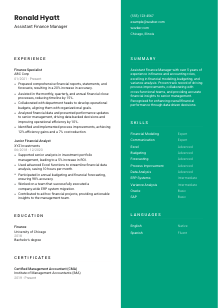
Balancing budgets, but your CV seems in the red? Check out this Assistant Finance Manager CV example, created with Wozber free CV builder. Learn how to blend your fiscal finesse with job requirements, propelling your finance career into the green!
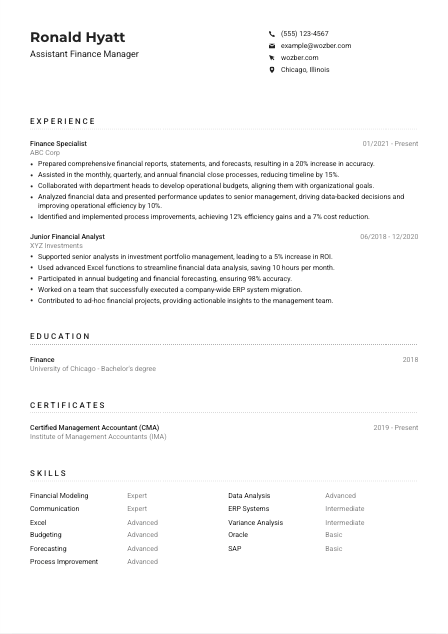
Assistant Finance Managers sit close to the numbers that leadership uses to steer the business. That means a CV for this role needs to show more than general finance exposure. It should make clear that you can support close cycles, produce reliable reporting, work through budget questions with operational teams, and spot cost or process issues before they grow into bigger financial problems.
Screening for this position often starts with whether your background clearly maps to reporting, forecasting, Excel-based analysis, and ERP-driven finance work. Wozber's free CV builder helps you shape that experience into an ATS-compliant CV that reflects the language of the posting, so hiring teams can quickly see where you have handled close support, variance analysis, and management reporting.
Finance hiring moves quickly past the header when the basics are clear and credible. For an Assistant Finance Manager application, this section should confirm who you are, how to reach you, and whether you meet practical requirements without distracting from the financial substance of the CV.
Use your full name in a larger, clean font so the document feels professional from the first line. In finance roles, presentation matters because accuracy and order are part of the job. A header that looks tidy and businesslike sets the right tone before the reader gets to your reporting, budgeting, or close experience.
Place "Assistant Finance Manager" directly under your name if it matches the role you are pursuing. This helps frame your background immediately, especially when your recent title is something adjacent such as Finance Specialist or Financial Analyst. It tells the reader how to interpret the experience that follows.
Your contact details should be simple, current, and easy to scan.
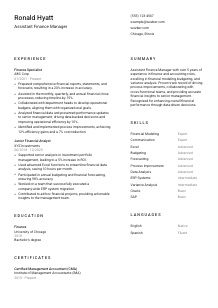
If the posting asks for candidates based in a specific city, list your city and state clearly. Here, Chicago, Illinois is part of the stated requirement, so showing it in the header removes an avoidable question early in the review process. For other Assistant Finance Manager openings, only include location details that are actually relevant to the employer's hiring setup.
A LinkedIn profile or professional website is useful when it supports the same story as your CV. Keep titles, dates, and employer names consistent. If your profile includes finance systems exposure, budgeting projects, or reporting examples that reinforce your CV, it can strengthen the overall application.
Your header should answer the practical basics in seconds and then get out of the way. When the name, title, contact details, and any required location information are clean and aligned, the reader can move straight to your finance experience.




This is the section most likely to decide whether you move forward. Assistant Finance Manager CVs need to show hands-on finance work, not broad business support. Hiring teams look for reporting cadence, close participation, budgeting involvement, analysis quality, and signs that your work improved efficiency, accuracy, or cost control.
Start by pulling out the core responsibilities from the job description, then reflect those same work areas in your bullets where they are genuinely part of your background. For this role, that includes financial reports and forecasts, monthly and annual close support, budget tracking, performance updates, and process improvement. If you have done those tasks under a different title, make that connection obvious instead of assuming the reader will infer it.
List roles from most recent to oldest, and make the newest position do the heaviest lifting. Assistant Finance Manager hiring often focuses on current reporting scope and the level of exposure you have to budgeting, forecasting, and management review. In the example CV, the move from Junior Financial Analyst to Finance Specialist shows a clear progression toward broader reporting and operational finance responsibility.
Each bullet should combine a finance task with a result. Good examples include preparing forecasts that improved planning accuracy, supporting close activities that shortened cycle time, or presenting variance findings that helped leaders adjust spending. The sample bullets work because they connect actions such as financial reporting and management updates with business outcomes like efficiency gains and more accurate reporting.
Numbers are especially persuasive in finance because they reflect how the work is measured. Use percentages, time reductions, accuracy improvements, cost savings, or reporting cycle improvements wherever they are true. A bullet such as reducing close timelines by 15% or improving report accuracy by 20% tells a hiring manager far more than saying you "helped with reporting."
Cut bullets that do not strengthen your case for this job. Prioritise work involving Excel analysis, forecasting, budget ownership, ERP exposure, variance review, cost reduction, and reporting to senior stakeholders. Even when you include broader projects, frame them through their financial value. For example, an ERP migration matters here because it shows system familiarity and process change within a finance environment.
By the end of the experience section, the reader should understand your reporting range, your role in the close process, and the business value of your analysis. That is the core of an Assistant Finance Manager CV.
Education is usually a supporting section for this role, but it still matters because many employers set a clear degree requirement. For Assistant Finance Manager positions, the most relevant academic background is typically finance, accounting, or a closely related discipline that supports reporting, modeling, and budget analysis work.
If the posting asks for a Bachelor's degree in Finance, Accounting, or a related field, make sure that wording is easy to find. Do not bury the field of study. In the example CV, "Bachelor's degree" and "Finance" are both clearly listed, which immediately satisfies a core requirement from the posting.
Use a consistent format that includes degree, field, school, and graduation year or date. Finance CVs benefit from clean structure because the role itself depends on orderly reporting and precise documentation. A simple, standard education entry does that job well.
If your degree directly supports the role, make that the focal point rather than overloading the section with extra detail. A finance degree already signals grounding in accounting principles, financial analysis, and business decision support. If your background is related but not exact, you can use supporting coursework to strengthen the connection.
Relevant coursework can help earlier-career candidates or applicants coming from a broader business program. Include classes such as financial modeling, managerial accounting, corporate finance, forecasting, or ERP-related systems work if they reinforce requirements named in the posting. Skip generic course lists that do not deepen your finance profile.
Honors, scholarships, finance society leadership, or analytical project work are worth listing when they add credible detail to your background. Keep the focus on achievements that support the role's analytical and business-facing demands, rather than unrelated campus activity.
Your education section should make it easy to confirm that you meet the academic baseline and have a relevant finance foundation. Once that is clear, your experience can carry the rest of the case.
Certifications are not always mandatory for Assistant Finance Manager roles, but they can strengthen your positioning, especially when they support management accounting, reporting discipline, or financial analysis. They work best when they reinforce the kind of finance work the employer actually needs.
List certifications that connect naturally to budgeting, reporting, planning, or accounting management. A credential such as the CMA is a strong example because it supports the analytical and operational finance side of the role. Only prioritise certifications that add meaningful relevance to the position you are targeting.
Put the most job-relevant certification first, especially if it supports planning, analysis, internal reporting, or financial control. Recruiters scanning a finance CV should not have to search for the credential that best supports your candidacy.
Show the issue date, active period, or current standing when that information helps clarify status. In finance, current credentials signal ongoing professional development and attention to standards. The example CV's CMA entry includes a date range, which gives the reader useful context right away.
If you are actively maintaining a credential or working toward one that strengthens your finance management track, include it when appropriate. This is particularly useful if your experience already covers reporting and budgeting, and you want to show deeper commitment to the field.
A well-chosen certification adds another layer of trust to your finance profile. It should support the type of reporting, planning, and analytical work expected from an Assistant Finance Manager, not sit on the page as unrelated decoration.
The skills section should read like a compact version of the job requirements. For Assistant Finance Manager roles, that usually means a mix of technical finance capabilities, systems knowledge, and communication skills tied to reporting and collaboration with business leaders.
Start with the role's stated needs, then compare them with your real strengths. In this job description, financial modeling, Excel proficiency, ERP knowledge, budgeting, forecasting, variance analysis, and strong English communication are central. That gives you a clear framework for what belongs near the top of your skills list.
Balance technical and collaborative capabilities. An Assistant Finance Manager may build models, work in Oracle or SAP, and analyse variances, but they also need to explain results to department heads and senior management. The sample CV handles this well by combining Excel, Financial Modeling, ERP Systems, and Data Analysis with Communication.
Lead with the abilities that appear in the posting and that recur across similar finance roles. That usually means Excel, financial modeling, budgeting, forecasting, variance analysis, ERP familiarity, and process improvement. Keep lower-priority or more basic skills farther down so the section reflects the actual work of the role.
Your skills list should make the finance toolkit behind your experience easy to scan. When the right mix of analysis, systems, and communication is visible at a glance, the rest of the CV lands more quickly.
Language requirements are usually straightforward, but they still deserve careful handling. In finance roles that involve management reporting, cross-functional budget discussions, and written updates, language ability affects how confidently an employer can place you in the role.
Read the posting closely for required language ability. Here, strong English competence is named directly, so your CV should address it clearly rather than leaving the employer to infer it from your writing alone.
List English prominently and pair it with an honest proficiency level. For a role that involves reports, forecasts, and presentations to senior management, this matters because written and spoken clarity are part of day-to-day performance, not a side detail.
Additional languages can be useful, especially in companies with international stakeholders, regional operations, or multilingual teams. They are usually secondary to the required finance capabilities, but they can still add value. In the example CV, Spanish strengthens the profile without distracting from the core finance story.
Use straightforward levels such as Native, Fluent, Advanced, or Conversational, and be honest. Finance roles often involve precise communication around numbers, timelines, and operational decisions, so overstating language ability can create problems quickly.
Do not overbuild this section unless the position has a strong international component. For most Assistant Finance Manager applications, the main purpose is to confirm required English proficiency and then note any added language strength concisely.
A clear language section helps confirm that you can handle the reporting and stakeholder communication side of the job. For this role, that starts with strong English and stays brief unless the position calls for more.
The summary should quickly tell the reader what kind of finance professional you are and where your value sits. For an Assistant Finance Manager role, that usually means analytical depth, reporting reliability, budgeting support, and the ability to translate financial performance into useful management insight.
Before writing, identify the few responsibilities that matter most in the posting. Here, those include financial reporting, close support, budgeting, forecasting, variance analysis, and process improvement. Your summary should reflect that mix rather than opening with generic claims about being results-driven or detail-oriented.
Start with a direct professional identity and a credible experience range, such as experience in finance and accounting roles or progression toward finance management. This gives the hiring manager context for everything that follows. The example summary does this well by immediately establishing more than 5 years of relevant experience.
Choose two to four strengths that align tightly with the posting, such as financial modeling, budgeting, forecasting, variance analysis, management reporting, or process improvement. Then connect them to the kind of value they produce. That might be better forecast accuracy, faster close support, clearer performance updates, or stronger cost control.
Aim for a short paragraph that can be read in seconds. Skip broad adjectives and make each phrase earn its place. A finance summary works best when it sounds grounded in reporting work, analysis quality, and operational business support, not in vague ambition.
A good summary should make the reader expect solid finance execution in the sections below. If it clearly links your experience to reporting, planning, and analytical support, it is doing its job.
You now have a clear structure for presenting yourself as an Assistant Finance Manager who can support reporting cycles, contribute to budgets and forecasts, work effectively in ERP-driven environments, and turn financial analysis into decisions that leadership can use.
Use Wozber's free CV builder to shape that experience into an ATS-friendly CV template, align your wording with the posting through practical ATS optimisation, and present a CV that makes your finance range easy to judge. The finished document should make one thing clear fast: you can step into the reporting, planning, and analytical demands of the role with confidence.