



Use Wozber and land your dream job
Create CV
No registration required
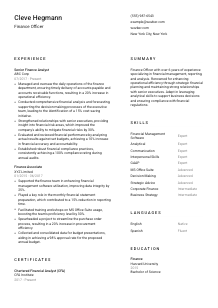
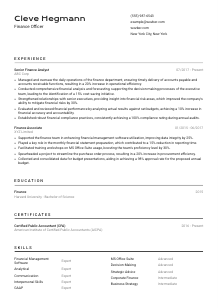
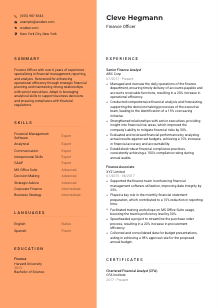
Crunching numbers, but your CV seems bankrupt? Check out this Finance Officer CV example, created with Wozber free CV builder. Learn how to present your fiscal finesse in line with job expectations, paving your career path as profitably as an investment portfolio!
Finance Officer hiring usually turns on whether your CV shows control over the numbers behind the business, not just familiarity with finance tasks. Teams want to see who can keep payables, receivables, and ledger activity running accurately while also producing analysis that helps leaders make budget, forecast, and risk decisions. Your CV should make that operating range visible early.
A tailored Finance Officer CV also changes how quickly your background reads in an ATS and to a finance leader scanning for the right kind of ownership. Using Wozber's free CV builder to align section wording with the posting and keep an ATS-friendly CV format helps surface the experience that matters most here, such as GAAP compliance, forecasting work, and executive-facing analysis.
For a Finance Officer, the header does not need flair. It needs to confirm who you are, what role you are targeting, and whether basic requirements like location and contact access are already covered.
Use your full name as the most prominent text on the page. Finance hiring tends to reward clean presentation, so keep the styling straightforward and professional rather than decorative.
Place "Finance Officer" under your name when that is the role you are applying for. This helps frame the rest of the CV around finance operations, reporting, and oversight instead of leaving the reader to interpret whether your background is more analytical, accounting-heavy, or strategy-focused.
List a reliable phone number and a professional email address, then check both carefully. In finance hiring, small accuracy lapses can create the wrong impression fast, especially in a CV built around trust, controls, and detail management.
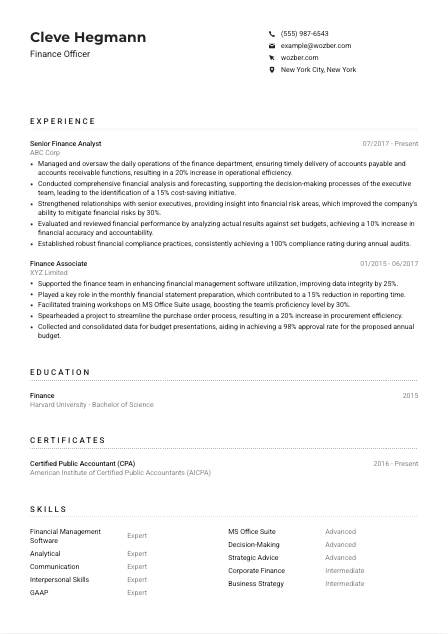
If the employer specifies a city or region, show it in your contact details. Here, listing "New York City, New York" directly addresses a stated requirement and removes avoidable doubt about availability. Treat that as tailoring to this opening, not as a universal rule for every Finance Officer role.
A LinkedIn profile or professional website can support the CV when it reflects the same titles, dates, and finance accomplishments. Keep it consistent with your CV, especially around reporting scope, certifications, and measurable results.
Your personal details should answer the easy questions immediately: who you are, what finance role you want, how to reach you, and whether a basic requirement like location is met. That clears the way for the hiring team to focus on your analysis, controls, and business judgment.




Finance Officer experience is judged less by how many responsibilities you handled and more by whether you improved accuracy, reporting quality, compliance, and decision support. This section should show the scale of your work, the processes you owned, and the business results tied to them.
Mark the responsibilities that define the job before you start editing bullets. For this opening, that includes daily finance operations, financial analysis and forecasting, GAAP compliance, executive partnership, and budget-versus-actual review. Those themes should shape what rises to the top of your experience section.
Start with your most recent role and include job title, employer, and dates. Finance careers often show progression from analyst or associate work into broader ownership, so the structure should make that growth easy to follow.
Each bullet should show what you owned and what changed because of your work. Instead of writing only that you handled accounts payable or forecasting, show the result. The example CV does this well with bullets about improving operational efficiency, identifying cost savings, and strengthening risk mitigation through executive support.
Use numbers that finance teams actually care about: efficiency gains, cost reductions, reporting speed, audit results, forecast accuracy, budget variance improvement, close-cycle timing, or control compliance. Metrics like a 20% efficiency increase, 15% cost-saving initiative, or 100% audit compliance give substance to claims that would otherwise read as routine.
Prioritise bullets that reflect finance operations, reporting, analysis, controls, and advisory work. If a point does not support your case for handling budgets, forecasts, reconciliations, executive communication, or regulatory standards, cut it or rewrite it so the relevance is obvious.
After reading your experience section, a finance leader should be able to tell whether you can run core processes, interpret performance, and speak credibly about financial risk and results. Make that judgment easy with specific ownership, finance language, and measurable outcomes.
Education matters in Finance Officer hiring because it establishes technical grounding in accounting, finance, and business analysis. Keep it concise, but make sure it clearly reflects the academic background the employer asked for.
Start by checking whether the posting calls for a specific degree or field. Here, a bachelor's degree in Finance, Accounting, or a related area is part of the baseline, so that information should be easy to find.
List degree, field of study, school, and graduation year in a clean order. Finance CVs benefit from structure and consistency, and this section should read as clearly as a well-formatted report.
If your degree directly matches the role, name it plainly. A "Bachelor of Science in Finance" instantly supports the requirements in a way a vague or shortened entry does not. The example CV handles this by keeping the finance field explicit.
Early-career candidates can strengthen this section with coursework in financial accounting, corporate finance, auditing, investment analysis, or budgeting. If you are already several years into finance work, those details are usually less valuable than strong experience metrics.
Add distinctions, student finance organizations, or major projects only when they reinforce your candidacy. Good additions might include case competitions, treasury roles, or capstone work tied to financial analysis, controls, or valuation.
Education should confirm that you have the academic base for financial reporting, analysis, and compliance work. Keep it precise and relevant, then let your experience carry the heavier proof.
Certifications carry real weight in finance because they point to technical discipline and recognized standards. When a posting mentions designations such as CPA or CFA, include them prominently if you hold them.
When the posting names preferred certifications, move those to the front of the section. In this case, CPA and CFA are both directly relevant because they reinforce accounting standards, analysis depth, and professional commitment.
Choose certifications that support Finance Officer work, such as accounting, financial analysis, reporting, controls, or compliance. A short, relevant list is stronger than a broad collection of unrelated credentials.
Show the certifying body and the date earned or active period. That context matters in finance, where current standing and recognized issuers help the credential carry weight.
If a certification is active, in progress, or recently renewed, present that clearly. The example CV lists CPA and CFA with ongoing status, which works well because it immediately reinforces professional standing without extra explanation.
Well-chosen certifications tell the reader that your finance knowledge has been tested against recognized standards. For roles involving compliance, reporting judgment, and executive trust, that can be a meaningful advantage.
The skills section should read like a practical snapshot of how you operate in finance, not a generic list of strengths. Focus on tools, technical knowledge, and communication abilities that support reporting accuracy, analysis, and cross-functional decision-making.
Start with the terms the employer already uses. Here that includes financial management software, MS Office Suite, analytical ability, communication, interpersonal skills, and GAAP. Matching that language naturally improves alignment and keeps the section relevant.
Lead with skills that affect finance output every day, such as financial reporting, forecasting, reconciliations, variance analysis, compliance standards, and system proficiency. Put the strongest role-linked capabilities first instead of burying them under broad soft skills.
Organise the section so a reader can quickly scan both your finance toolkit and your ability to work with leadership. The sample CV mixes GAAP, financial management software, and MS Office Suite with communication and strategic advice, which is a useful model when the role includes both operational control and executive interaction.
Your skills list should make it easy to see whether you can handle the technical side of finance work and communicate the numbers to decision-makers. Relevance matters more than volume.
Language ability matters in finance when the role involves written reporting, executive updates, policy communication, or coordination across teams. Keep this section factual and place the employer's stated requirement first.
If the posting calls for strong English speaking and writing, list English prominently with an honest proficiency level. For a Finance Officer, this supports more than conversation. It connects directly to reporting accuracy, budget commentary, and executive communication.
After the required language, include any others you can use professionally. Additional languages may be helpful in multinational environments, regional operations, or vendor and stakeholder communication, even when they are not mandatory.
Use clear labels such as native, fluent, intermediate, or basic. Finance communication often involves nuance in written analysis and verbal explanation, so inflated claims can create problems later.
Even if a posting only names English, other languages can still strengthen your profile when they are genuine and relevant. In the example CV, Spanish adds useful breadth without distracting from the core requirement.
If multilingual ability supports board materials, international reporting, client communication, or cross-border coordination, it is worth keeping. If it has little bearing on your target roles, keep the section brief and factual.
List languages honestly and in order of relevance. For Finance Officer roles, the key point is whether you can communicate clearly in the language used for reporting, analysis, and leadership discussions.
A Finance Officer summary should tell the reader, in a few lines, what level of finance responsibility you have handled and where you create value. Focus on operating scope, analytical strength, and the business outcomes your work supports.
Before writing, identify the two or three priorities that define the opening. For this role, finance operations, forecasting and analysis, compliance, and executive support are more important than a broad biography.
Start with your title or closest equivalent and your years of experience. A line such as the example's "Finance Officer with over 6 years of experience" works because it gives immediate context before moving into specialization.
Use the next sentence to mention the work you are known for, such as improving reporting efficiency, supporting strategic decisions through forecasting, strengthening controls, or advising leadership on financial risk. Keep these points grounded in real accomplishments from your experience section.
Aim for a compact paragraph that can be read in seconds. Finance leaders often scan the summary to decide whether the rest of the CV is likely to show the right mix of reporting discipline, analysis, and stakeholder credibility.
By the end of the summary, the reader should already understand your finance scope, your strongest contribution, and the kind of business support you provide. If those three things are clear, the rest of the CV has a strong opening.
A Finance Officer CV should leave little ambiguity about whether you can manage core finance operations, interpret performance, and communicate findings to leadership. Review each section for concrete proof: process ownership, analysis, compliance knowledge, system proficiency, and measurable results.
Use Wozber's free CV builder to tighten role-specific wording, strengthen ATS optimisation, and present your background in an ATS-friendly CV template that keeps the finance story easy to scan. The finished CV should make one conclusion straightforward: you can be trusted with the numbers and the decisions around them.




