



Use Wozber and land your dream job
Create CV
No registration required
Juggling vehicles but your CV is stuck in gridlock? Navigate this Traffic Manager CV example, created with Wozber free CV builder. Learn how to match your signal coordination skills to job criteria, paving a career path that flows as smoothly as the green light!
Creative agencies feel traffic problems fast. Deadlines slip, handoffs get messy, production gets overloaded, and account teams start chasing updates instead of moving work forward. A Traffic Manager CV needs to show that you can keep project flow steady across creative, account, and production teams while protecting delivery dates, quality standards, and budget control.
Screening for this kind of role often happens through workflow language first. If your CV clearly uses terms tied to intake, resourcing, traffic systems, project coordination, budget tracking, and on-time delivery, hiring teams can quickly place you in an agency operations context instead of mistaking you for a general project coordinator. Wozber's free CV builder helps shape that language into an ATS-compliant CV, so the first read makes your command of agency workflow easier to recognize.
For Traffic Managers, the personal details section should remove any administrative doubt right away. Agency hiring teams want to know who you are, how to reach you, and whether you meet practical requirements such as location before they spend time reviewing project flow and operations experience.
Use your full name in a slightly larger font than the rest of the page so it stands out at the top. Keep it clean and professional. In operations-heavy roles like traffic management, polished presentation matters because it reflects the same clarity you are expected to bring to schedules, status updates, and team coordination.
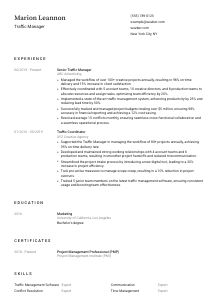
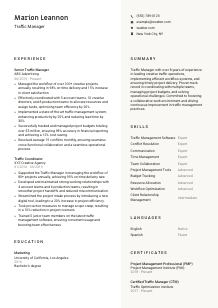
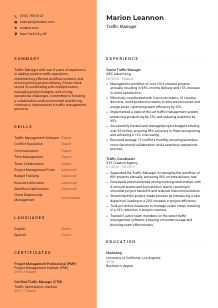
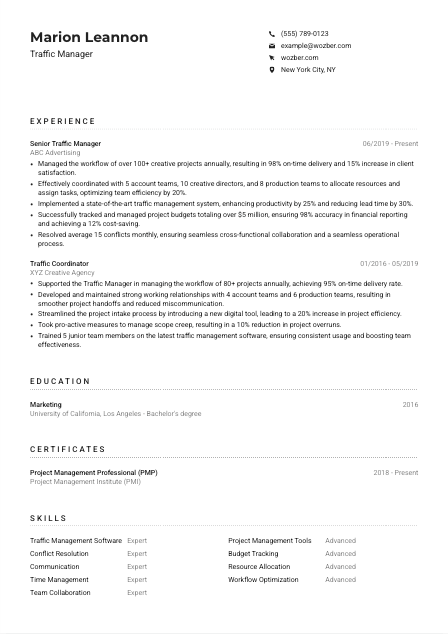
Place "Traffic Manager" directly under your name if that is the role you are pursuing. This helps frame your background immediately, especially if earlier titles include variations like Traffic Coordinator or Project Coordinator. In the example, moving from Traffic Coordinator to Senior Traffic Manager makes the progression clear and keeps the CV centered on agency workflow leadership.
Include a current phone number and a professional email address you check regularly. This sounds basic, but hiring moves quickly in agency environments, and a missed call can delay interviews. If your email still uses a casual handle, replace it with a straightforward format based on your name.
If the employer specifies a city requirement, include your city and state so there is no guesswork. For this opening, listing "New York City, NY" directly answers a stated requirement. If you are relocating, make that clear rather than leaving the employer to assume local availability.
A LinkedIn profile or personal website can support your CV if it is current and consistent with the same titles, dates, and accomplishments. For Traffic Managers, this can reinforce your agency background, software familiarity, and cross-functional scope. Only include it if it strengthens the picture already built on the page.
This top block should settle logistics in seconds. When your name, role, contact details, and location are clear, the reader can move straight to the parts that prove you can run creative workflow under pressure.




Experience carries the most weight for a Traffic Manager because the job is judged through execution. Hiring teams want to see how many projects you handled, how you assigned resources, what systems you improved, and whether your decisions led to better delivery speed, smoother handoffs, or tighter budget control.
Read the job description like an operations brief. Mark the exact responsibilities that define the role, such as managing creative workflow, coordinating with account and production teams, optimising traffic systems, tracking budgets, and resolving operational issues. These should shape the language of your bullets so the employer sees agency-relevant experience instead of general project support.
List positions in reverse chronological order, starting with the role that best reflects your current scope. For traffic management, recency matters because agencies care about your present-day command of timelines, staffing pressure, and delivery processes. If you have both coordinator and manager experience, the progression should show growing ownership over workflow and resource allocation.
Each bullet should describe a real operational contribution, not a generic duty. Focus on project volume, on-time delivery, team coordination, intake management, scheduling, production flow, or process improvements. The example does this well by showing ownership of more than 100 creative projects, coordination across multiple account and production groups, and implementation of a stronger traffic management system.
Use metrics that reflect how traffic work is actually evaluated. Strong examples include on-time delivery rate, lead-time reduction, utilization improvement, budget accuracy, project volume, cost savings, and conflict resolution cadence. Numbers like 98% on-time delivery or a 30% reduction in lead time tell a hiring manager far more than broad claims about being organised.
Keep the section centered on agency operations and creative workflow. If an older role does not connect to scheduling, project coordination, resource management, stakeholder communication, or process improvement, shorten it or remove it. Every line should help the reader picture you managing the pace and priorities of a busy creative team.
A Traffic Manager's experience section should read like a record of controlled delivery. When your bullets show project volume, cross-functional coordination, system improvements, and measurable operational results, the hiring team can quickly see how you would run their workflow.
Education is usually a qualification check for Traffic Manager roles rather than the centre of the decision. Still, it should be clear and complete, especially when the posting asks for a bachelor's degree in marketing, business, or a related field.
If the posting calls for a bachelor's degree, list that credential plainly and early in the education section. For this role, a degree in Marketing, Business, or a related area supports the mix of agency operations, client-facing coordination, and commercial awareness the work often requires.
Include degree, field of study, school name, and graduation year or date range. Keep the layout simple so the information is easy to scan. Traffic management is all about clarity and order, and your formatting should reflect that instinct.
When your degree lines up well with the job, make that visible. In the example, a Bachelor's degree in Marketing fits naturally with an advertising agency environment and needs no extra explanation. If your field is adjacent rather than exact, the title of the degree may still qualify if your experience strongly supports the role.
Most experienced Traffic Managers do not need to list courses, but it can help earlier-career candidates or applicants from less direct academic backgrounds. If you include coursework, keep it tied to project management, marketing operations, production, business processes, or communication rather than filling space with general classes.
Honors, leadership roles, or substantial academic projects are worth mentioning only if they reinforce relevant strengths such as coordination, planning, team leadership, or campaign work. Once you have several years of agency experience, these details should stay brief.
This section should confirm that you meet the degree requirement without competing with your experience. A concise, accurate entry is enough to support the operational story told elsewhere on the CV.
Certifications matter most here when they reinforce structured execution. In agency environments, credentials such as PMP or Certified Traffic Manager can signal formal grounding in process discipline, delivery planning, and workflow oversight.
When a job description mentions preferred credentials, move those to the top of your list if you hold them. For this role, PMP and CTM are the clearest examples because they connect directly to project governance and traffic operations.
Do not overcrowd this section with every course completion or webinar. Feature certifications that support scheduling, process management, agency workflow, or resource coordination. In the example, PMP and CTM work well because they reinforce both project structure and traffic specialization.
Add the year earned and, if relevant, note active status. Dates help show that your training is current enough to support present-day systems and practices. This is especially useful when agencies are updating workflows, tools, or reporting expectations.
Traffic management increasingly overlaps with project operations, software adoption, and process improvement, so current credentials can strengthen your positioning. Renew or add certifications when they reflect the kind of delivery environment you want to work in, especially if you are moving into larger or more complex agency settings.
Well-chosen certifications support the impression that you can run work with structure and consistency. For a Traffic Manager, they are most useful when they back up real agency experience with formal process discipline.
The skills section should reflect how traffic managers actually work. Hiring teams look for a mix of workflow tools, coordination ability, scheduling judgment, communication across departments, and enough financial discipline to track budgets and project costs accurately.
Start with the skills the employer calls out explicitly, then add closely related abilities you genuinely use. Here, that includes traffic management software, project management tools, communication, cross-functional collaboration, budget tracking, and conflict resolution. These are the terms that help both ATS screening and human review connect your background to agency operations.
Organise your skills so they are easier to scan. For example, you might separate platform knowledge from workflow strengths and stakeholder-facing skills. A Traffic Manager CV often reads better when software, resource allocation, reporting, and communication are not mixed into one long undifferentiated list.
Choose skills that support the daily mechanics of the role. Useful examples include workflow optimisation, resource allocation, budget tracking, production coordination, time management, and communication with account and creative teams. The sample skill list works because it stays close to the real demands of agency traffic operations instead of drifting into generic office skills.
A focused skills section tells the employer what kinds of projects, systems, and team dynamics you can handle right away. For Traffic Manager roles, that means operational control, software fluency, and communication strong enough to keep creative work moving.
Language skills are usually secondary for Traffic Manager roles unless the agency serves multilingual clients or distributed teams. Even so, this section can help if it clarifies your command of English or adds useful range for client, vendor, or cross-office communication.
If the posting specifies a language requirement, list it first and state your level clearly. This job asks for English mastery, so English should appear at the top with an accurate rating such as Native or Fluent, depending on your background.
After the required language, list others that may support the work. In agency settings, additional languages can help with client communication, vendor coordination, or internal collaboration across markets, but they should not distract from the main qualification the role asks for.
A second language is worth listing if you can use it professionally or if it broadens the kind of teams and accounts you can support. For example, Spanish may be useful in some client-facing or multicultural agency environments, but it is an advantage, not a substitute for strong traffic management experience.
Stick to standard descriptions such as Native, Fluent, Advanced, or Intermediate. Avoid vague wording. Clear proficiency levels help the employer understand whether you can handle meetings, status updates, and written communication in that language.
Only present language ability as a strength when it has a practical use in the work. For Traffic Managers, that usually means smoother communication across teams, clearer client support, or broader agency coverage, not a general claim about being globally minded.
This section works best when it confirms required English proficiency and adds any genuinely useful additional language capability. Present it plainly, and let it support the broader picture of strong coordination and communication.
The summary should quickly position you as someone who can control workflow in a fast-moving creative environment. In a few lines, show your years of experience, the kind of teams or projects you support, and the operational outcomes you consistently deliver.
Start with your title and years of experience, then define your area of strength. For a Traffic Manager, that usually means creative workflow, resource coordination, project delivery, and process improvement in an agency or production setting. This opening should immediately distinguish you from broader project managers or account-side candidates.
Use one or two concrete results that reflect how your work improves delivery. Metrics such as project volume, on-time completion, lead-time reduction, or budget oversight can sharpen the summary quickly. The example summary works because it references workflow systems, timely delivery, budget management, and operational problem-solving without sounding overloaded.
Aim for a short paragraph with substance. Avoid vague statements about passion or leadership unless you tie them to actual work such as coordinating cross-functional teams, improving intake processes, or maintaining quality across multiple concurrent projects.
Adjust the final phrasing to reflect the language of the role you are applying for. If the posting emphasizes agency workflow systems, on-time delivery, and collaboration with creative and production teams, those ideas should appear naturally in your summary. This is one of the fastest ways to make the CV feel targeted from the first few lines.
A well-written summary tells the reader what scale of workflow you handle and what kind of control you bring to it. By the time they reach your experience section, they should already expect strong delivery discipline, smart coordination, and agency-ready execution.
A Traffic Manager CV should leave little ambiguity about how you work. Project volume, on-time delivery, traffic systems, resourcing decisions, budget tracking, and conflict resolution all need to appear in language that reflects real agency operations. When those details are clear, the hiring team can quickly picture you running deadlines, handoffs, and priorities across creative teams.
Wozber's free CV builder helps turn that experience into an ATS-friendly CV format, and its ATS CV scanner can help you align your wording with the job description's workflow, software, and coordination requirements. The final result should make one thing easy to judge: you can keep creative work moving without losing control of quality, timing, or budget.




