



Use Wozber and land your dream job
Create CV
No registration required
Navigating terminals, but your CV seems grounded? Take off with this Airport Manager CV example, created with Wozber free CV builder. Learn how to match your aviation expertise with managerial acumen, ensuring your career trajectory reaches new heights!
Airport management CVs are reviewed through the lens of daily operational control. Hiring teams want to see whether you have handled the moving parts that keep an airport running safely and efficiently, from facilities and security coordination to customer service standards, budget ownership, and regulatory relationships. Your CV should make that operational scope visible fast, with clear examples of how you improved service levels, maintained compliance, or kept complex airport activity on track.
A tailored CV also helps separate broad operations experience from true airport leadership. When the language reflects airport operations, regulatory coordination, financial planning, and stakeholder management in the same terms used by the employer, it is easier for both ATS screening and human reviewers to see the match. Wozber's free CV builder helps you build an ATS-compliant CV around those priorities, so your background reads as airport-ready rather than generically managerial.
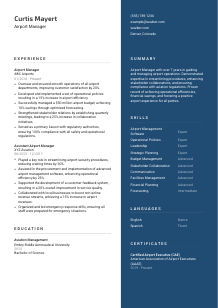
This section does simple but important work. For an Airport Manager, it should immediately confirm who you are, how to reach you, and any practical detail that affects hiring logistics, especially when the employer has stated a location requirement.
Place your name at the top in a clean, readable format. Airport leadership roles involve communication with airlines, regulators, vendors, and public stakeholders, so even the header should feel clear and professional rather than styled for effect.
Add "Airport Manager" directly under your name if that is the role you are pursuing. Matching the title used in the posting helps frame your experience correctly and supports ATS alignment, especially when your recent background includes adjacent roles such as Assistant Airport Manager or Operations Manager.
Include your phone number, professional email address, and, if relevant, a LinkedIn profile or website that reflects your airport operations background. Hiring teams may move quickly when filling leadership roles tied to active airport operations, so make every contact channel current and dependable.
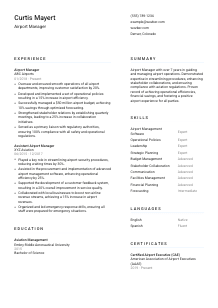
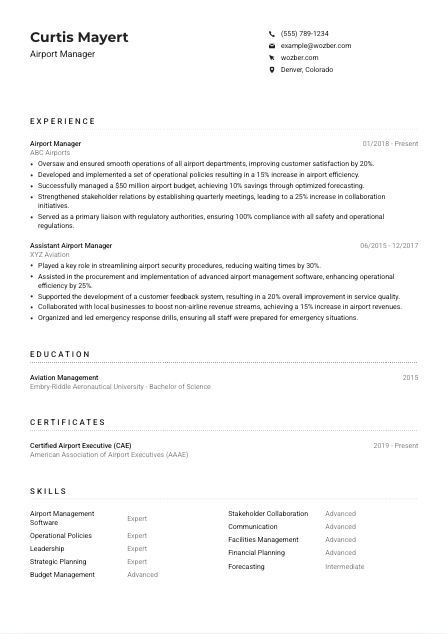
If a posting calls for a candidate in a specific area, include your city and state. Here, listing Denver, Colorado directly answers a stated requirement and removes a common point of hesitation early in the review.
Include a digital profile only if it strengthens your case with relevant content, such as aviation leadership experience, operational accomplishments, or industry affiliations. A polished LinkedIn page with consistent titles, dates, and certifications can reinforce the credibility of the CV you submit.
When this section is accurate and concise, the employer can move straight to your operational background without getting stuck on avoidable questions about contact details, title alignment, or location.




For Airport Manager hiring, experience carries the most weight because it shows how you have handled operational complexity in a live environment. The strongest entries show responsibility across airport functions, measurable improvements, and steady coordination with internal teams, external partners, and regulators.
Before rewriting your bullets, isolate the employer's main needs. In this case, the role centers on airport operations oversight, policy development, compliance, budgeting, forecasting, customer experience, and stakeholder coordination. Those themes should shape which achievements you lead with and which phrases you mirror naturally in your experience section.
List positions in reverse chronological order and give the most space to work that involved airport operations, management, or aviation leadership. If your earlier career includes less relevant industries, keep those entries shorter so the CV stays centered on airport environments, operational decision-making, and management scope.
Each role should show what you were responsible for and what changed because of your work. Good Airport Manager bullets often cover service performance, policy implementation, emergency readiness, compliance, vendor or airline coordination, and budget control. The example CV does this well by pairing responsibilities with outcomes such as improved customer satisfaction, higher efficiency, and stronger stakeholder collaboration.
Use numbers where they reflect how your work was measured. Customer satisfaction gains, reduced wait times, budget size, cost savings, compliance rates, revenue growth, drill frequency, or efficiency improvements all give hiring teams a clearer picture of your impact. Managing a $50 million budget or achieving 100% compliance tells far more than saying you "supported financial planning" or "handled regulations."
Keep the section focused on evidence that you can oversee airport operations and lead across functions. General management bullets that do not connect to facilities, safety, service delivery, financial oversight, or regulatory coordination can dilute the case you are making. Every line should help the reader picture you running an airport, not just managing a team.
A focused experience section should leave little doubt about your ability to manage airport operations, work across stakeholders, and deliver measurable improvements in service, compliance, and financial performance.
Education matters here because many Airport Manager roles set a bachelor's degree as a baseline requirement. Keep this section straightforward and make the connection to aviation, business, or operations clear when your degree supports the work directly.
If you hold a bachelor's degree in Aviation Management, Business Administration, or a related field, name it clearly. When your degree aligns directly with the posting, as a Bachelor of Science in Aviation Management does here, it quickly confirms that you meet a formal screening requirement.
List your degree, school, field of study, and graduation year. Airport leadership CVs usually benefit from clarity over detail in this section, especially when your professional experience already carries the strongest evidence of readiness.
Do not bury the specialization. If your coursework or degree focus relates to airport operations, aviation systems, transportation management, or business administration, put that field front and centre so both recruiters and ATS tools pick it up quickly.
Relevant coursework, honors, or aviation-focused projects can help if you are earlier in your career or if they connect directly to airport operations, safety, logistics, or business planning. For a more experienced Airport Manager, these details are optional and should only stay if they add something your experience section does not already show.
If you have completed recent workshops, executive programs, or aviation-related training, mention them when they support the role. Topics such as airport security, emergency management, aviation regulations, or financial planning can reinforce that your knowledge is current.
This section should confirm the academic baseline quickly and support the broader picture of you as a manager who understands both airport operations and the business side of the job.
Certifications are especially useful in airport management because they show commitment to industry standards and professional development beyond the degree requirement. When a posting names a preferred credential, that certification deserves visible placement.
Lead with certifications that carry weight in airport operations and management. In this example, the Certified Airport Executive credential from AAAE aligns directly with a stated preference, so it should be easy for the employer to find.
Include certifications that support your work in airport leadership, compliance, safety, emergency response, or operations management. A short list of role-specific credentials is more convincing than a long list of general training items.
Add the issuing organisation and the date earned, and note if the credential remains active. This is particularly important for certifications tied to current standards, continuing education, or recognized aviation associations.
Airport operations change with regulation, security expectations, passenger demand, and infrastructure needs. If you are pursuing or maintaining relevant credentials, that signals professional discipline and current engagement with the field.
Well-chosen certifications reinforce that your background is grounded in airport practice, current standards, and leadership development that matters in daily operations.
An Airport Manager skills section should read like the toolkit of someone who can keep operations steady, compliant, and financially sound. That means combining technical familiarity, operational judgment, and leadership capabilities instead of listing broad management terms alone.
Scan the posting for required tools and capabilities, then match them with skills you genuinely use. Here, airport management software, Microsoft Office, leadership, communication, budgeting, forecasting, facilities oversight, and policy development all belong near the top because they reflect how the role is performed day to day.
Airport leadership is not only about people management. Include software and operational competencies alongside leadership skills, especially if you have worked with airport management platforms, reporting tools, scheduling systems, budgeting workflows, or compliance documentation. The sample CV handles this well by pairing airport management software with strategic planning, budget management, and stakeholder collaboration.
Choose the skills that best support the responsibilities in the target role rather than trying to catalogue everything you can do. A focused list helps the employer quickly connect your capabilities to airport operations, financial oversight, stakeholder communication, and regulatory coordination.
When this section is tailored well, it gives a fast read on whether you have the systems fluency, management range, and communication strength to lead an airport environment effectively.
Airport managers work in an environment where clear communication matters every day, whether with staff, passengers, vendors, regulators, or community stakeholders. Language skills can strengthen your profile when they support that operational reality.
If the employer specifically asks for English proficiency, list English clearly and note your level accurately. Since this posting requires excellent English skills, that language should appear first and be impossible to miss.
Additional languages can be useful when they help with passenger service, staff communication, or stakeholder relationships. Spanish, for example, may be valuable in many airport settings, but include extra languages based on real proficiency and relevance rather than assumption.
Terms such as "Native," "Fluent," "Advanced," or "Intermediate" work well when they reflect your actual ability. Airport operations often involve high-stakes communication, so accuracy matters more than optimistic wording.
Do not force this section if you only speak one language well. If you do have additional language ability, present it as practical support for service quality, coordination, or public communication rather than as a generic personal asset.
A concise language section is enough. What matters is that the listed languages support the role and are believable in the context of your work, especially in a setting where communication can affect safety, customer experience, and stakeholder trust.
For an Airport Manager, language details should reinforce one thing above all: you can communicate reliably in the environment the airport operates in.
Your summary should give a hiring team a fast, accurate read on the level of airport responsibility you have handled. In a few lines, it should connect your years of experience with the outcomes and leadership areas that matter most for the target role.
Open with your identity as an Airport Manager or airport operations leader and your years of relevant experience. Keep it grounded in the actual work, such as overseeing operations, improving efficiency, managing budgets, or coordinating with regulators and stakeholders.
Choose two or three themes from the posting that match your background most strongly. For this job, that could mean operational policy development, financial planning, regulatory compliance, and stakeholder collaboration. The sample summary works because it stays close to those priorities instead of drifting into generic leadership language.
Use the summary to mention a few concrete achievements or results, especially if they reflect the scale of your work. Efficiency gains, savings delivered, improved customer satisfaction, or a record of compliance make the opening far more credible than adjectives alone.
Aim for a short paragraph that can be read in seconds. Airport leadership CVs benefit from direct wording and role-specific detail, not broad claims about passion or ambition. A concise summary with operational substance sets up the rest of the CV well.
Once your summary is aligned, the employer should immediately understand your airport background, the level of responsibility you have handled, and the kind of operational results you are likely to bring.
A well-tailored Airport Manager CV should show more than management experience. It should present a clear record of operational oversight, compliance discipline, financial control, and coordination with the airlines, authorities, and local stakeholders that shape airport performance.
Use Wozber's free CV builder to organise that experience in an ATS-friendly CV format, strengthen wording with role-specific terminology, and check alignment with an ATS CV scanner. The result should make it easy to judge one thing quickly: you are ready to lead airport operations with confidence and control.