




Use Wozber and land your dream job
Create CV
No registration required
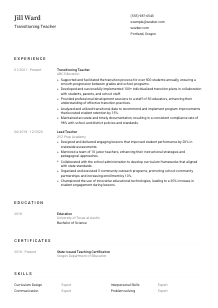
Shuffling classrooms, but your CV feels stuck at the chalkboard? Check out this Transitioning Teacher CV example, created with Wozber free CV builder. Learn how to pivot your pedagogical prowess to match job specifics, positioning your teaching journey for a successful career evolution!
Transitioning Teacher roles sit at the point where student support, instructional planning, and school coordination meet. Hiring teams want to see how you help students move successfully between grades, schools, or programs, and whether you can turn that work into clear plans, family communication, staff guidance, and documented follow-through.
When that work is tailored clearly on the page, your CV is easier to sort in both human review and ATS screening. Wozber's free CV builder helps you align your wording with the posting, keep an ATS-compliant CV structure, and surface the parts of your background that show you can manage transition planning, collaboration, and program improvement from day one.
School hiring starts with practical details. For a Transitioning Teacher, this section should confirm that you are reachable, professionally presented, and, when the posting asks for it, already based in the required area.
Use your full name exactly as you use it professionally. Keep it easy to read and more prominent than the rest of the contact block so the hiring team can immediately connect your application, interview notes, and certification records.
Place "Transitioning Teacher" directly under your name if that is the role you are pursuing. This creates an immediate connection between your CV and the opening, especially when a district is reviewing applicants across classroom teaching, student support, and specialist roles.
Include a reliable phone number and a professional email address. Check both carefully. In school hiring, where interview coordination may involve administrators, HR staff, and support teams, a typo in your contact information can stall the process for no good reason.
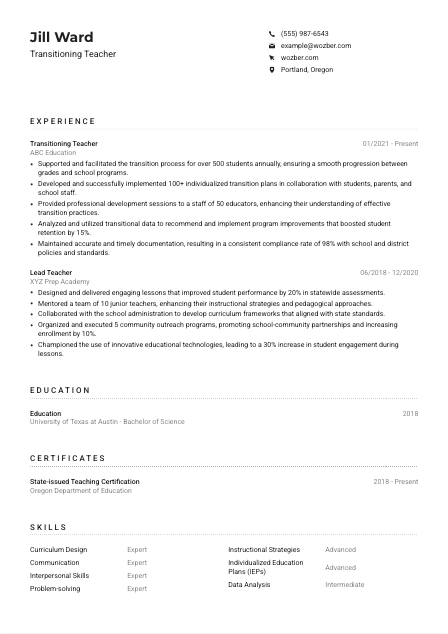
If the employer asks for local residency, show it clearly. In the example, listing Portland, Oregon directly in the header answers that requirement without forcing the reader to search for it. Use this only when location is relevant to the job, not as filler in every application.
A LinkedIn profile or personal site can add value when it supports your school-based work with concrete material such as certifications, professional development, presentations, or education-focused accomplishments. Keep it current and consistent with the dates, roles, and credentials shown on your CV.
This section should answer the first practical questions fast: who you are, how to reach you, and whether you meet any location requirement. Once that is handled, the rest of the CV can focus on your work with students, families, and school teams.




This is the section where schools look for proof that you can coordinate movement points in a student's education without losing instructional continuity, family trust, or compliance. Focus on outcomes, collaboration, and the systems you used to keep transitions organised.
Before editing your bullets, mark the responsibilities that define the role. For this kind of position, that usually means transition planning, collaboration with parents and staff, professional development, data analysis, and documentation. Those themes should shape what stays on the page and what gets trimmed.
Use reverse-chronological order and include your title, school or organisation, and dates. This lets the reader quickly track whether you have the required K-12 experience and how your work progressed from classroom instruction into transition-focused responsibilities or leadership.
Write bullets that show what you handled and what changed because of your work. The example does this well by stating that more than 100 individualized transition plans were developed in collaboration with students, parents, and staff. That tells a hiring team far more than a generic line about supporting student transitions.
Quantify scope, participation, compliance, retention, training reach, or student outcomes when you can support the numbers. Metrics such as 500 students supported annually, 15% retention improvement, or 98% documentation compliance help schools understand your scale of work and the consistency of your execution.
General teaching experience still matters because it shows instructional judgment, classroom credibility, and work with diverse learners. But for a Transitioning Teacher CV, lead with accomplishments tied to movement between programs, individualized planning, staff coaching, and data-informed improvements. If you include broader classroom achievements, connect them back to student support and progression.
The best experience sections make it easy to picture you handling transition plans, family conversations, staff coordination, and reporting requirements in a real school setting. That practical picture matters more than broad claims about being passionate or student-centered.
For this role, your degree is a core requirement, not a side note. Present it clearly so the reader can confirm your academic background before moving on to the school-based experience and certifications that deepen your profile.
If the posting asks for a bachelor's degree in Education or a related field, make sure that information is easy to find. A Bachelor of Science in Education, like the one shown in the example, should appear exactly and prominently in this section.
List degree, field of study, school name, and graduation year or date. Clean formatting works especially well in ATS-friendly CV formats and helps district reviewers confirm qualifications without digging through extra text.
When your degree directly matches the posting, say so clearly rather than relying on implied relevance. If your degree is in a related field, use the exact field name and make sure the rest of your CV shows the teaching and transition work that supports it.
Most experienced educators do not need to expand this section much. Still, if you completed relevant coursework in curriculum design, special education support, adolescent development, or transition planning, it can help when you are earlier in your career or moving into a more specialised student-support role.
Teaching and transition-related certifications strengthen this section, especially when the job prefers state-issued licensure or a transition credential. Keep the degree itself distinct, then use the certification section to show current professional standing and specialization.
Your education section should quickly answer one question: do you meet the formal academic requirement for the role. Once that is clear, the CV can shift attention to your classroom experience, transition planning, and school-based results.
Certifications carry real weight in education because they show licensure status, specialization, and ongoing professional development. For Transitioning Teacher roles, they can also help distinguish candidates who have moved beyond general teaching into transition-focused practice.
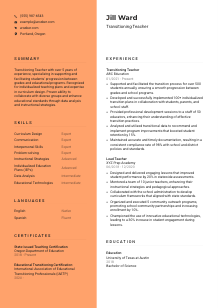
If a school prefers a state-issued teaching license or an educational transitioning credential, those should appear first when you have them. In the example, both the Oregon teaching certification and the Educational Transitioning Certification speak directly to the employer's stated preference.
Prioritise certificates connected to student transitions, instructional practice, special populations, curriculum design, or school compliance. A short, relevant list carries more weight than a longer one filled with unrelated workshops.
Add issue dates, renewal windows, or "Present" where appropriate. Schools often need to know whether a credential is current, especially when licensure status affects hiring eligibility or assignment responsibilities.
Transition work changes with district policies, student support models, and inclusive education practices. Recent certifications or active renewals show that your methods are current and that you stay engaged with the standards shaping this work.
A well-chosen certification section tells a school that your qualifications are active, relevant, and matched to the kind of student transition work the role requires. It is a concise but important credibility check.
A Transitioning Teacher needs more than broad teaching strengths. Your skills section should show that you can plan instruction for diverse learners, coordinate with multiple stakeholders, read student data, and keep transition processes moving without losing detail.
Start with the capabilities the employer actually names. Here, that includes curriculum design, instructional strategies for diverse learners, communication, interpersonal skills, and problem-solving. Those exact terms belong in your skills section when they reflect your real background.
Include both classroom-facing and transition-facing abilities. Curriculum design and instructional strategies show teaching depth. Skills such as individualized planning, data analysis, family communication, and IEP familiarity show that you can support students through change, not just deliver lessons.
Do not crowd this section with every platform or soft skill you have ever used. Choose the skills most relevant to student movement, school coordination, and learner support. The example strikes a workable balance with curriculum design, problem-solving, instructional strategies, IEPs, and data analysis.
This section should read like the toolkit of someone who can guide student transitions, collaborate across a school community, and respond to data and learner needs with sound instructional judgment.
Language ability matters in school environments because clear communication affects student support, parent engagement, and collaboration with staff. For a Transitioning Teacher, list languages in a way that reflects both the job requirement and the communities you may serve.
When the posting states that English is mandatory, list it first and state your proficiency level clearly. This removes any ambiguity for roles that depend on documentation, staff coordination, and direct communication with families.
Additional languages can be valuable when you work with multilingual families or diverse student populations. Spanish, for example, may strengthen your ability to support meetings, explain transition plans, or build trust with caregivers in some school communities.
Choose straightforward labels such as Native, Fluent, Advanced, or Conversational. That helps schools understand whether you can handle family communication, classroom interaction, or only basic exchanges.
Do not overstate fluency. In education settings, language claims may quickly be tested in parent meetings, written communication, or student support conversations, so precision matters.
For most Transitioning Teacher CVs, languages are supportive rather than central unless the school specifically serves multilingual communities or calls for bilingual staff. Keep them visible, but let your student support work and instructional experience lead.
Listed well, languages add context to how you connect with students and families. They are most persuasive when the rest of the CV already shows strong collaboration, documentation, and school-based support work.
Your summary should give a school a quick, grounded picture of the educator behind the CV. For this role, that means leading with transition-related experience, school collaboration, and the kind of outcomes that matter in student progression and program continuity.
Open with your identity as an educator and the part of your background most relevant to student transitions. A useful summary makes clear that you work across grades, programs, or support structures rather than sounding like a generic classroom profile.
Include your years of experience and, where relevant, the K-12 setting or type of transition work you have handled. The example summary works because it quickly establishes more than 5 years of experience and a specialization in helping students move between grades and educational programs.
Choose capabilities that match the posting, such as individualized transition planning, curriculum design, collaboration with families and staff, or data-informed program improvement. If you mention achievements, keep them tied to outcomes you can support elsewhere in the CV.
Aim for a short paragraph that reads cleanly in both ATS and human review. Skip broad adjectives and focus on what kind of educator you are, what transition work you have done, and what school-facing strengths you bring into the role.
A focused summary helps the reader understand from the first lines that your background goes beyond classroom instruction into coordinated transition support, stakeholder communication, and student-centered planning. That is the thread the rest of the CV should continue.
A Transitioning Teacher CV works best when every section points to the same story: you can guide students through educational change, collaborate with families and staff, use data to improve transition outcomes, and keep documentation aligned with school expectations.
Use Wozber's free CV builder to shape that story into an ATS-friendly CV format, refine your wording with role-specific terminology, and check alignment with an ATS CV scanner before you apply. The final result should make it easy for a school to see that you are ready to support student transitions with structure, care, and professional consistency.




